

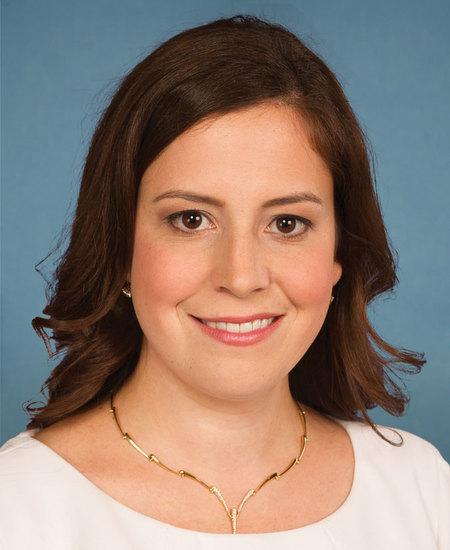
Photo of Elise M. Stefanik
R United States House · District 21 · New York

Rep. Elise M. Stefanik

Compare
Total votes
2,837
all sessions
Attendance
95%
130 missed
Lower than 97% of chamber peers
With party
96%
of cast votes
Near the chamber average
Bipartisan score
2%
crosses aisle rarely
Near the chamber average
Sponsored
1,218
bills & resolutions
Near the chamber average
Committees
9
assignments
1,218 bills and resolutions

Sponsored bills

Total
1,218
Primary
134
Co-sponsor
1,084
This page
1,218
matching current filters
Co-sponsor HRES 206
In committee · United States House · Co-sponsor
Recognizing the importance of stepped-up basis under section 1014 of the Internal Revenue Code of 1986 in preserving family-owned farms and small businesses.

Maddy summaryThis is a non-binding resolution (HRES 206), not a legislative bill. It expresses the House's support for preserving the "stepped-up basis" tax provision (Section 1014 of the Internal Revenue Code), which allows heirs to reset the tax cost basis of inherited assets like farmland or business equipment to their current market value. The resolution cites that 98% of farms and 19% of businesses are family-owned, noting that eliminating this provision could increase taxes for 66% of midsized farms. It specifically urges opposition to new taxes on family farms and small businesses but does not change any tax law or policy.

In committee Mar 10, 2025 1 co-sponsor
Co-sponsor HR 1916
In committee · United States House · Co-sponsor
Pay Our Border Patrol and Customs Agents Act of 2025

Maddy summaryThis bill ensures that U.S. Border Patrol agents and Customs and Border Protection (CBP) officers who remain on duty during a government shutdown receive their salaries. It appropriates funds from the Treasury for fiscal year 2025 to cover their pay during any shutdown period beginning after the bill's enactment. The provision specifically applies to CBP personnel who are not furloughed under standard shutdown protocols. It directly affects federal workers in CBP’s Border Patrol and Office of Field Operations during government funding gaps.

In committee Mar 6, 2025 1 co-sponsor
Co-sponsor HR 1905
In committee · United States House · Co-sponsor
Protecting American Students Act

Maddy summaryHR 1905, the Protecting American Students Act, modifies how private colleges and universities calculate whether they owe an excise tax on investment income. It specifies that only students meeting specific eligibility requirements under the Higher Education Act (20 U.S.C. 1091(a)(5)) can be counted toward the tax threshold, excluding others from the calculation. The bill also requires these institutions to report both the pre- and post-adjustment student counts on their tax returns. This affects private colleges subject to the investment income tax, changing their tax calculation method and adding reporting obligations starting in 2026. The bill does not directly protect students or alter student aid but adjusts tax compliance for educational institutions.

In committee Mar 6, 2025 1 co-sponsor
Co-sponsor HR 1878
In committee · United States House · Co-sponsor
IVF Access and Affordability Act

Maddy summaryHR 1878 creates a new federal tax credit for out-of-pocket expenses related to fertility treatments like IVF. It allows eligible taxpayers to claim a credit equal to up to $20,000 per year (or $40,000 for joint filers) for qualifying expenses, subject to income limits ($200,000 AGI for individuals, $400,000 for couples). The credit phases out for taxpayers earning above these thresholds and cannot be claimed for expenses covered by insurance or other deductions. This directly affects individuals and couples seeking fertility treatments who pay for them out-of-pocket.

In committee Mar 5, 2025 1 co-sponsor
Co-sponsor HR 1813
In committee · United States House · Co-sponsor
To amend the Child Nutrition Act of 1966 to set maximum monthly allowances for milk under the special supplemental nutrition program for women, infants, and children.

Maddy summaryThis bill sets specific maximum monthly milk allowances for participants in the WIC program (Women, Infants, and Children). It directly affects WIC recipients, including pregnant women, new mothers, infants, and children up to age 5, by establishing clear upper limits for milk distribution under different food packages. The key provision specifies that Food Package IV may not exceed 16 quarts of milk monthly, while Packages V, VI, and VII may not exceed 22, 22, and 24 quarts respectively. These limits apply to milk provided under the WIC food packages outlined in federal regulations. The change is a direct policy adjustment to the existing WIC nutrition program structure.

In committee Mar 3, 2025 1 co-sponsor
Co-sponsor HR 620
In committee · United States House · Co-sponsor
FARM Act

Maddy summaryHR 620, the FARM Act, expands the Committee on Foreign Investment in the United States (CFIUS) to review foreign investments in U.S. agriculture. It requires CFIUS to assess transactions where foreign entities gain control of U.S. agricultural businesses (including those using agricultural products defined under 7 U.S.C. 451) and adds agricultural supply chains to the list of critical infrastructure and critical technologies. The bill mandates annual reports from the Secretary of Agriculture and the Comptroller General to Congress, detailing foreign investments in U.S. agriculture, potential threats to supply chains, and espionage risks targeting agricultural research or data. This directly affects foreign investors seeking to acquire U.S. agricultural assets and reshapes CFIUS review processes for the sector.

In committee Feb 28, 2025 1 co-sponsor
Co-sponsor HRES 176
In committee · United States House · Co-sponsor
Encouraging the EU to DESIGNATE Resolution

Maddy summaryThis resolution urges the European Union to formally designate Iran's Islamic Revolutionary Guard Corps (IRGC) as a terrorist organization under the EU's Common Position 931 framework, which allows for such designations. It cites the U.S. (2019) and Canada (2024) as precedents for designating the IRGC, noting the EU has only sanctioned individual IRGC members, not the entity itself. The resolution emphasizes the IRGC's documented ties to terrorism, human rights abuses in Iran, support for proxy groups like Hamas and Hezbollah, and its role in supplying drones to Russia for its war in Ukraine. The House requests the EU expedite this designation and encourages U.S. diplomatic efforts to prioritize it.

In committee Feb 27, 2025 1 co-sponsor
Co-sponsor HR 1710
In committee · United States House · Co-sponsor
PLO and PA Terror Payments Accountability Act of 2025

Maddy summaryThis bill requires the U.S. President to impose sanctions on foreign individuals and entities that support the Palestinian Authority (PA) and Palestine Liberation Organization (PLO) system of paying terrorists and their families. It targets those who work for PA/PLO entities facilitating these payments (like the Commission of Prisoners or Institute for Care of Martyrs' Families), provide such payments, or materially assist the system. Sanctions include blocking U.S. property, denying visas, and revoking existing visas for targeted individuals. The bill terminates if the Secretary of State certifies the PA/PLO has ended these payments. (Based on HR 1710, PLO and PA Terror Payments Accountability Act of 2025)

In committee Feb 27, 2025 1 co-sponsor
Co-sponsor HR 1761
In committee · United States House · Co-sponsor
Donald J. Trump $250 Bill Act

Maddy summaryThis bill, HR 1761, would require the U.S. Treasury to print $250 Federal Reserve notes featuring a portrait of Donald J. Trump within one year of enactment, primarily to commemorate the 250th anniversary of the United States. It amends the Federal Reserve Act (Section 3) to mandate this specific currency denomination and attempts to modify existing law (Section 4) to allow living presidents on currency. The bill directly affects the U.S. Treasury's currency printing authority and would override current practices, as $250 bills do not exist in circulation and the Constitution prohibits denominations above $100. This is a symbolic procedural measure with no practical implementation under current U.S. currency law.

In committee Feb 27, 2025 1 co-sponsor
Co-sponsor HR 1707
In committee · United States House · Co-sponsor
Grown in America Act of 2025

Maddy summaryHR 1707, the Grown in America Act of 2025, creates a new tax credit for agricultural businesses that use predominantly domestically produced inputs. The credit equals 25% of a business's domestic agricultural input costs (capped at $100 million annually), but only if the business meets a 3-year average threshold for domestic sourcing (starting at 50% in 2026 and rising to 85% after 2033). It directly affects food and agricultural producers who source inputs like crops or fish raised in the U.S. for products sold domestically without further processing. The bill defines "domestic agricultural input costs" as expenses for U.S.-produced commodities used in U.S.-made food products, excluding certain commodities listed by the Secretary of Agriculture.

In committee Feb 27, 2025 1 co-sponsor
Showing 211 to 220 of 1,218 bills
Previous 1 … 21 22 23 … 122 Next