

Supporting Accurate Views of Emergency Services Act of 2021 or the 911 SAVES Act This bill requires the Office of Management and Budget, by 30 days after the bill's enactment, to categorize public safety telecommunicators as a protective service occupation under the Standard Occupational Classification System.
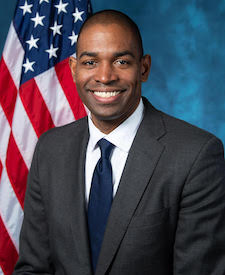
Rep. Antonio Delgado
Sponsored bills
PPP Extension Act of 2021 This bill extends the Paycheck Protection Program, established to support small businesses in response to COVID-19 (i.e., coronavirus disease 2019), through June 30, 2021. Currently, the program is set to expire on March 31, 2021. For the final 30 days of the program (i.e., from June 1 until June 30), the Small Business Administration may only process applications submitted prior to June 1, and it may not accept any new loan applications. The bill excludes the budgetary effects of this bill from PAYGO scorecards under the Statutory Pay-As-You-Go Act of 2010 and from Senate PAYGO scorecards.
Investing in Our Communities Act This bill reinstates the exclusion from gross income for interest on certain bonds issued to advance the refunding of a prior bond issue. The exclusion was repealed for bonds issued after 2017.
Fairness to Kids with Cancer Act of 2021 This bill requires the share of federal funds for cancer research that is allocated to pediatric cancer research to equal the percentage of the U.S. population that is under the age of 18.
Resident Physician Shortage Reduction Act of 2021 This bill increases the number of residency positions eligible for graduate medical education payments under Medicare for qualifying hospitals, including hospitals in rural areas and health professional shortage areas. Current law provides for an increase of up to 200 positions per fiscal year beginning in FY2023, with a total increase of 1,000 positions; each hospital may receive up to 25 additional positions. The bill provides for an additional increase of 2,000 positions per fiscal year from FY2023-FY2029; during this period, each hospital may receive up to 75 additional positions in total under the bill and current law. Additionally, one-third of the positions that are made available under the bill must be allocated to hospitals that are already operating above applicable resident limits. The bill also requires the Government Accountability Office to report on strategies to increase the diversity of the health professional workforce, including with respect to representation from rural, low-income, and minority communities.
Willie O'Ree Congressional Gold Medal Act This bill provides for the award of a Congressional Gold Medal to Willie O'Ree or, if unavailable, to a member of his family, in recognition of his contributions and commitment to hockey, inclusion, and recreational opportunity.
This bill requires the Joint Committee on the Library to enter into an agreement to obtain a statue of Shirley Chisholm, the first African American woman elected to Congress. The committee shall place the statue in a permanent public location in the U.S. Capitol.
This bill directs the Department of State to include additional information in its annual reports concerning Taiwan's participation at the World Health Organization's World Health Assembly (WHA) as an observer. The report shall describe changes and improvements to the State Department's plan to support Taiwan's observer status at the WHA, following any meetings at which Taiwan did not participate under such status. (China has opposed Taiwan's participation in the WHA.)
This joint resolution eliminates the deadline for the ratification of the Equal Rights Amendment, which prohibits discrimination based on sex. The amendment was proposed to the states in House Joint Resolution 208 of the 92nd Congress, as agreed to in the Senate on March 22, 1972. The amendment shall be part of the Constitution whenever ratified by the legislatures of three-fourths of the states.
Neighborhood Homes Investment Act This bill establishes a new business-related tax credit to finance home building and rehabilitation in neighborhoods that meet certain eligibility criteria relating to poverty rates, income, and home values. The credit is limited to 35% of the lesser of the qualified development cost (i.e., the cost of construction, substantial rehabilitation, demolition, and environmental remediation of residential properties) or 80% of the national median sale price for new homes. The credit applies to single family homes containing four or fewer residential units, condominiums, or houses or apartments owned by cooperative housing corporations.