

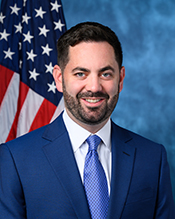
Photo of Michael Lawler
R United States House · District 17 · New York On the 2026 ballot

Rep. Michael Lawler

Compare
Total votes
1,879
all sessions
Attendance
99%
27 missed
Near the chamber average
With party
85%
of cast votes
Lower than 91% of chamber peers
Bipartisan score
8%
crosses aisle rarely
Higher than 89% of chamber peers
Sponsored
2,541
bills & resolutions
Higher than 99% of chamber peers
Committees
6
assignments
2,541 bills and resolutions

Sponsored bills

Total
2,541
Primary
193
Co-sponsor
2,348
This page
2,541
matching current filters
Co-sponsor HR 7417
In committee · United States House · Co-sponsor
Women’s Heart Health Expansion Act of 2026

Maddy summaryHR 7417 reauthorizes and expands the WISEWOMAN program to include heart health screenings and education for low-income women. The bill directs the CDC to award grants for blood pressure and cholesterol screenings, health education, and referrals for heart disease prevention, building on existing breast and cervical cancer services. It specifically targets low-income women who are already served by the WISEWOMAN program or meet new eligibility criteria set by the Secretary. The expansion is funded with $250 million over five fiscal years (2027-2031), with services to be provided by current WISEWOMAN grantees or approved alternative providers.

In committee Feb 9, 2026 1 co-sponsor
Co-sponsor HR 7450
In committee · United States House · Co-sponsor
Disaster Zone Energy Affordability and Investment Act

Maddy summaryThis bill modifies tax credit rules to help businesses recover after disasters. It allows businesses operating in designated disaster areas to treat certain unused tax credits (carryforwards) as transferrable credits against current tax liability, rather than letting them expire. Specifically, it applies to taxpayers making eligible expenditures for business operations in areas with a major disaster declaration after December 31, 2023, or a state-declared disaster meeting specific criteria. The change affects businesses in affected zones by providing immediate tax relief for qualifying expenses incurred within two years of the disaster declaration. It does not involve energy policy or new funding, but adjusts existing tax credit rules for disaster recovery.

In committee Feb 9, 2026 1 co-sponsor
Co-sponsor HR 7415
In committee · United States House · Co-sponsor
HARM Act 2.0

Maddy summaryThe HARM Act 2.0 requires the U.S. government to identify and designate successor groups of the Wagner mercenary force (such as Africa Corps, Redut PMC, and Patriot PMC) as terrorist organizations under existing law. It mandates the Secretary of State to submit a report listing these groups, their leaders, and related entities, followed by a review by the Comptroller General. If designated, these groups and individuals would face sanctions including asset freezes and transaction bans under Executive Order 13224. The bill also requires annual reports for five years detailing the groups' activities, human rights abuses, financial networks, and the effectiveness of sanctions.

In committee Feb 9, 2026 1 co-sponsor
Co-sponsor HR 7410
In committee · United States House · Co-sponsor
To designate the facility of the United States Postal Service located at 15422 NY 104 in Martville, New York, as the "Sergeant Staret J. Engleston Memorial Post Office Building".

This bill designates the facility of the United States Postal Service located at 15422 NY 104 in Martville, New York, as the "Sergeant Staret J. Engleston Memorial Post Office Building".

In committee Feb 5, 2026 1 co-sponsor
Co-sponsor HR 7402
In committee · United States House · Co-sponsor
Unlocking Homeownership Act

Maddy summaryThe Unlocking Homeownership Act allows individuals to use funds from 529 college savings plans for their first home purchase, rather than only for education expenses. It specifically permits distributions from these accounts to cover down payments or closing costs for a principal residence, provided the buyer (or their spouse, child, grandchild, or ancestor) has never owned a home in the past two years. Funds must be used within 120 days of withdrawal, and the bill includes a special provision for disaster-affected areas, allowing redirected use of funds if home purchases are delayed due to a federally declared disaster. This policy change directly affects first-time homebuyers who have saved in 529 plans, expanding the permissible use of those savings.

In committee Feb 5, 2026 1 co-sponsor
Co-sponsor HR 7371
In committee · United States House · Co-sponsor
No Flight, No Fight Act of 2026

Maddy summaryHR 7371 (No Flight, No Fight Act of 2026) bans air carriers from transporting adult roosters as cargo, except for shipments originating from or destined to qualifying commercial farms. The bill requires shippers to provide USDA-certified documentation proving the farm meets the $350,000 annual gross income threshold for commercial operations. It defines "adult rooster" as a male chicken over 6 months old and specifies that exemptions apply only to legitimate agricultural purposes, not to prevent illegal activities like cockfighting. The Department of Transportation will enforce this rule, with violations subject to civil penalties, effective 180 days after enactment.

In committee Feb 5, 2026 1 co-sponsor
Co-sponsor HR 7370
In committee · United States House · Co-sponsor
REUSE Act of 2026

Maddy summaryHR 7370, the REUSE Act of 2026, requires the Environmental Protection Agency (EPA) to produce a public report within two years of enactment. The report must evaluate the feasibility, best practices, and economic impacts of reuse and refill systems for products like food, beverages, cleaning supplies, and shipping containers across sectors including retail, education, and waste management. It specifically examines job creation opportunities, cost-benefit analyses for businesses and waste management, equitable distribution strategies, and barriers to implementation. The bill does not create new regulations but mandates this study to inform future policy decisions on sustainable product systems.

In committee Feb 4, 2026 1 co-sponsor
Primary HR 7367
In committee · United States House · Lead sponsor
TANF Hygiene Access Act

Maddy summaryHR 7367, the TANF Hygiene Access Act, creates a 5-year federal demonstration program to help low-income households access essential hygiene products. The bill authorizes $25 million in the first year (increasing to $32.5 million by year 5) for competitive grants to states, tribes, or tribal organizations. These entities can use funds to distribute specific hygiene items - like soap, diapers, feminine products, and baby wipes - to low-income households, with no more than 15% of funds allowed for administrative costs. Grantees must report on metrics like geographic reach, families served, and distribution frequency, and the program requires a final report to Congress assessing whether a larger-scale program would be feasible.

In committee Feb 4, 2026 0 co-sponsors
Co-sponsor HR 5438
In committee · United States House · Co-sponsor
Incentivize Savings Act

Maddy summaryThis bill modifies federal budget rules for unspent agency funds. It requires federal agencies to allocate 49% of unused funds to the next fiscal year, 49% toward paying the national debt, and 2% for retention bonuses (capped at 10% of an employee's base pay). Agencies must also limit future budget requests to the previous year's amount adjusted for inflation. The bill directly affects all executive branch agencies (excluding the Red Cross), altering how they manage leftover budget authority. It does not create new savings programs for individuals but changes government fiscal management procedures.

In committee Feb 4, 2026 1 co-sponsor
Co-sponsor HR 3699
In committee · United States House · Co-sponsor
Energy Choice Act

Maddy summaryThis bill prevents state or local governments from banning or restricting energy connections (like installation, modification, or access) based on the type or source of energy, such as electricity, natural gas, or renewable fuels. It directly affects consumers choosing energy providers and energy companies seeking to offer services. The key provision prohibits local laws, regulations, or policies that limit energy services sold in interstate commerce, covering all energy types listed in the bill’s definitions. It does not create new programs but limits regulatory authority at the state or local level. The law aims to ensure open access to diverse energy sources without source-based restrictions.

In committee Feb 4, 2026 1 co-sponsor
Showing 381 to 390 of 2,541 bills
Previous 1 … 38 39 40 … 255 Next