

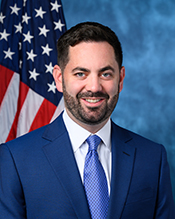
Photo of Michael Lawler
R United States House · District 17 · New York On the 2026 ballot

Rep. Michael Lawler

Compare
Total votes
1,879
all sessions
Attendance
99%
27 missed
Near the chamber average
With party
85%
of cast votes
Lower than 91% of chamber peers
Bipartisan score
8%
crosses aisle rarely
Higher than 89% of chamber peers
Sponsored
2,547
bills & resolutions
Higher than 99% of chamber peers
Committees
6
assignments
2,547 bills and resolutions

Sponsored bills

Total
2,547
Primary
194
Co-sponsor
2,353
This page
2,547
matching current filters
Co-sponsor HR 4909
In committee · United States House · Co-sponsor
SNAP Nutrition Security Act of 2023

Maddy summaryHR 4909, the SNAP Nutrition Security Act of 2023, amends the Food and Nutrition Act to improve data collection and reporting on SNAP (Supplemental Nutrition Assistance Program) usage. It requires the USDA to collect store-level point-of-sale data on specific food items purchased with SNAP benefits and mandates annual reports analyzing food security, nutrition security, and diet quality for SNAP participants. The bill also directs states to include actions taken to improve food and nutrition security in their annual reports to Congress. These changes aim to inform future SNAP policy decisions by providing detailed data on purchasing patterns and program effectiveness, without altering current benefit levels or eligibility.

In committee Aug 28, 2023 1 co-sponsor
Co-sponsor HR 4856
In committee · United States House · Co-sponsor
GusNIP Expansion Act of 2023

Maddy summaryThis bill expands the Gus Schumacher Nutrition Incentive Program (GusNIP) to increase access to healthy food for low-income SNAP participants. It raises the incentive funding percentage from 50% to 80% for eligible purchases, creates new cooperative agreements to scale state programs (requiring 90% of funds to be used for redeemed incentives at retailers), and expands a produce prescription program where healthcare providers can refer patients to buy fresh produce. The bill allocates increased annual funding through 2029, including $57.5 million annually for 2024-2028, and requires a study on transitioning produce prescription costs to health insurance within 10 years. It directly affects SNAP recipients, participating retailers (including farmers markets), and community health centers.

In committee Aug 28, 2023 1 co-sponsor
Co-sponsor HR 4576
In committee · United States House · Co-sponsor
Safeguarding Domestic Energy Production and Independence Act of 2023

Maddy summaryThis bill creates a new $0.20 per credit system (adjustable for inflation) for conventional biofuel waivers under the Clean Air Act, directly affecting refiners and fuel producers with renewable fuel obligations. Credits must be used immediately for that year's compliance and cannot be resold or applied toward other biofuel requirements. Revenue from credit sales is split equally: one-third funds advanced biofuel investments, one-third supports agricultural diversification programs, and one-third flows into the Habitat and Wildlife Restoration Fund. This fund targets conservation in areas impacted by corn/soy expansion since 2007, managed with the National Fish and Wildlife Foundation.

In committee Aug 28, 2023 1 co-sponsor
Co-sponsor HR 5266
In committee · United States House · Co-sponsor
Interdiction of Fentanyl in Postal Mail at Federal Prisons Act

Maddy summaryThis bill requires the Bureau of Prisons to develop and implement a strategy for scanning all incoming mail at federal prisons to stop fentanyl and other synthetic drugs from entering facilities. It directs the Bureau to evaluate existing scanning technology within 180 days and submit a detailed plan to Congress within 90 days, including how to provide digital copies of mail to inmates within 24 hours and physical copies within 30 days (if safe). The strategy must achieve 100% mail scanning capacity at all federal prisons, prioritize high-security facilities, and include a budget proposal for fiscal years 2024-2026. This directly affects federal prisons, inmates, and Bureau employees by changing mail processing procedures to enhance safety and reduce staffing burdens from manual mail checks.

In committee Aug 25, 2023 1 co-sponsor
Co-sponsor HR 5263
In committee · United States House · Co-sponsor
PFAS Strictest Standard Act

Maddy summaryThis bill requires the U.S. military to clean up PFAS chemical contamination at its sites using the strictest available standard. When addressing PFAS pollution from military activities, the Defense Department must meet the most stringent standard among state environmental rules, federal guidelines, or public health advisories for drinking water. It directly affects communities near military bases with PFAS contamination and the Department of Defense as the cleanup agency. The law ensures cleanup levels are as protective as possible under existing regulations, without changing other environmental laws.

In committee Aug 25, 2023 1 co-sponsor
Co-sponsor HR 5238
In committee · United States House · Co-sponsor
PLAY Act of 2023

Maddy summaryHR 5238 (PLAY Act of 2023) expands the child and dependent care tax credit to cover expenses for youth physical activities (e.g., fitness memberships, activity fees, and equipment) for dependents aged 4-18, with a $1,000 annual limit per taxpayer (or $2,000 for joint returns). It also increases the annual limit for employer-sponsored dependent care flexible spending arrangements from $10,000 to $12,000 for single parents. The bill creates a new $100 million HHS grant program (2024-2025) to fund recreational youth sports programs that reduce family costs, promote physical activity, and avoid competitive/elite sports or facility construction. These provisions directly affect families with children participating in non-competitive physical activities and eligible organizations like local governments or nonprofits.

In committee Aug 25, 2023 1 co-sponsor
Primary HR 5114
In committee · United States House · Lead sponsor
Giving Reservists A Valiant Eternity Act

Maddy summaryThis bill expands eligibility for Veterans Affairs (VA) headstones or grave markers to include reservists who do not qualify as veterans due to not meeting the minimum active-duty service requirements under federal law. Specifically, it amends 38 U.S. Code § 2306(a)(5) to explicitly cover members (or former members) of a Reserve who lack veteran status solely because of insufficient active-duty service. The key mechanism is updating the legal definition of eligible individuals under VA burial benefits. This directly affects reservists who served in the National Guard or other reserves but did not complete the required active-duty period, ensuring they receive the same burial benefits as veterans.

In committee Aug 24, 2023 0 co-sponsors
Co-sponsor HR 5014
In committee · United States House · Co-sponsor
Employing Veterans to Feed America Act

Maddy summaryThis bill requires the Department of Veterans Affairs to report on its Warrior Training Advancement Course (WARTAC), tracking veteran participation rates, cost savings, and hiring outcomes for veterans completing the program. It also creates a 2-year pilot program under the Department of Agriculture to hire veterans transitioning from military service into vacant USDA positions related to agriculture, conservation, and nutrition. The pilot mandates reporting on the number of veterans hired, their transition to full-time federal roles, and program effectiveness. These provisions directly affect veterans using the Transition Assistance Program (TAP) and federal agencies like the VA and USDA.

In committee Aug 24, 2023 1 co-sponsor
Co-sponsor HR 4949
In committee · United States House · Co-sponsor
Don Young Veterans Advancing Conservation Act

Maddy summaryHR 4949, the Don Young Veterans Advancing Conservation Act, establishes a Department of Commerce grant program to fund nonprofit organizations that train or employ veterans for underwater marine and coastal conservation work. The program, authorized for $1 million in fiscal year 2024 and increasing to $1.8 million by 2028, supports specific activities like coral restoration, invasive species removal, marine debris cleanup, and hurricane recovery. Nonprofits must be 501(c)(3) organizations and use funds to employ veterans in these conservation roles, with coordination required with the Department of the Interior. This directly affects veterans seeking meaningful employment and conservation-focused nonprofits receiving federal grants.

In committee Aug 24, 2023 1 co-sponsor
Co-sponsor HR 4764
In committee · United States House · Co-sponsor
Honey Identification Verification and Enforcement Act

Maddy summaryThis bill requires the FDA to establish a standard of identity for honey within one year of enactment, ensuring honey meets specific quality and composition criteria. It mandates that honey labels clearly list country of origin in descending order of predominance (e.g., "Product of USA, Canada"), with U.S. producers allowed up to 5% foreign honey without violating labeling rules. The FDA must also report to Congress within two years on enforcement actions against misbranded or adulterated honey. These provisions directly affect honey producers, importers, and retailers who must comply with the new labeling and quality standards.

In committee Aug 24, 2023 1 co-sponsor
Showing 1,991 to 2,000 of 2,547 bills