

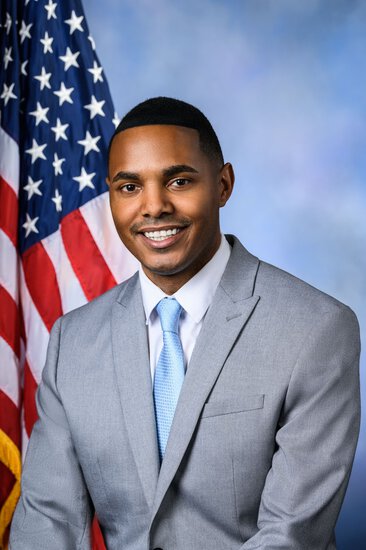
Photo of Ritchie Torres
D United States House · District 15 · New York On the 2026 ballot

Rep. Ritchie Torres

Compare
Total votes
2,837
all sessions
Attendance
97%
79 missed
Near the chamber average
With party
97%
of cast votes
Near the chamber average
Bipartisan score
2%
crosses aisle rarely
Near the chamber average
Sponsored
1,504
bills & resolutions
Higher than 78% of chamber peers
Committees
4
assignments
1,504 bills and resolutions

Sponsored bills

Total
1,504
Primary
170
Co-sponsor
1,334
This page
1,504
matching current filters
Co-sponsor HR 2016
In committee · United States House · Co-sponsor
Feed Our Families Act of 2025

Maddy summaryThe Feed Our Families Act of 2025 ensures SNAP (Supplemental Nutrition Assistance Program) benefits continue for 90 days during the first government funding lapse in a fiscal year. It appropriates emergency funds from the Treasury to cover SNAP operations for the initial 90 days of a lapse in discretionary appropriations for the program. These funds are held in reserve and can only be used to maintain SNAP program services during that period. The bill directly affects millions of low-income households relying on SNAP benefits by preventing immediate disruptions during early government shutdowns.

In committee Mar 10, 2025 1 co-sponsor
Co-sponsor HR 1976
In committee · United States House · Co-sponsor
Woman on the Twenty Act of 2025

Maddy summaryThis bill mandates that all new $20 U.S. currency printed after December 31, 2028, must prominently feature Harriet Tubman's portrait on the front. It requires the Treasury Secretary to release a preliminary design for this updated $20 bill by December 31, 2026. The bill directly affects the U.S. Treasury Department, codifying a 2016 announcement to feature Tubman on the $20 note (replacing Andrew Jackson) and ending a historical pattern where no woman had appeared on U.S. paper money.

In committee Mar 10, 2025 1 co-sponsor
Primary HR 2018
In committee · United States House · Lead sponsor
BODEGA Act of 2025

Maddy summaryHR 2018, the BODEGA Act of 2025, expands existing federal crime prevention grants to allow funding for panic buttons and surveillance equipment in small grocery stores. It specifically targets businesses classified under NAICS code 445131 (convenience stores, commonly known as bodegas) by adding them to the list of eligible recipients under the Omnibus Crime Control Act. The bill amends grant program rules to permit these security upgrades without requiring new funding, instead modifying how current grant dollars can be used. This change directly affects bodega owners in communities seeking enhanced safety measures for their businesses.

In committee Mar 10, 2025 0 co-sponsors
Co-sponsor HR 1910
In committee · United States House · Co-sponsor
Chief Risk Officer Enforcement and Accountability Act

Maddy summaryHR 1910, the Chief Risk Officer Enforcement and Accountability Act, requires large financial firms with at least $50 billion in total assets to appoint a Chief Risk Officer (CRO). The CRO must oversee enterprise-wide risk limits, implement risk governance policies, and develop systems for identifying emerging risks and ensuring risk management independence. The bill mandates that firms notify regulators within 24 hours of a CRO vacancy and submit a hiring plan within 7 days, with penalties including public disclosure and asset caps if the vacancy persists beyond 60 days. It applies specifically to large banks without holding companies and nonbank financial firms supervised by the Federal Reserve Board.

In committee Mar 6, 2025 1 co-sponsor
Co-sponsor HR 1933
In committee · United States House · Co-sponsor
James Earl Jones Congressional Gold Medal Act

Maddy summaryThis bill authorizes a posthumous Congressional Gold Medal for actor James Earl Jones to recognize his career achievements in theater and film. It directs the Treasury Secretary to strike a gold medal bearing his name, which will be presented to his son, Flynn Earl Jones, following Jones' passing. The bill also permits the sale of bronze duplicates to cover costs. As a ceremonial honor with no policy changes, it does not affect legislation or government operations.

In committee Mar 6, 2025 1 co-sponsor
Co-sponsor HR 1918
In committee · United States House · Co-sponsor
Farewell to Foam Act of 2025

Maddy summaryHR 1918, the Farewell to Foam Act of 2025, prohibits the sale of most foam food containers, packaging peanuts, and foam coolers starting January 1, 2028. It directly affects restaurants, grocery stores, food vendors, manufacturers, and retailers who sell these items, excluding medical coolers used for drugs or medical products. The bill imposes escalating civil penalties for violations: $250 for the second offense, $500 for the third, and $1,000 for fourth or subsequent violations, with reduced penalties for small businesses under specific revenue thresholds. Enforcement is led by the EPA Administrator, with states allowed to enforce under federal guidelines.

In committee Mar 6, 2025 1 co-sponsor
Co-sponsor HR 1954
In committee · United States House · Co-sponsor
Do No Harm Act

Maddy summaryHR 1954, the "Do No Harm Act," amends the Religious Freedom Restoration Act (RFRA) to clarify that RFRA does not override specific federal laws protecting against harm. It explicitly exempts provisions related to anti-discrimination (like the Civil Rights Act), workplace protections (wages, leave, collective activity), child safety, and healthcare access from RFRA's requirements. The bill ensures RFRA cannot be used to challenge government programs or contracts that provide these essential protections. It also clarifies that RFRA applies only to disputes involving government as a party, not private disputes between individuals. This change preserves existing legal safeguards while modifying RFRA's scope.

In committee Mar 6, 2025 1 co-sponsor
Co-sponsor HR 1901
In committee · United States House · Co-sponsor
CHIPP Act

Maddy summaryHR 1901, the CHIPP Act, makes Children's Health Insurance Program (CHIP) funding permanent for all future fiscal years, removing previous expiration dates that required annual congressional renewal. This directly affects low-income children and families who rely on CHIP coverage and the states that administer these programs. The key mechanism is amending federal law to require "such sums as are necessary" for CHIP funding starting in fiscal year 2029 and beyond. Other provisions adjust funding for related programs like pediatric quality measures and outreach, but the primary change is CHIP’s permanent funding structure.

In committee Mar 6, 2025 1 co-sponsor
Primary HR 1961
In committee · United States House · Lead sponsor
CARE Act

Maddy summaryHR 1961, the CARE Act, requires the Department of Health and Human Services (HHS) to create an after-action program to review and improve responses to public health emergencies. This program, to be implemented within two years, mandates HHS to analyze coordination with state/local partners, logistics, infection prevention, and recovery strategies, and report findings to Congress. The bill also requires HHS to establish a risk communication strategy within one year to ensure clear, targeted messaging for at-risk populations during health emergencies. It authorizes $3.5 million for the initial implementation of these programs. The law directly affects HHS agencies and their partners, including state health departments, tribes, and non-governmental organizations involved in emergency responses.

In committee Mar 6, 2025 0 co-sponsors
Co-sponsor HR 1877
In committee · United States House · Co-sponsor
Protecting Americans’ Social Security Data Act

Protecting Americans’ Social Security Data Act This bill prohibits political appointees and special government employees from accessing Social Security data systems that contain personally identifiable information about Social Security beneficiaries. Specifically, political appointees and special government employees may not access systems maintained by the Social Security Administration (SSA) that issue or record Social Security account numbers, that are used to determine eligibility for or to pay Social Security benefits, or that otherwise contain personally identifiable information about individuals receiving or applying for benefits.  The bill also establishes a civil right of action for an individual whose information was negligently accessed or disclosed in violation of these provisions. The individual may bring suit against the United States if the violator was a U.S. employee or officer, or against the violator if they were not a U.S. employee or officer. Such a claim must be brought within two years of the affected individual’s discovery of the violation. Upon a finding of liability, defendants are liable for specified monetary damages.  If an individual is criminally charged or subject to proposed disciplinary or adverse action by a federal or state agency for having accessed or disclosed information in violation of these provisions, SSA must notify the individual whose information was accessed or disclosed of the violation as soon as practicable.  Finally, the bill requires the SSA Office of the Inspector General to investigate and report to Congress on any unauthorized access to or disclosure of information in a beneficiary data system.

In committee Mar 5, 2025 1 co-sponsor
Showing 371 to 380 of 1,504 bills
Previous 1 … 37 38 39 … 151 Next