Original National Domestic Violence Awareness Month Resolution of 2021 This resolution supports the goals and ideals of National Domestic Violence Awareness Month. Further, it expresses the sense of the House of Representatives that Congress should continue to raise awareness of and support programs to end domestic violence.
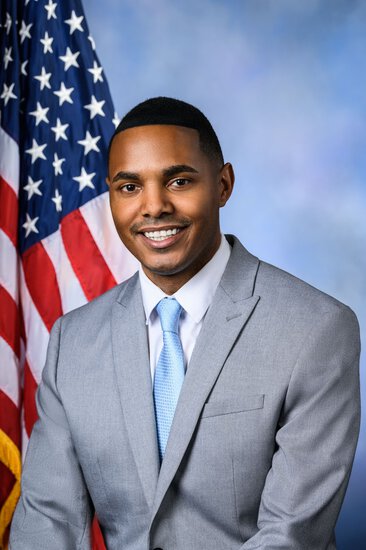
Rep. Ritchie Torres
Sponsored bills
Public Service Freedom to Negotiate Act of 20 21 This bill provides minimum collective bargaining rights and procedures for public employees and prohibits strikes by certain public safety workers. The Federal Labor Relations Authority (FLRA) shall determine for each state whether the laws of such state substantially provide for each of the minimum standard collective bargaining rights and procedures specified by this bill, including the right of public employees and supervisory employees to self-organize, form or join a labor organization, or collectively bargain. The FLRA must issue rules and take actions to establish and administer bargaining rights and procedures for those states that do not substantially provide for them. No employers, emergency services employees, or law enforcement officers may engage in a lockout, strike, or any other organized job action that is likely to result in a measurable disruption of the delivery of emergency or public safety services. Furthermore, no labor organization may be the cause of a violation of such prohibition.
College Student Hunger Act of 20 21 This bill expands the eligibility of students at institutions of higher education to participate in the Supplemental Nutrition Assistance Program (SNAP). SNAP eligibility for students is expanded to include certain low-income students who (1) are employed a minimum of 10 hours per week (currently 20 hours) during the regular school year, (2) are eligible for a federal Pell Grant, (3) have an expected family contribution equal to zero, or (4) are independent. Additionally, the bill directs the Department of Education to provide notification to certain students regarding their eligibility for SNAP benefits, the Inspector General of the Department of Agriculture (USDA) to conduct an audit of the operations of the Food and Nutrition Service to examine the procedures and outreach practices used by the service to provide to states information about the eligibility of students at institutions of higher education for participation in the program, USDA to update its state outreach plan guidance, and USDA to implement projects to decrease student hunger at institutions of higher education and to reduce barriers to college students fully utilizing SNAP benefits at these institutions.
This concurrent resolution recognizes the disparity between wages paid to Latina women, and its impact on women, families, and the nation and reaffirms Congress' commitment to supporting equal pay and to narrowing the gender wage gap.
DHS Software Supply Chain Risk Management Act of 2021 This bill requires the Management Directorate of the Department of Homeland Security (DHS) to issue guidance regarding new and existing contracts relating to the procurement of information and communications technology or services. The bill requires contractors to submit to DHS a bill of materials, a certification that each item in the bill of materials is free from certain security vulnerabilities or defects affecting the security of the end product or service, a notification of any identified vulnerability or defect, and a plan to mitigate, repair, or resolve any identified vulnerability or defect. The Government Accountability Office must report to specified congressional committees with (1) a review of this bill's implementation; (2) information regarding DHS engagement with industry; (3) an assessment of how guidance issued pursuant to this bill complies with Executive Order 14208, relating to improving the nation's cybersecurity; and (4) any recommendations related to improving the supply chain for covered contracts.

This concurrent resolution supports the goals and ideals of the National Day of Silence (during which students vow to remain silent to bring attention to the harassment and discrimination faced by lesbian, gay, bisexual, transgender, queer and questioning individuals in schools).
This resolution calls for the creation of a Green New Deal with the goals of achieving greenhouse gas and toxic emissions reductions needed to stay under 1.5 degrees Celsius of warming; establishing millions of high-wage union jobs and ensuring economic security for all; investing in infrastructure and industry; securing clean air and water, climate and community resiliency, healthy food, access to nature, and a sustainable environment for all; and promoting justice and equality. The resolution calls for accomplishment of these goals through a 10-year national mobilization effort. The resolution also enumerates the goals and projects of the mobilization effort, including building smart power grids (i.e., power grids that enable customers to reduce their power use during peak demand periods); upgrading all existing buildings and constructing new buildings to achieve maximum energy and water efficiency; removing pollution and greenhouse gas emissions from the transportation and agricultural sectors; cleaning up existing hazardous waste and abandoned sites; ensuring businesspersons are free from unfair competition; and providing higher education, high-quality health care, and affordable, safe, and adequate housing to all.
This resolution rejects the Supreme Court's decisions in the Insular Cases (a series of cases regarding the application of constitutional rights in U.S. territories) and recognizes that constitutional and democratic principles apply throughout the states and territories of the United States.
Oversight of Law Enforcement Surveillance Act of 2021 This bill establishes reporting requirements related to the use of surveillance technology by law enforcement agencies in major metropolitan areas. The term major metropolitan area means an area with at least 250,000 residents. Specifically, the bill requires a law enforcement agency of a major metropolitan area receiving federal funds from the Department of Homeland Security (DHS) to report annually to DHS, the Inspector General of DHS, and Congress on the use of surveillance technology. Additionally, the bill requires the Inspector General of DHS to report annually to Congress on the use of surveillance technology and the impact of its use on civil liberties and privacy.
Protecting the Rights Of Towns against federal Enforcement contrary to Constitutional Tenets for Immigration Act of 2021 or the PROTECT Immigration Act of 2021 This bill establishes that the authority to investigate, apprehend, or detain aliens for the purposes of immigration enforcement is limited to immigration officers and authorized Department of Homeland Security employees, except when such authority is provided to other individuals under specified statutes. Specifically, this restriction does not apply in certain instances involving (1) an actual or imminent mass influx of aliens, (2) persons bringing in and harboring aliens in violation of immigration laws, or (3) an alien illegally present in the United States who had previously left or was deported after being convicted of a felony. The bill repeals the authority allowing the Department of Justice to enter into agreements authorizing state or local government employees to perform immigration enforcement functions.