

Women's Health Protection Act of 2021 This bill prohibits governmental restrictions on the provision of, and access to, abortion services. Specifically, governments may not limit a provider's ability to prescribe certain drugs, offer abortion services via telemedicine, or immediately provide abortion services when the provider determines a delay risks the patient's health. Furthermore, governments may not require a provider to perform unnecessary medical procedures, provide medically inaccurate information, comply with credentialing or other conditions that do not apply to providers whose services are medically comparable to abortions, or carry out all services connected to an abortion. In addition, governments may not (1) require patients to make medically unnecessary in-person visits before receiving abortion services or disclose their reasons for obtaining such services, or (2) prohibit abortion services before fetal viability or after fetal viability when a provider determines the pregnancy risks the patient's life or health. The bill also prohibits other governmental measures that are similar to the bill's specified restrictions or that otherwise single out and impede access to abortion services, unless a government demonstrates that the measure significantly advances the safety of abortion services or health of patients and cannot be achieved through less restrictive means. The Department of Justice, individuals, or providers may bring a lawsuit to enforce this bill, and states are not immune from suits for violations. The bill applies to restrictions imposed both prior and subsequent to the bill's enactment.
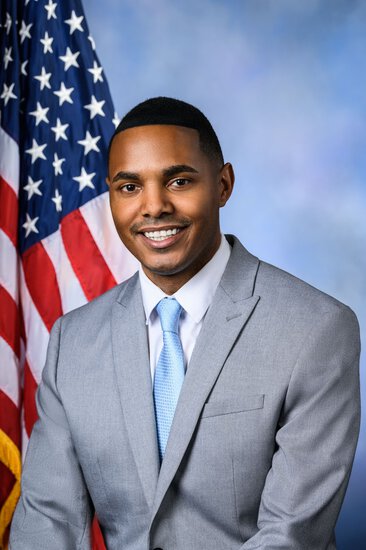
Rep. Ritchie Torres
Sponsored bills
Original Black History Month Resolution of 2022 This resolution recognizes the importance of commemorating Black History Month to acknowledge the achievements of Black Americans throughout history.
Maddy summaryHRES 939 is a symbolic House resolution expressing support for designating February 21-25, 2022, as "Public Schools Week." It does not create new policies, allocate funding, or impose requirements on schools or students. The resolution uses supportive language to acknowledge public education's role in democracy but has no legal effect. It was introduced by multiple representatives as a non-binding gesture of appreciation for public schools.
This resolution condemns the atrocities and possible crimes against humanity being perpetrated against women and girls in Ethiopia. It also supports the full investigation of atrocities against women and girls in Tigray, Amhara, Afar, and other parts of northern Ethiopia.
Environmental Justice Air Quality Monitoring Act of 2022 This bill requires the Environmental Protection Agency to implement a pilot program to award, on a competitive basis, grants or contracts to state, local, and tribal air agencies to carry out specified projects for hyperlocal air quality monitoring systems in environmental justice communities (i.e., communities with significant representation of communities of color, low income communities, or tribal and indigenous communities that experience, or are at risk of experiencing, higher or more adverse human health or environmental effects). A project carried out using a grant or contract awarded under the pilot program may not exceed five years in duration.
Congressional Tribute to Constance Baker Motley Act of 2022 This bill provides for the award of a Congressional Gold Medal posthumously to Constance Baker Motley in recognition of her contributions and service to the United States in advancing civil rights as an attorney, elected official, and judge.
This resolution extends collective bargaining rights prescribed in the Congressional Accountability Act of 1995 to employees of the House of Representatives.
This resolution recognizes that the Harlem Renaissance represented a pivotal moment in American history for African Americans and the African diaspora community of intellectuals, artists, performers, writers, poets, and musicians whose works of political discourse and creative expression set a path for self-determination and self-empowerment that is still evident today. The resolution also celebrates the lasting impact of the Harlem Renaissance on the art, literature, music, discourse, and culture of the United States.
VSO Support Act of 2022 This bill requires the Department of Veterans Affairs to implement a grant program for eligible veterans service organizations to offset costs relating to the COVID-19 pandemic that were incurred between April 1, 2020, and December 31, 2020.
Part-Time Worker Bill of Rights Act This bill modifies various employment, leave, and pension rules with respect to part-time workers. Specifically, the bill removes the requirement that employees work a minimum number of hours during the preceding 12-month period before becoming eligible for family and medical leave. The bill also sets the maximum length of service on which employers may condition the eligibility of part-time employees for a qualified pension plan (e.g., 401(k) retirement plan). Except as required by an applicable collective bargaining agreement, such service requirement may be no longer than two consecutive 12-month periods of at least 500 hours of service for part-time employees who have reached the age of 21 by the end of such periods. The bill further prohibits employers of more than 15 employees from setting disparate terms of employment or working conditions for part-time employees, including with respect to compensation, notice of work hours, and promotion opportunities, among others. Additionally, the bill requires such employers to offer available, qualified part-time employees additional work hours before hiring new employees for such hours. Among other enforcement methods, employers must maintain three years of records for offers of additional hours and employee responses to such offers. The bill also provides a private right of action for employees to enforce the nondiscrimination requirements of this bill.