

Break Free From Plastic Pollution Act of 2021 This bill sets forth requirements and incentives to reduce the production of a variety of products and materials, including plastics, and increase efforts to collect, recycle, or compost products and materials. The bill makes certain producers of products (e.g., packaging, paper, single-use products, beverage containers, or food service products) fiscally responsible for collecting, managing, and recycling or composting the products after consumer use. In addition, the bill establishes (1) minimum percentages of products that must be reused, recycled, or composted; and (2) an increasing percentage of recycled content that must be contained in beverage containers. Beginning on January 1, 2023, the bill phases out a variety of single-use products, such as plastic utensils. The bill also sets forth provisions to encourage the reduction of single-use products, including by establishing programs to refund consumers for returning beverage containers and by establishing a tax on carryout bags. The bill creates a temporary moratorium on new or expanded permits for certain facilities that manufacture plastics until regulations are updated to address pollution from the facilities. The Environmental Protection Agency (EPA) must publish guidelines for a national standardized labeling system for recycling and composting receptacles. Producers must include labels on their products that are easy to read and indicate whether the products are recyclable, compostable, or reusable. The EPA must also ensure that certain clothes washers have filtration units as required by this bill. Finally, the bill establishes limitations on the export of plastic waste to other countries.
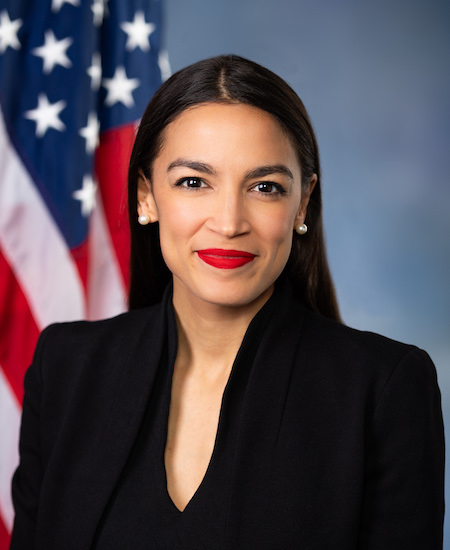
Rep. Alexandria Ocasio-Cortez
Sponsored bills
This bill designates the facility of the United States Postal Service located at 40 Fulton Street in Middletown, New York, as the Benjamin A. Gilman Post Office Building.
Save America’s Forgotten Equines Act of 2021 or the SAFE Act of 2021 This bill prohibits the transporting, receiving, possessing, purchasing, selling, or donation by a person of an equine (e.g., horse) that the person has reason to believe will be slaughtered for human consumption.
Downpayment Toward Equity Act of 2021 This bill establishes a grant program through the Department of Housing and Urban Development for states and other entities to provide qualifying assistance to certain first-time, first-generation home buyers in purchasing their first homes. Qualifying assistance includes assistance for mortgage down payments, mortgage closing costs, reduction of mortgage interest rates, subsidies for shared equity homes, or for certain preoccupancy modifications to a home to accommodate persons with disabilities. The bill also establishes grant requirements regarding home buyer income, types of housing, homeowner occupancy, types of mortgages, and home buyer counseling.
This resolution condemns human rights violations and violations of international religious freedom in India, including those targeting Muslims, Christians, Sikhs, Dalits, Adivasis, and other religious and cultural minorities. The resolution also calls on the Department of State to designate India as a country of particular concern under the International Religious Freedom Act of 1998 and the Frank R. Wolf International Religious Freedom Act of 2016.
Military Spouse Hiring Act This bill expands the Work Opportunity Tax Credit (WOTC) to include the hiring of a qualified military spouse. (The WOTC permits employers who hire individuals who are members of a targeted group such as qualified veterans, ex-felons, or long-term unemployment recipients to claim a tax credit equal to a portion of the wages paid to those individuals.) A qualified military spouse is any individual who is certified by the designated local agency as being (as of the hiring date) a spouse of a member of the Armed Forces.
Social Security Expansion Act This bill increases benefits and certain taxes related to the Social Security program. Changes to benefits include (1) increasing the primary insurance amount for certain beneficiaries; (2) revising the method of calculating cost-of-living adjustments; (3) establishing a new minimum benefit for certain low earners; and (4) allowing certain children of retired, deceased, or disabled workers to receive benefits until age 22 if they are a full-time student. Changes to taxes include (1) increasing the net investment income tax and making active trade or business income subject to this tax; and (2) extending payroll taxes on wages, salaries, and self-employment earnings to income above $250,000 (the maximum amount subject to the Social Security payroll tax is currently $147,000 for 2022). The bill also combines the existing Federal Old-Age and Survivors Insurance Trust Fund and the Federal Disability Insurance Trust Fund into a single Social Security Trust Fund.
Protecting Our Kids Act This bill makes various changes to federal firearms laws, including to establish new criminal offenses and to expand the types of weapons and devices that are subject to regulation. Among the changes, the bill generally prohibits the sale or transfer of certain semiautomatic firearms to individuals who are under 21 years of age; establishes new federal criminal offenses for gun trafficking and related conduct; establishes a federal statutory framework to regulate ghost guns (i.e., guns without serial numbers); establishes a framework to regulate the storage of firearms on residential premises at the federal, state, and tribal levels; subjects bump stocks to regulation under federal firearms laws; generally prohibits the import, sale, manufacture, transfer, and possession of large capacity ammunition feeding devices; and requires the Department of Justice to report on the demographic data of persons who are determined to be ineligible to purchase a firearm based on a background check performed by the national instant criminal background check system.
This resolution condemns in the strongest terms the great replacement theory, which it describes as a white supremacist conspiracy theory that has been used to falsely justify racially motivated, violent acts of terrorism domestically and internationally.
Sustaining Our Democracy Act This bill establishes and provides funds through FY2032 for the State Election Assistance and Innovation Trust Fund for purposes of promoting election activities. Specifically, the bill establishes the Democracy Advancement and Innovation Program, through which the Office of Democracy Advancement and Innovation (also established by this bill) shall make allocations to states for carrying out democracy promotion activities. These activities include improving the administration of federal elections, recruiting and training nonpartisan election officials and poll workers, and increasing voting access. The bill requires each state, in order to receive allocated funds, to (1) submit a plan for approval that describes how the state will distribute resources and carry out democracy promotion activities, and (2) establish uniform and nondiscriminatory state-based administrative complaint procedures. The bill prohibits states from using funds for certain activities, including any activity that diminishes the ability of any eligible voter to participate in the electoral process.