

Public Service Expenditure Cap Modification Act This bill waives for FY2023 a cap on the amount that recipients of Community Development Block Grant funds may spend on public service activities (e.g., those concerned with employment, crime prevention, childcare, and health). Current law prohibits recipients from expending more than 15% of funds on such activities. The bill also directs the Department of Housing and Urban Development to allow recipients to provide emergency grant payments on behalf of eligible families for up to six months. Currently, these payments, which provide assistance with housing, utilities, or other subsistence support, are limited to three months.
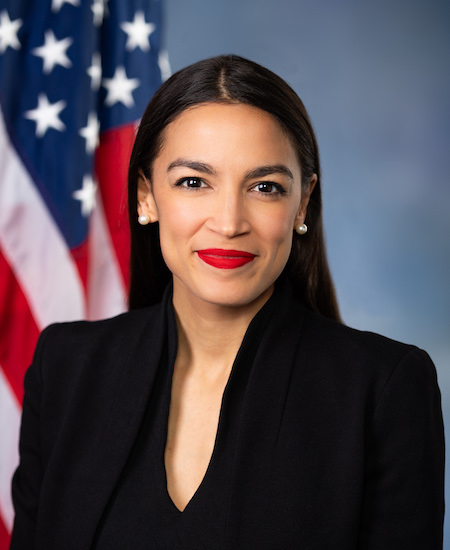
Rep. Alexandria Ocasio-Cortez
Sponsored bills
Reviewing the Effects of Programs, Orders, and Rules with Thorough Study Act or the REPORTS Act This bill requires federal agencies, when publishing notice of a proposed major rule, to include an analysis of the rule's potential impact on low-income individuals and racial inequity. The Government Accountability Office must annually report on the impact of certain programs on low-income individuals and racial inequity.
This bill designates the facility of the United States Postal Service located at 39 West Main Street, in Honeoye Falls, New York, as the CW4 Christian J. Koch Memorial Post Office.
This bill designates the facility of the United States Postal Service located at 170 Manhattan Avenue in Buffalo, New York, as the Indiana Hunt-Martin Post Office Building.
Reward Work Act This bill prohibits issuers from purchasing their own securities on a national exchange. The bill also requires one-third of an issuer's board of directors to be elected by employees in order for the issuer to be allowed to register securities.
This bill designates the facility of the United States Postal Service located at 3900 Crown Road Southwest in Atlanta, Georgia, as the John R. Lewis Post Office Building.
Reproductive Health Care Accessibility Act This bill establishes various grants and related programs that address sexual and reproductive health care for individuals with disabilities. Specifically, the Health Resources and Services Administration must support training for health care providers who offer sexual and reproductive health care to individuals with disabilities, and educating individuals with disabilities about sexual and reproductive health care. The Administration for Community Living must establish a national center to provide recommendations, technical assistance, and other resources related to the provision of sexual and reproductive health care for individuals with disabilities. The bill also authorizes support for medical schools, nursing schools, and other educational institutions that offer obstetrics and gynecology training programs to expand the number of individuals with disabilities entering the reproductive health care workforce. Additionally, the Department of Health and Human Services must study the effectiveness and other aspects of reproductive health care services and programs for individuals with disabilities.
Maximizing Outcomes through Better Investments in Lifesaving Equipment for (MOBILE) Health Care Act This bill allows a health center that currently receives funding through a Health Resources & Services Administration Health Center Program grant to use a New Access Point grant to set up a mobile unit regardless of whether the health center also establishes a permanent health care delivery site. New Access Point grants help health centers establish new delivery sites to provide comprehensive primary care to medically underserved populations. Under current law, health centers may only use the grants to set up a mobile unit if they also establish a permanent site.
This concurrent resolution expresses the sense of the House of Representatives that Congress and the President should examine and support ways to expand access to contraceptives.
Social Security Fairness Act of 2021 This bill repeals provisions that reduce Social Security benefits for individuals who receive other benefits, such as a pension from a state or local government. The bill eliminates the government pension offset , which in various instances reduces Social Security benefits for spouses, widows, and widowers who also receive government pensions of their own. The bill also eliminates the windfall elimination provision , which in some instances reduces Social Security benefits for individuals who also receive a pension or disability benefit from an employer that did not withhold Social Security taxes. These changes are effective for benefits payable after December 2021.