

Reduce Financial Barriers to Immigration and Citizenship Act of 2021 This bill prohibits the Department of Homeland Security (DHS) from charging fees for certain immigration applications (or petitions), requires DHS to provide fee waivers to certain applicants, and addresses related issues. DHS may not impose fees for certain applications for or related to (1) asylum or refugee status, (2) special immigrant juvenile status, (3) U or T non-immigrant visas (victims of certain crimes such as human trafficking), (4) the Violence Against Women Act, (5) special immigrant status for Afghan or Iraqi nationals employed by the U.S. government, or (6) immigration-related fee waivers. DHS must also waive immigration-related application fees for an applicant who receives a means-tested benefit or meets certain conditions related to financial hardship. However, DHS is not required to provide fee waivers for applications for certain employment-based immigration benefits. Receipt of a fee waiver may not be used as a factor (1) for determining whether an alien should be considered a public charge, or (2) when considering an affidavit of support filed by a sponsor. The bill also requires all collected immigration-related adjudication fees to be used only to fund the adjudication and administration of immigration benefits and naturalization.
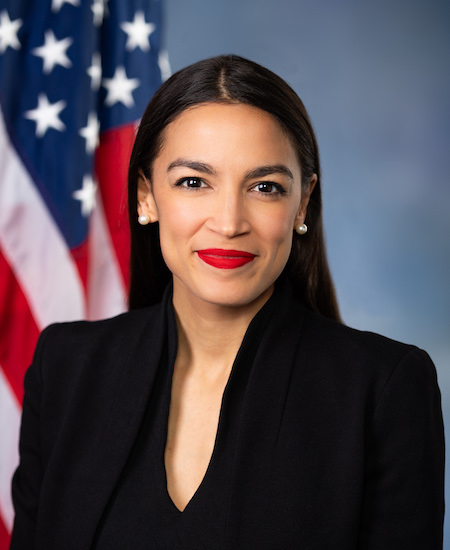
Rep. Alexandria Ocasio-Cortez
Sponsored bills
Welcoming Evacuees Coming from Overseas to Mitigate Effects of Displacement Act of 2021 or the WELCOMED Act of 2021 This bill makes certain individuals from Afghanistan eligible for any benefit that is available to a refugee, such as resettlement assistance. Specifically, this bill shall apply to a national of Afghanistan (or an individual with no nationality who last habitually resided in Afghanistan) who is temporarily paroled into the United States for urgent humanitarian reasons or significant public benefit during the four-year period beginning on July 1, 2021.
Afghan and Iraqi Allies Resettlement Improvement Act This bill addresses the settlement of Afghan and Iraqi special immigrant visa (SIV) holders. (Generally, SIV holders are individuals who received visas due to their work with the U.S. Armed Forces in Iraq or Afghanistan.) The Department of Health and Human Services must survey long-term outcomes, such as employment, housing, and educational attainment, of SIV holders as part of its annual survey of refugees. The Department of State must implement additional ways to deliver information in certain languages (i.e., Dari, Pashto, or Urdu) to prospective SIV holders about resettlement in the United States to assist with their adjustment process. The State Department and the Department of Defense must jointly establish a temporary program to offer SIV holders employment as translators, interpreters, and cultural awareness instructors.
District Court Judgeships Act of 2021 This bill requires the appointment of additional U.S. district court judges and converts certain temporary district court judgeships into permanent judgeships. Specifically, the bill requires the appointment of 203 district court judges in specified judicial districts in Arkansas, Arizona, California, Colorado, Delaware, Florida, Georgia, Idaho, Illinois, Indiana, Louisiana, Maryland, Michigan, Minnesota, Missouri, North Carolina, Nebraska, Nevada, New Jersey, New Mexico, New York, Ohio, Oregon, Pennsylvania, South Carolina, Tennessee, Texas, Utah, Virginia, Washington, Wisconsin, and West Virginia. Additionally, the bill converts certain temporary district court judgeships to permanent judgeships in specified judicial districts in Alabama, Arizona, California, Florida, Kansas, Missouri, New Mexico, North Carolina, and Texas.
Higher Education Dream Act of 2021 This bill prohibits institutions of higher education that receive federal student aid from discriminating against Dreamer students (e.g., students who have been granted Deferred Action for Childhood Arrivals status) based on their immigration status, including charging out-of-state tuition to students who would qualify as residents of the state. The bill also makes Dreamer students eligible for federal financial aid. The bill prohibits the use or publication of certain identifiable information related to such students, subject to civil penalties.
Supreme Court Ethics Act This bill establishes a new statutory requirement for the Judicial Conference of the United States to issue a judicial code of conduct for judges and justices of U.S. courts, including Justices of the Supreme Court. Currently, the Judicial Conference issues a code of conduct for judges of U.S. courts (but not for Justices of the Supreme Court).
Ending Homelessness Act of 2021 This bill expands the housing choice voucher program and provides assistance to homeless individuals and families. Specifically, the bill provides FY2022-2025 funding for the expansion of the housing choice voucher program for certain extremely low income families. Furthermore, beginning in FY2026, the bill creates and funds an entitlement to housing choice vouchers for certain extremely low income families. Eligibility for the entitlement expands annually, extending to low-income families by FY2030. The bill also reduces the geographic area used to calculate an area's fair market rent for purposes of voucher payment standards and prohibits the use of criminal history in determining eligibility for certain housing assistance. Additionally, the bill prohibits housing discrimination on the basis of a renter's source of income or a renter's veteran status. The bill also provides additional FY2022-FY2026 funding for the Department of Housing and Urban Development (HUD) to assist the homeless, including to award emergency relief grants in jurisdictions with the highest need and award grants to provide outreach and coordinate services. Furthermore, the bill provides additional FY2022-FY2026 funding for the Housing Trust Fund, which provides affordable housing for extremely low-income and very low-income families. While this additional funding is available, HUD must ensure that priority for occupancy in assisted units is given to individuals and families who are homeless. Finally, the bill permanently reauthorizes certain homeless assistance grants and makes permanent the U.S. Interagency Council on Homelessness.
Housing is Infrastructure Act of 2021 This bill generally addresses housing affordability and infrastructure. The bill authorizes the Department of Housing and Urban Development (HUD) to provide grants, programs, and other support related to public housing, affordable housing preservation and construction, and mortgage access. The bill also establishes and funds the National Investment Authority (NIA) which must design, finance, and implement a strategy of long-term national economic growth and development. The NIA must select projects that coordinate investment of public and private capital in equitable, inclusive, and sustainable growth of the economy. Furthermore, the bill establishes the National Infrastructure Bank (NIB) to implement the strategy by engaging in credit market activities that support public and private investment in critical public infrastructure projects. The bill gives the NIA bond issuing authority and authorizes the Board of Governors of the Federal Reserve System to purchase these bonds. The Federal Reserve must lend funds on a short-term basis upon the request of the NIB and other subsidiaries. Additionally, the Department of the Treasury must provide for a line of credit not to exceed 100% of the NIA's total assets. Finally, the bill (1) authorizes HUD to provide support for fair housing organizations, and (2) requires consultation with a fair housing enforcement organization as part of an application for certain housing grants or funds.
The People's Response Act This bill establishes multiple grant programs and requirements to promote qualified approaches to community safety. These are programs or services that are disconnected from carceral institutions (e.g., law enforcement, child welfare services, and immigration enforcement). Specifically, the bill establishes the Division of Community Safety within the Department of Health and Human Services (HHS) to administer the grants and carry out related activities. These include grants for community-based organizations to support qualified approaches to community safety, such as unarmed first responder agencies and 9-1-1 diversion programs; neighborhood-level interventions, including safe passage to school and violence interruption programs; behavioral health treatment, nutrition support, and other public health programs; housing security programs; and programs for youth and families, survivors of violence, and individuals exiting incarceration or criminal supervision. Additionally, the division must administer grants pertaining to qualified approaches for community safety for state and local governments and hiring and training first responders. The bill also establishes an advisory board to oversee the division's activities. Membership on the board must reflect the racial, ethnic, and other demographic diversities of the United States. The board must also include members who have personal experience with the criminal justice system. Furthermore, HHS must set up (1) a federal health response unit to respond to any public health emergency, assist with qualified approaches to community safety, and provide resources for safe and inclusive schools; and (2) an interagency task force to promote qualified approaches to community safety across federal programs.
Veterans Visa and Protection Act of 2021 This bill provides permanent resident status and citizenship eligibility to certain noncitizen veterans and addresses related issues. The Department of Homeland Security (DHS) must establish a program that allows (1) eligible noncitizen veterans outside of the United States to be admitted as permanent residents, and (2) eligible noncitizen veterans in the United States to obtain permanent resident status. Generally, an eligible noncitizen veteran under this bill is one who was not removed from the United States for certain crimes related to violence or national security. DHS may waive these eligibility requirements for humanitarian, family unity, public interest, or exceptional military service reasons. A noncitizen veteran who obtains permanent resident status under this bill shall be eligible for (1) naturalization through service in the Armed Forces, and (2) military and veterans benefits as if they had not been removed (or ordered removed) from the United States. For a noncitizen veteran in removal proceedings or subject to a final removal order, the Department of Justice (DOJ) must determine whether the veteran is eligible for permanent resident status under this bill. If the veteran is eligible, DOJ must adjust the veteran's status. The bill also protects noncitizen veterans or service members from being removed from the United States unless the veteran has been convicted of a crime of violence.