

Maddy summaryThis resolution (HRES 1558) is a symbolic House of Representatives measure supporting October as "National Domestic Violence Awareness Month." It does not create new laws or allocate funding but formally expresses the House's support for raising awareness about domestic violence and its impacts, and urges continued backing for existing programs that address domestic violence. The resolution cites statistics on domestic violence prevalence (e.g., 24 people per minute affected by intimate partner violence) to underscore the importance of the observance. It directly affects public awareness efforts but does not change policies or directly impact individuals.
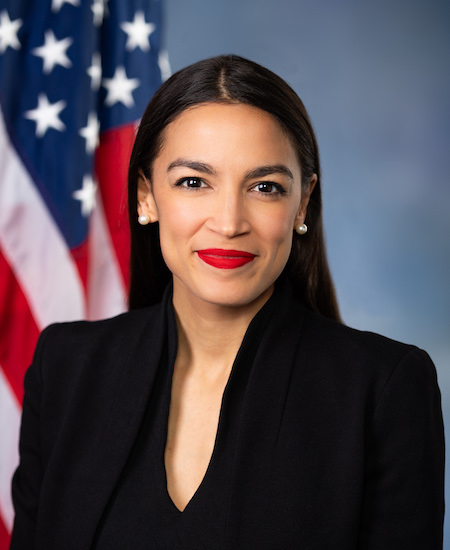
Rep. Alexandria Ocasio-Cortez
Sponsored bills
Maddy summaryThis bill requires federal agencies that use or fund complex computer systems (like AI or machine learning algorithms) affecting government programs, economic opportunities, or protected rights to establish civil rights offices focused on algorithmic bias. These offices must submit detailed biennial reports to Congress on algorithm risks, mitigation steps, stakeholder engagement, and policy recommendations. The law also mandates an interagency working group under the Justice Department to coordinate efforts across agencies. It applies only to covered federal agencies, not private companies, and focuses on creating new reporting requirements rather than directly changing how algorithms operate.
Maddy summaryHRES 1553 is a resolution expressing the House of Representatives' sense that action is needed to address a federal tax exemption under Puerto Rico's Act 22. This provision allows wealthy Americans who do not reside in Puerto Rico to receive 100% exemptions from income and capital gains taxes in Puerto Rico while legally avoiding U.S. federal taxes. The resolution focuses on the tax loophole enabling this arrangement, which the bill claims contributes to housing displacement and price spikes on the island. It does not change tax law but urges the House to act on this issue. (Note: As a resolution, it is procedural and not a binding legislative measure.)
Maddy summaryThe VA Employee Fairness Act of 2024 modifies collective bargaining rules for employees of the Veterans Health Administration (VHA). It removes existing subsections (b), (c), and (d) from the law governing VHA employee bargaining and renumbers the remaining provision. This change streamlines the collective bargaining framework but does not alter the Secretary of Veterans Affairs' existing authorities over incentive pay and expedited hiring. The bill directly affects VHA employees by changing how their collective bargaining rights are structured under federal law. The law remains neutral, focusing solely on procedural adjustments to the existing bargaining framework.
Maddy summaryThis bill establishes minimum safety standards for railroad bridges and requires railroad carriers to provide detailed inspection reports classifying bridges as poor, fair, or good condition, including repair timelines and costs for bridges in poor condition. It mandates railroad carriers to post visible signs identifying bridge ownership and a contact number for public safety concerns, and creates a public database showing basic bridge condition information without detailed technical specifications. The bill also establishes a safety concern reporting system for the public and authorities, and requires the Department of Transportation to conduct randomized bridge inspections to verify reported conditions. Railroad carriers that fail to meet safety requirements face civil penalties, including weekly fines for continued operation of unsafe bridges.
Maddy summaryHR 9982 creates a dedicated Office of Children’s Health Protection within the EPA to address environmental risks affecting children. The office, led by an EPA-appointed director, will assess health threats like pollution or chemicals that disproportionately impact infants, children, and adolescents, and coordinate federal efforts to reduce these risks through policy, research, and school health programs. It establishes a permanent advisory committee to guide the EPA and requires $7.8 million annually for the office plus $13.2 million for the committee through 2029. The bill directly affects children’s health by mandating EPA action on environmental hazards through specific programs, not by changing existing regulations or creating new taxes.
Maddy summaryThe Stop Wall Street Looting Act targets private equity fund practices that harm workers and communities by imposing new restrictions and accountability measures. It establishes joint liability for private equity firms and their executives for debts and worker protections when they acquire companies, limiting post-acquisition dividends and buybacks for four years. The bill also imposes a 100% surtax on certain payments received by investment firms from controlled target firms and requires new transparency about fund activities, including detailed financial disclosures. It strengthens worker protections in bankruptcy cases by prioritizing unpaid wages, severance pay, and pension benefits over other creditor claims. These provisions aim to prevent private equity firms from stripping assets and leaving workers and communities bearing the costs when investments fail.
Maddy summaryHRES 1525 is a non-binding resolution calling for the U.S. government to address policies contributing to forced migration and displacement. It urges reforms such as overhauling economic sanctions, investing in developing countries to reduce poverty and instability, and reforming trade agreements to protect workers. The resolution also calls for expanding legal immigration pathways, improving asylum processing, and creating a roadmap to citizenship for immigrants living in the U.S. As a resolution, it does not create new laws but sets policy priorities for future legislative action.
Maddy summaryHR 9878, the No Shame at School Act of 2024, requires schools to automatically certify students from households with unpaid meal fees for free or reduced-price meals (instead of allowing discretion), and mandates retroactive reimbursement for past unpaid meals. It directly affects school districts and students in households owing meal fees by prohibiting stigmatizing practices like special tokens, public lists of names, or withholding grades due to unpaid fees. Key provisions ban schools from physically segregating students, using debt collectors, or taking food away from students who owe fees, while requiring clear communication to households about meal applications. The bill defines "covered child" as any student enrolled in a participating school meal program whose household owes fees or is eligible for free/reduced meals.
Maddy summaryThis bill eliminates a tax credit for using carbon dioxide (CO2) in enhanced oil recovery (EOR) operations. It amends the Internal Revenue Code by removing Section 43 (the EOR credit) and modifying Section 45Q to prohibit the credit for new facilities starting construction after the law's enactment. The primary effect is ending the federal tax incentive for oil companies that inject CO2 to extract more oil from existing wells. This change directly affects oil and gas companies planning new EOR projects using CO2, as they will no longer qualify for this specific tax credit.