Therapeutic Fraud Prevention Act of 20 21 This bill prohibits commercial conversion therapy, which is a practice or treatment designed to change a person's sexual orientation or gender identity or otherwise change behaviors, thoughts, or expressions related to gender or sexual attraction. This prohibition does not apply to treatment that assists an individual undergoing a gender transition or facilitates identity exploration and development.
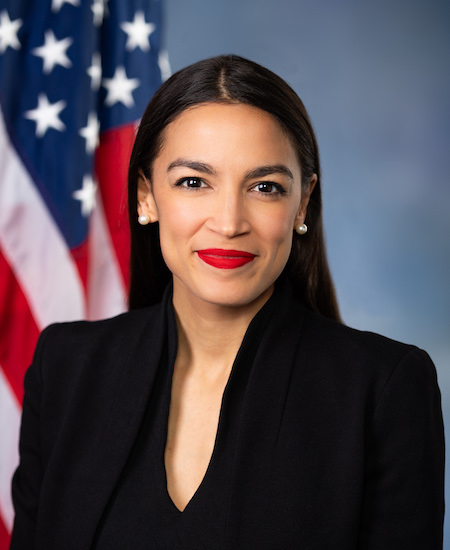
Rep. Alexandria Ocasio-Cortez
Sponsored bills
Saving Hazardous And Declining Environments Act or the SHADE Act This bill requires the Department of Housing and Urban Development to award grants for government entities and nonprofit organizations to plant trees in low-income communities and in communities meeting designated minority or limited English-proficiency thresholds.
Healthy Future Students and Earth Pilot Program Act of 2021 This bill establishes a pilot program for providing 100% plant-based food and milk options in school meals. The Department of Agriculture must award up to 50 grants to school food authorities. Recipients may use funds for activities including training food service personnel on serving 100% plant-based options and covering additional costs of buying plant-based foods and milks.
Vanessa Guillén Military Justice Improvement and Increasing Prevention Act This bill modifies the process and policy related to the disposition of charges and convening of courts-martial for certain sexual assault cases and other specified offenses under the Uniform Code of Military Justice (UCMJ). Among other elements, the bill provides that the determinations on the preferral, disposition, and referral of charges for specified offenses under the UCMJ must be made by a commissioned officer of the Armed Forces who is designated as a court-martial convening authority (in grade O-6 or higher) and who is available for detail as trial counsel, has significant trial experience, and is outside the chain of command of the member subject to the charges.
Municipal IDs Acceptance Act This bill directs financial regulatory agencies to update specified guidance to include municipal identification cards as acceptable forms of identification for purposes of verifying the identity of a bank customer.
Puerto Rico Self-Determination Act of 2021 This bill establishes a process for the people of Puerto Rico to vote on the political status (e.g., statehood) of the territory. Congress may ratify the decision through a joint resolution. The bill declares that the legislature of Puerto Rico has the authority to call a status convention regarding the political status of the territory. The bill provides for public financing of delegate elections to the status convention and establishes a Congressional Bilateral Negotiating Commission to provide advice and consultation to delegates of the status convention. The status convention must provide self-determination options for a referendum of the people of Puerto Rico. Ranked-choice voting is a permitted format for the referendum. Delegates shall carry out an educational campaign through traditional paid media related to the referendum. The bill provides for congressional consideration of a joint resolution to ratify the self-determination option selected through the referendum.
Territorial Equity Act of 2021 This bill alters provisions relating to the treatment of U.S. territories under Medicaid, Medicare, Medicare Advantage, the Supplemental Security Income (SSI) program, and other federal assistance programs. The bill modifies provisions under several health care programs with respect to U.S. territories. Among other changes, the bill eliminates Medicaid funding limitations for U.S. territories beginning in FY2022, repeals provisions that exclude residents of Puerto Rico from a certain automatic enrollment process for Medicare medical services, establishes minimum criteria for certain elements used in Medicare Advantage payment calculations for areas within U.S. territories, and allows residents of U.S. territories who are unable to obtain health insurance through their employer or a health insurance exchange to instead obtain coverage that is at least as broad as the coverage available to Members of Congress and their staff through the District of Columbia exchange. The bill also modifies provisions under other federal assistance programs. Among other changes, the bill allows Puerto Rico, American Samoa, and the Northern Mariana Islands to participate in the Supplemental Nutrition Assistance Program (SNAP, formerly known as the food stamp program); makes residents of Puerto Rico eligible for the federal earned income tax credit; and extends the SSI program to Puerto Rico, Guam, the Virgin Islands, and American Samoa.

Philippine Human Rights Act This bill imposes limitations on providing assistance to the police or military of the Philippines. No federal funds may be used to provide such assistance until the Philippines government has taken certain actions, including (1) investigating and successfully prosecuting members of its military and police forces who have violated human rights, (2) withdrawing the military from domestic policing activities, and (3) establishing that it effectively protects the rights of journalists and civil society activists. The President shall also direct U.S. representatives at multilateral development banks to vote against providing loans to the police or military of the Philippines.
Pink Tax Repeal Act This bill prohibits product manufacturers or service providers from selling substantially similar products at different prices based on the gender of the intended purchaser. If, for example, the only difference between two products is the color, they are substantially similar. The bill provides authority for the Federal Trade Commission and state attorneys general to enforce these requirements.
Stronger Communities through Better Transit Act This bill requires the Department of Transportation to establish a grant program to support operating projects for public transportation (e.g., service expansion) and related capital improvements, particularly in underserved communities and areas of persistent poverty.