

Maddy summaryThe Loan Forgiveness for Educators Act would provide full student loan forgiveness to educators who work in high-need schools or early childhood education programs. After completing 5 years of qualifying service, educators would have 100% of their outstanding student loans forgiven, with the option for monthly loan forgiveness during their service period. The bill defines "high-need schools" as those with over 30% of students in poverty or identified for improvement, and includes special provisions for educators working in Native American, Tribal, and Bureau of Indian Education schools. Educators could count service completed before the law's enactment toward their 5-year requirement, and the program would cover both FFEL and Direct Loan programs.
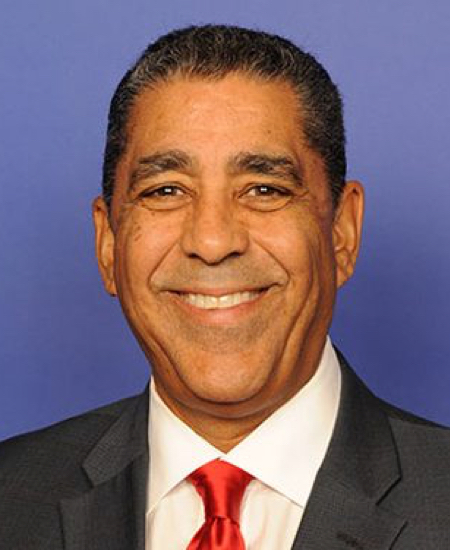
Rep. Adriano Espaillat
Sponsored bills
Maddy summaryHR 1716, the Global Aircraft Maintenance Safety Improvement Act, requires U.S. airlines to annually report detailed information about heavy maintenance work performed outside the U.S. on their aircraft, including locations, work descriptions, and any safety issues identified after maintenance. It prohibits U.S. airlines from entering new contracts for such maintenance with repair stations in countries classified by the FAA as "Category 2" due to safety deficiencies. The bill also mandates that mechanics and supervisors at foreign repair stations performing heavy maintenance on U.S. aircraft must hold appropriate FAA certifications. Additionally, it establishes a working group with international aviation authorities to review and recommend improvements for overseeing foreign repair stations.
Maddy summaryThis resolution (HRES 242) is a non-binding congressional recognition honoring Roberto Clemente's legacy as a baseball legend and human rights advocate. It specifically acknowledges his historic achievements as the first Latino MLB star to win a World Series as a starter, MVP, and Hall of Fame inductee, while highlighting his activism against racial discrimination and humanitarian work, including aid efforts in Nicaragua after an earthquake. The resolution urges Major League Baseball to permanently retire his jersey number 21 and expand Roberto Clemente Day to require all players and staff to wear number 21 annually. As a symbolic resolution, it does not create new law or policy but formally commemorates Clemente's impact on baseball and social justice.
Maddy summaryHRES 157 is a symbolic resolution recognizing the Dominican community's historical presence and contributions to Washington Heights and Inwood in New York City. It highlights their long-standing role in founding cultural organizations (like Casa Dominicana and the Dominican Day Parade), supporting local businesses, and shaping the neighborhood through arts, education, and civic engagement. The resolution expresses support for designating a Dominican cultural heritage district under the National Park Service and calls for preserving this history. As a non-binding statement, it does not create new laws but formally acknowledges the community's impact on the area's identity and development.
Maddy summaryThis bill prohibits colleges receiving federal funds from discriminating against "Dreamer students" in admissions, enrollment, or tuition rates. It requires institutions to treat eligible Dreamers (those meeting specific immigration criteria, like DACA recipients or long-term residents) the same as in-state students for tuition and admissions, and strictly protects their immigration information from disclosure. The bill also allows Dreamers to access federal financial aid for higher education, reversing a 1996 prohibition. These changes apply to all institutions of higher education receiving federal funding.
American Families United Act This bill authorizes the Department of Homeland Security (DHS) or the Department of Justice (DOJ) to exercise discretion in certain immigration cases. Under this bill, DOJ or DHS may, on a case-by-case basis, exercise discretion by declining to remove a non-U.S. national ( alien under federal law) or bar an alien from entering the United States to prevent hardship for the alien's U.S. citizen spouse, parent, or child. This discretion may also be exercised if the alien is the spouse or child of a deceased U.S. citizen. For the purposes of this bill, it shall be presumed that family separation constitutes hardship. However, DOJ or DHS may not exercise this discretion if the alien is removable or inadmissible due to certain grounds, including specified crime- and security-related grounds. This exercise of discretion may be applied to an alien who was ordered removed or denied entry prior to this bill's enactment if the alien files a motion to reopen or reconsider within two years of this bill's enactment.
Maddy summaryHR 1723, the Abortion is Health Care Everywhere Act of 2023, amends the Foreign Assistance Act to remove restrictions on using U.S. foreign aid funds for abortion services. It explicitly allows U.S. foreign assistance programs to fund comprehensive reproductive health care, including abortion services, training, and equipment. This change directly affects U.S. international health programs and recipient countries, enabling them to integrate safe abortion care into broader reproductive health services. The bill aims to align U.S. policy with global health guidelines by making abortion services a standard part of reproductive health care funded through foreign assistance.
Maddy summaryThis bill modifies federal highway funding rules to prioritize safety for cyclists and pedestrians. It allows states and local governments to receive 100% federal funding for projects that connect existing bike/pedestrian infrastructure or reduce safety risks for these users, instead of the usual lower federal share. The bill also requires projects to align with state safety plans focusing on vulnerable road users and includes specific "Proven Safety Countermeasures" for cyclists/pedestrians. These changes directly affect states administering federal highway funds and local governments seeking to improve non-motorized transportation infrastructure.
Maddy summaryHR 1349 establishes the African Burial Ground International Memorial Museum and Educational Center at the National Historic Landmark site in Lower Manhattan, New York City, which contains the remains of up to 20,000 enslaved Africans and early African Americans. The bill directs the National Park Service to acquire adjacent land (with federal funding covering two-thirds of costs), design, and operate the museum to honor enslaved individuals buried there, explore slavery's history, and examine African cultural traditions brought to the U.S. The museum will partner with the National Museum of African American History and Culture and be overseen by an advisory council including New York City and State officials. This legislation directly affects the National Park Service, the City of New York, and the Smithsonian Institution through its operational framework and funding authorization.
Maddy summaryThe Outdoors for All Act establishes a federal grant program to fund outdoor recreation projects in underserved communities. It authorizes the Secretary of the Interior to award grants to eligible entities (like states, cities, tribal organizations, or nonprofits) for acquiring land, developing parks, or renovating outdoor facilities in qualifying urban areas (population 25,000+ or tribal lands) or low-income communities (where 30%+ of residents have incomes at or below 80% of local median income or 200% of the federal poverty line). Grants require a 100% cash or in-kind match (with limited waivers), prohibit funding for indoor facilities or maintenance, and prioritize projects enhancing park access, engaging youth, creating jobs, or improving environmental benefits like reducing urban heat islands. The program mandates annual reporting and focuses on concrete community outcomes rather than speculative results.