

Maddy summaryHRES 455 is a symbolic House resolution expressing support for Black service members who died protecting the U.S. during military conflicts while facing racism in the Armed Forces and systemic inequities. It acknowledges their historical contributions and struggles, citing examples from the Revolutionary War through the Global War on Terror. The resolution has no legislative effect - it solely affirms recognition on Memorial Day without proposing policy changes or requiring action. As a non-binding resolution, it directly affects public acknowledgment of this group but does not alter military policies or address systemic issues.
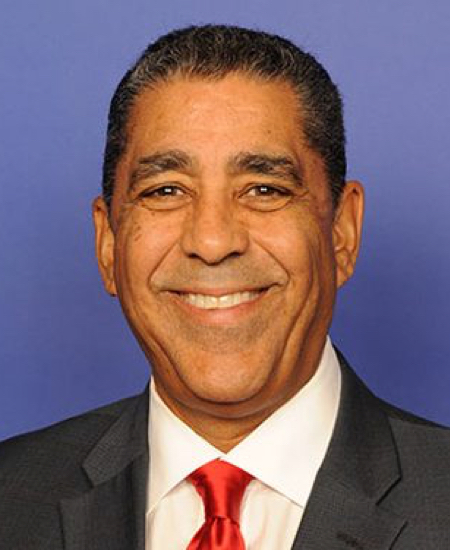
Rep. Adriano Espaillat
Sponsored bills
American Aviation Diversity Act This bill authorizes appropriations for the Federal Aviation Administration's Minority Serving Institutions (MSI) Intern Program. (This program is open to all eligible undergraduate and graduate college students who attend an accredited college or university. A focus of the MSI intern program is providing opportunities to eligible students from groups that have been underrepresented in aviation, aeronautics, and science, technology, engineering, or mathematics (STEM), such as African Americans, Asian Americans and other Pacific Islanders, Hispanics, Native Americans, Native Hawaiians or other Pacific Islanders, persons with disabilities, student veterans, and women.)
Maddy summaryThe Cady Housh and Gemesha Thomas Student Suicide Prevention Act of 2023 requires states to establish a policy mandating annual suicide prevention training for school staff and high school students (grades 9-12). The training must be evidence-based, cover recognizing suicide warning signs, appropriate responses, and referrals to mental health services, while including cultural competency. It allocates $48 million in federal funds, with at least 15% dedicated to supporting this training program, and requires states to collaborate with mental health experts. The bill directly affects school staff and high school students in states that adopt the policy and receive federal funding.
Maddy summaryHR 3607, the SYLLABLE Act of 2023, creates a federal grant program to fund high-quality dual language immersion programs for students from low-income families, English learners, and minority children. It authorizes up to $15 million in funding for fiscal year 2024 to award no more than five grants to local educational agencies, requiring partnerships between schools, early childhood programs, and technical assistance providers. The grants support bilingual programs from preschool through fifth grade that use the partner language for at least half of instruction, include teacher training in dual language teaching, and measure student progress in both English and the partner language. The program must serve high-need schools and evaluate outcomes like literacy development, academic achievement, and program effectiveness over five years.
Maddy summaryHR 3606 (FLUENT Act) creates a federal grant program to expand family literacy services for English language learner families, targeting caregivers with limited English proficiency. It authorizes $50 million annually (2024-2028) for grants up to $1 million each to organizations providing research-based programs that include interactive caregiver-child literacy activities, adult education, and school collaboration. The program requires grantees to improve children's English language skills, primary language literacy, and caregivers' ability to support education, with measurable outcomes tracked across seven key areas. It prioritizes "hardest-to-reach" families and mandates services for children under age 8 with caregivers aged 16+.
Maddy summaryHR 3605, the Reaching English Learners Act, creates a new federal grant program to improve teacher preparation for educators working with English learners. The bill authorizes competitive grants to partnerships between colleges and school districts (high-need local educational agencies or early childhood programs) to develop or strengthen teacher training programs. These grants fund evidence-based strategies like bilingual education and dual-language instruction, clinical classroom experiences with English learners, and training on supporting students with disabilities who are English learners. Partners must contribute 50% of costs from non-Federal sources and track outcomes like teacher certification rates and employment in high-need schools. The program aims to ensure future teachers meet state requirements to effectively support English learners in early childhood, elementary, and secondary education.
Maddy summaryHR 3610, the Neighbors Not Enemies Act, repeals specific sections (4067-4070) of the Alien Enemies Act of 1798 from U.S. law. This bill removes the legal authority allowing the president to detain or deport non-citizens during wartime based on that historical statute. The repeal directly affects the federal legal framework governing emergency powers over non-citizens, eliminating a provision dating to the Quasi-War with France. The bill makes no new policy changes but formally removes this outdated legal mechanism from the U.S. Code.
Maddy summaryThe AIR PUMP Act requires airlines to provide nursing crew members (like flight attendants and pilots) with reasonable break time to express breast milk for up to one year after their child's birth, as well as a private, non-bathroom space for this purpose. It specifically excludes breaks during critical flight phases and ensures accommodations won't compromise safety, security, or require significant costs (e.g., aircraft modifications). The bill includes anti-retaliation protections for employees who request accommodations or file complaints, and enforces these requirements through the Department of Labor using existing Fair Labor Standards Act mechanisms. This directly affects airline employees who are nursing parents and their employers, aligning airline workplace policies with federal breastfeeding protections.
Maddy summaryHCONRES 47 is a non-binding resolution urging the U.S. Senate to provide "advice and consent" for ratifying the UN Convention on Biological Diversity (CBD), which the U.S. signed in 1993 but has never ratified. Currently, the U.S. participates only as an observer in CBD negotiations without voting rights, limiting its influence on global biodiversity policies that affect national security and economic interests. The resolution notes the U.S. is already legally compliant with the CBD’s obligations under existing law and is a top international conservation funder. It argues that ratification would restore U.S. voting power and alignment with global efforts to address biodiversity loss, which impacts all Americans.
This resolution encourages the U.S. Holocaust Memorial Museum to continue its work in educating the public about the dangers of antisemitism and the origins of the Holocaust, congratulates those responsible for the creation of the museum, condemns antisemitism, supports educational and community-based programs that counter antisemitism and hate, and supports the designation of a U.S. Holocaust Memorial Museum Day.