

Maddy summaryHCONRES 75 is a non-binding resolution expressing Congress's support for issuing a new commemorative postage stamp honoring the Buffalo Soldiers. It directly affects the U.S. Postal Service by urging the Citizens’ Stamp Advisory Committee to recommend such a stamp to the Postmaster General. The resolution highlights the historical significance of the Buffalo Soldiers - African American soldiers who served in all-Black regiments from 1866 to 1948 - and references a previous 1994 stamp that was discontinued. It does not create a new law but formally requests the Postal Service consider this commemoration.
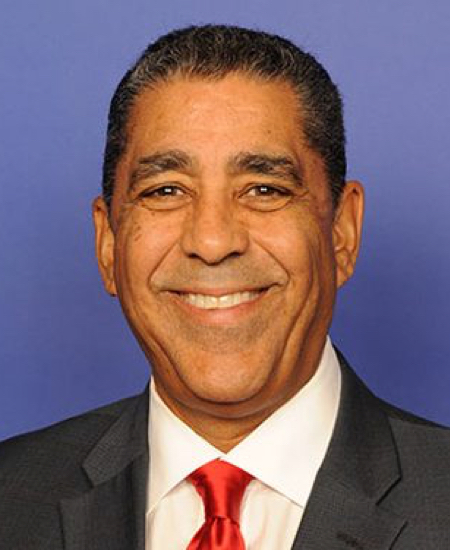
Rep. Adriano Espaillat
Sponsored bills
This concurrent resolution recognizes the difficult challenges Black veterans faced when returning home after serving in the Armed Forces, their heroic military sacrifices, and their patriotism in fighting for equal rights and for the dignity of a people and a nation. The concurrent resolution also recognizes the need for the Department of Veterans Affairs to continue to work to eliminate any health and benefit disparities for minority veterans.
Maddy summaryThe Advanced Coursework Equity Act aims to increase access to advanced courses like AP, STEM programs, and Algebra I for students in under-resourced schools, particularly focusing on historically underrepresented groups including Black, Latino, Native American students, students with disabilities, English learners, and low-income students. The bill establishes a federal grant program requiring states and schools to implement either "open enrollment" (allowing any student to enroll in advanced courses without academic prerequisites) or "universal screening" (systematically screening all students for advanced courses based on objective measures) to improve equitable access. It mandates data collection and reporting on enrollment and performance by student subgroups (race, disability, socioeconomic status, etc.) and sets specific 3-year equity goals for each subgroup. The grant program provides funding to states and schools to support these changes, with requirements for staff training, advisory councils, and communication with families about advanced course opportunities.
Maddy summaryThis bill would authorize the U.S. government to confiscate Russian sovereign assets held in U.S. jurisdiction and use those funds to support Ukraine's reconstruction and humanitarian needs following Russia's invasion. It prohibits releasing these blocked assets until Russia fully compensates Ukraine or agrees to an international compensation mechanism. The bill establishes a "Ukraine Support Fund" to hold confiscated assets and requires regular congressional reporting on how these funds are allocated for Ukraine's recovery. It also includes provisions for international coordination with allies on sanctions and asset management related to Russia's invasion of Ukraine.
Maddy summaryThe SMOKE Act establishes new federal workplace safety standards to protect employees from wildfire smoke exposure. It requires employers to monitor PM2.5 air quality (AQI ≥151), implement engineering controls (like filtered buildings), provide respirators, and communicate risks when smoke levels are hazardous. Employees at risk of health harm from smoke can take up to 12 weeks of unpaid leave per year, with job protection upon return. The law excludes emergency responders and workplaces with certified filtered air systems (e.g., closed vehicles or buildings with filtered ventilation). OSHA must finalize these standards within 42 months of enactment.
Maddy summaryHR 6172, the AMMO Act, requires federal firearms licensees (dealers/manufacturers) to implement new rules for selling ammunition to non-licensed buyers. It prohibits transfers exceeding 100 rounds of .50 caliber or 1,000 rounds of other calibers within any 5-day period and mandates written certification from buyers confirming they haven’t exceeded these limits. Licensees must also conduct background checks through the National Instant Criminal Background Check System (NICS) before selling ammunition to non-licensed individuals, similar to firearm sales. The bill includes recordkeeping, signage, and reporting requirements for violations, with penalties including fines up to $250,000 for licensees and $50,000 for buyers making false statements.
Maddy summaryThis bill creates a tax credit for video distributors (like cable or streaming companies) that carry content from independent programmers meeting specific criteria. Distributors earn a credit up to $0.30 per subscriber for new or expanded carriage agreements reaching at least 40% of subscribers, based on license fees paid to qualifying creators. The credit applies only to content from small, independent creators (not owned by large media companies, publicly traded firms, or networks). The FCC must submit biennial reports tracking how many independent programmers benefit from this policy, including average carriage duration.
Maddy summaryThe Streamline Emergency Care Act provides $20 million annually (2024-2028) for grants to nonprofit hospitals and clinics already operating emergency rooms. Grants, capped at $500,000 each, fund hiring staff, purchasing modern equipment, or training existing personnel to improve ER capacity and efficiency. The program requires grantees to use funds solely for these operational improvements and mandates a congressional report on the program's effectiveness by 2027. This directly affects eligible nonprofit emergency care providers seeking to enhance their facilities' responsiveness.
Maddy summaryHR 5976, the Youth Mental Health Research Act, establishes a new NIH research initiative led by the National Institute of Mental Health. The bill directs collaboration between three NIH institutes to coordinate research on youth mental health, focusing specifically on building community resilience for at-risk youth and improving how mental health services reach young people in schools, communities, and other settings where they live and work. It authorizes $100 million annually for fiscal years 2024 through 2028 to fund this research. The bill does not create direct services but aims to generate evidence to inform future mental health support strategies for young people.
Maddy summaryHR 6201, the Iranian Sanctions Enforcement Act of 2023, creates the Iran Sanctions Enforcement Fund to cover costs related to seizing and forfeiting property from Iran or its designated proxies (like Hezbollah or the Revolutionary Guard Corps) that violate U.S. sanctions. The fund, initially $150 million, pays for investigative costs, property management, informant rewards, and equipment for federal, state, and local agencies involved in enforcement. It also establishes an Export Enforcement Coordination Center within Homeland Security to improve interagency cooperation on enforcing export controls targeting Iran. The bill requires annual reports on fund usage and mandates repayment of the initial $150 million by 2034, unless waived for national security reasons.