

Maddy summaryThe Stronger Communities through Better Transit Act establishes a new federal grant program to improve public transportation service. It provides funding to urban areas, states, and Indian tribes to cover up to 50% of public transit operating costs (up to 80% in persistent poverty areas and 100% for Indian tribes), with requirements to report on service frequency, access to jobs, and conduct community surveys. The program mandates that a majority of funds must benefit underserved communities and areas of persistent poverty, defined as census tracts with high poverty rates or minority populations. Recipients must maintain their transit funding levels and report on improvements in access to essential services. The bill authorizes $20 billion annually for fiscal years 2024-2027.
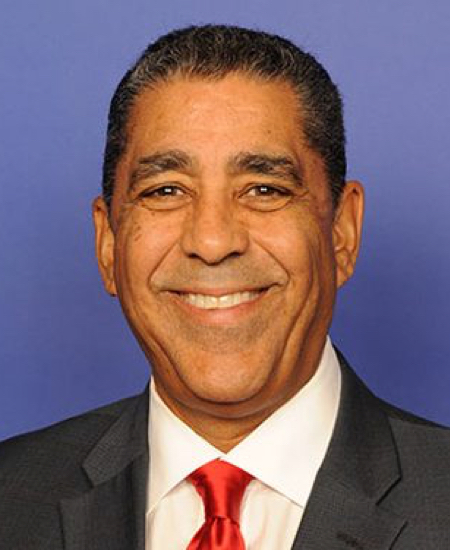
Rep. Adriano Espaillat
Sponsored bills
Maddy summaryThis resolution commemorates the 60th anniversary of President Johnson's 1964 War on Poverty declaration and acknowledges its historical achievements, such as creating Medicare, Medicaid, and SNAP, alongside its shortcomings. It specifically notes the War on Poverty's failure to adequately address fair employment, workforce preparation, and racial disparities in poverty, while recognizing that current antipoverty policies have not adapted to today's challenges. The resolution is purely symbolic, with no new policy requirements, and urges continued efforts to address poverty through existing frameworks.
Maddy summaryThe Transit Emergency Relief Act (HR 7012) amends federal transportation law to provide more flexible funding for public transit agencies facing emergencies. It allows funds designated for emergency relief (under 49 U.S.C. § 5324) to remain available until spent, be used for prior or current fiscal years, and not reduce existing funding. The bill also increases annual funding caps for transit programs and adds $50 million per year (2024-2027) specifically for this emergency relief program. Public transportation agencies receiving federal grants are directly affected, as the changes simplify access to funds during crises while requiring compliance with labor standards (49 U.S.C. § 5333). This creates more predictable support for transit systems recovering from unexpected disruptions.
Maddy summaryThis bill restores visa eligibility for immigrants who had diversity visas allocated for fiscal years 2017-2022 but were denied entry due to specific travel restrictions (like Executive Orders 13769/13780 or related proclamations) or pandemic-related delays. The State Department must notify affected individuals within 90 days of the bill’s enactment, giving them one year to confirm they wish to proceed with their visa applications. Unused visas from those years can be reallocated without counting against current annual limits, and applicants who fail to respond or are denied for standard reasons (like education requirements) lose eligibility. The policy directly affects individuals impacted by these specific past barriers to immigration.
Maddy summaryHRES 967 would amend House rules to allow Members who have recently given birth to vote by proxy for up to six weeks after childbirth. Specifically, a new rule permits a Member to designate another Member as their proxy during this period to cast votes on their behalf. The proxy cannot be used to count the Member's presence for quorum purposes in the House or its committees. This change directly affects female Members during their postpartum leave, with no other proxy voting allowed under the amendment.
Maddy summaryHRES 963 is a symbolic resolution honoring Korean American Day, which commemorates the January 13, 1903 arrival of the first large wave of Korean immigrants to the U.S. It recognizes Korean Americans' contributions to U.S. society, including their economic, cultural, and military impacts, and marks the 121st anniversary of this historic migration. The resolution urges all Americans to observe Korean American Day to appreciate these contributions. As a commemorative measure, it does not create new policies or affect specific groups beyond this ceremonial recognition.
Maddy summaryThe Affordable Connectivity Program Extension Act of 2024 allocates $7 billion in funding for the Affordable Connectivity Program (ACP) during fiscal year 2024. The ACP provides subsidies to low-income households to help cover the cost of internet service and connected devices like laptops or tablets. This funding ensures the program can continue supporting eligible households throughout the year, with the money remaining available until fully spent. The bill extends existing program funding without changing eligibility criteria or service requirements.
Maddy summaryHR 6905, the Building Collapse Prevention Act, requires the Department of Housing and Urban Development (HUD) to establish a program where the National Institute of Standards and Technology (NIST) inspects buildings containing federally assisted rental housing after specific safety events. It directly affects residents in housing funded by federal programs like public housing (under the 1937 Housing Act), Section 8 rental assistance, and supportive housing for the elderly or disabled. The law mandates NIST inspections following local safety violations that could cause collapse or after a building collapse occurs, to identify structural issues. This creates a formal process for evaluating safety risks in vulnerable federally supported housing units.
Maddy summaryThis bill designates the U.S. Postal Service facility at 86 Main Street in Haverstraw, New York, as the "Paul Piperato Post Office Building." It updates all official references in federal law, maps, and documents to reflect this new name. The bill does not change postal services, funding, or affect any specific group of people; it solely modifies the facility's official designation. This is a routine naming resolution with no substantive policy provisions.
Maddy summaryThis bill amends the Higher Education Act to require colleges and universities receiving federal student aid to collect and report hate crime data in more detailed categories. Specifically, it mandates that institutions disaggregate hate crime statistics by specific subcategories, including anti-Semitism, Islamophobia, homophobia, biphobia, transphobia, disability bias, and targeted ethnic groups. The policy directly affects all institutions covered under the Higher Education Act by changing how they document and disclose campus hate incidents. This change aims to provide more precise data on hate crimes targeting specific identities, improving transparency in campus safety reporting.