

Maddy summaryThis bill strengthens the Voting Rights Act of 1965 by clarifying how to prove voting discrimination and expanding requirements for preclearance of voting changes. It establishes new standards for determining when voting practices dilute minority voting strength or deny/abridge voting rights, requiring plaintiffs to show specific conditions for vote dilution claims and including factors like historical discrimination and racial polarization in court analyses. The bill modifies the criteria for determining which states and political subdivisions must seek preclearance for voting changes, and adds new transparency requirements for jurisdictions to publicly disclose changes to voting qualifications, polling locations, and election districts. It directly affects states and local governments that implement voting policies, particularly those with a history of voting rights violations or that make changes to voting qualifications, procedures, or district boundaries. The bill aims to prevent discriminatory voting practices by providing clearer standards for courts and requiring greater transparency in voting rule changes.
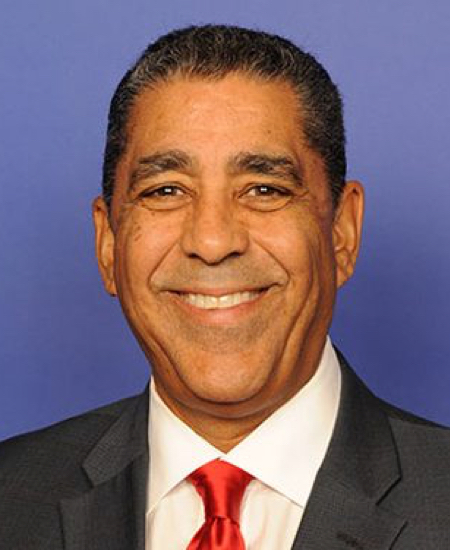
Rep. Adriano Espaillat
Sponsored bills
Maddy summaryThe Richard L. Trumka Protecting the Right to Organize Act of 2025 strengthens workers' organizing rights by making it an unfair labor practice for employers to threaten permanent replacement of striking workers, discriminate against workers who support unions, or require employees to attend employer campaigns unrelated to their job duties. It expands the definition of "employee" to make it harder for companies to classify workers as independent contractors and requires employers to post notices about workers' rights in conspicuous locations. The bill establishes a new electronic voting system for union elections, creates a 90-day bargaining period before mediation can be requested, and increases penalties for violations of labor laws. These changes are intended to make it easier for workers to form unions and negotiate better wages and working conditions.
Maddy summaryThis bill directs the State Department to review restrictions on U.S. citizens traveling to North Korea, particularly focusing on humanitarian visits for Americans with relatives there (estimated at 100,000 people). It requires the Secretary of State to submit a report within 180 days detailing how the U.S. will pursue a formal end to the Korean War through diplomatic negotiations with North and South Korea. The bill also mandates a separate report outlining a clear roadmap for achieving a binding peace agreement, including necessary negotiation steps and key stakeholders. These provisions aim to address the ongoing state of war, which the bill states prevents formal U.S.-North Korea relations and family reunifications.
Maddy summaryHR 1835 (MERIT Act) provides reinstatement or compensation to federal employees who were terminated during a specific mass layoff period (January 20, 2025, through the bill’s enactment date). Affected probationary employees - newly hired workers on a trial period or not yet permanent - can choose to return to a similar position with matching benefits or receive a lump-sum payment covering the pay difference between their terminated role and any new federal job they held during the layoff period. Agencies must notify affected employees within 30 days and offer reinstatement or payment within 90 days, with employees required to accept or decline within 30 days to avoid losing eligibility. The bill defines "mass termination" as 15+ separations in a 30-day period by a single agency.
Maddy summaryHR 1840, the "Closing the De Minimis Loophole Act," ends the duty-free exemption for small shipments under $800 entering the U.S., directly affecting importers and e-commerce businesses, especially those shipping goods from China. It requires importers to provide detailed Harmonized Tariff Schedule (HTS) codes (up to 10 digits) for certain goods and mandates new documentation rules to ensure accurate duty collection. The law takes immediate effect for China-origin goods and applies to all other countries 120 days after enactment. The bill also requires the Treasury Department to create new regulations for enforcing these changes and handling postal shipments.
Maddy summaryHRES 181 is a symbolic resolution recognizing Black History Month by highlighting the historical and ongoing contributions of Black labor to the U.S. economy and society. It commemorates Black labor from slavery through modern times, including agricultural work, unionization efforts (like A. Philip Randolph’s Brotherhood of Sleeping Car Porters), and contemporary issues like the racial wage gap (where Black workers earned $878 weekly vs. $1,059 for others in 2023). The resolution does not create new laws or policies but formally acknowledges these contributions to raise public awareness. It is sponsored by 70+ House members and aligns with the 2025 Black History Month theme focused on "African Americans and Labor." As a commemorative resolution, it has no direct effect on individuals or legislation.
Maddy summaryHR 1817, the Arturo Alfonso Schomburg Congressional Gold Medal Act, authorizes a posthumous Congressional Gold Medal in honor of Arturo Alfonso Schomburg, a pioneering collector of African diaspora history. The bill directs the Treasury Secretary to strike the medal and present it to the National Museum of African American History and Culture at the Smithsonian Institution for permanent display. It also permits the sale of bronze duplicates to cover costs, with proceeds deposited into the U.S. Mint fund. This is a commemorative act with no direct impact on current laws or individuals, solely recognizing Schomburg's legacy in preserving Black historical contributions.
Maddy summaryHR 1787 authorizes the U.S. Mint to produce commemorative coins honoring baseball legend Roberto Clemente, including $5 gold, $1 silver, and half-dollar coins, with specific specifications for weight, size, and metal content. The bill requires the coins to feature Clemente's image and commemorative inscriptions, and mandates a surcharge ($35 for gold, $10 for silver, $5 for half-dollar) paid to the Roberto Clemente Foundation for its educational, youth sports, and disaster relief programs. All coins must be minted in 2027, sold at face value plus surcharge and production costs, and will be legal tender. The bill focuses solely on the coin program, not broader policy changes.
Safe Schools Improvement Act This bill requires states to direct their local educational agencies (LEAs) to establish policies that prevent and prohibit bullying and harassment of elementary and secondary school students. In particular, these policies must prohibit bullying and harassment based on race, color, national origin, disability, religion, or sex. Sex includes sexual orientation, gender identity, and sex characteristics (including intersex traits). Further, LEAs must provide (1) students, parents, and educational professionals with annual notice of the conduct prohibited in their disciplinary policies; (2) students and parents with grievance procedures that target such conduct; and (3) the public with annual data on the incidence and frequency of that conduct at the school and LEA level. The Department of Education must conduct and report on an independent biennial evaluation of programs and policies to combat bullying and harassment in elementary and secondary schools. The National Center for Education Statistics must collect state data to determine the incidence and frequency of the conduct prohibited by LEA disciplinary policies.
Maddy summaryThis bill amends Section 5(e)(6) of the Food and Nutrition Act of 2008 by removing a reference to "subparagraph (B)" and renumbering the following provisions. It does not change SNAP eligibility rules or benefits; it only adjusts the internal numbering of existing provisions. The change takes effect January 1 following enactment. As a procedural amendment, it directly affects how the law is cited but does not alter policy or impact beneficiaries.