

Maddy summaryHR 2366, the American Families United Act, amends immigration law to expand discretion for the Attorney General and Secretary of Homeland Security regarding family-related cases. It allows them to halt removal proceedings or grant relief for spouses and children of U.S. citizens if removal would cause "hardship" (with family separation presumed to constitute hardship), including special provisions for widows/orphans of deceased citizens. The bill also permits waiving certain inadmissibility grounds and excludes cases involving serious violations like terrorism or criminal offenses. This policy change directly affects noncitizens facing removal proceedings who have U.S. citizen family members, without creating new benefits but modifying existing discretionary authority.
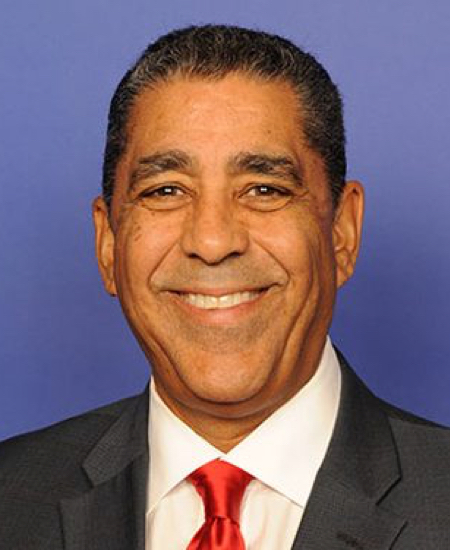
Rep. Adriano Espaillat
Sponsored bills
Maddy summaryThe Paycheck Fairness Act strengthens equal pay protections by expanding the definition of "sex" to include pregnancy, childbirth, sexual orientation, gender identity, and sex characteristics. It modifies employer defenses for pay disparities to require proof that any pay difference is job-related, not based on sex, and accounts for the entire pay gap. The bill prohibits employers from asking about salary history, enhances penalties for violations, and requires employers with 100+ employees to collect and report detailed pay data by race, sex, and job category. It also establishes training programs for employers on eliminating pay bias and creates a National Equal Pay Enforcement Task Force to coordinate enforcement efforts. This legislation directly affects employers, particularly those with 100+ employees, and aims to address pay disparities impacting women, people of color, and other underrepresented groups.
Maddy summaryH.J. Res. 80 would declare the Equal Rights Amendment (ERA) part of the U.S. Constitution, asserting it has been ratified by 38 states (three-fourths of the states) despite the original 1972 deadline. If passed, this resolution would formally establish the ERA as a constitutional amendment, requiring all federal and state laws to align with its gender equality protections. The bill does not create new laws but confirms the ERA's status as part of the Constitution, affecting how laws are interpreted and enforced. It is a procedural step to resolve the legal dispute over the ERA's validity after decades of debate.
Maddy summaryHRES 238 is a non-binding House resolution expressing the House's position that every person has the basic right to emergency health care, including abortion care during medical emergencies. It does not create new laws or alter existing regulations but formally states the House's view that abortion restrictions in emergencies endanger patients' health and lives. The resolution specifically highlights how current abortion bans put pregnant people at risk during life-threatening conditions like hemorrhage or infection, disproportionately impacting Black, Indigenous, people of color, immigrants, and low-income individuals. It serves as a symbolic statement opposing policies that restrict emergency reproductive care access.
Maddy summaryThis bill creates a tax credit for cable, satellite, and internet-based video distributors (like streaming services) that carry content from independent video producers. Distributors can claim a credit equal to the lesser of their actual license fees paid for carrying independent programming or $0.10 per average monthly subscriber, with a maximum of $0.30 per subscriber. It also requires the Federal Communications Commission to submit biennial reports to Congress on how many independent programmers are being carried and for how long, to help assess the program's effectiveness. The credit applies to agreements where distributors carry independent content to at least 40% of their subscribers, targeting small, non-corporate video producers who aren't owned by major networks or distributors.
Maddy summaryThis bill amends the PACT Act to correct an oversight affecting veterans who served in Guam. It specifically adds the period from August 15, 1958, to July 31, 1980, to the eligibility window for veterans who served in Guam (or its territorial waters) and developed diseases linked to herbicide exposure. The change ensures veterans who served in Guam during that specific timeframe are included in the presumption of service connection for such conditions. This directly impacts veterans who served in Guam between 1958 and 1980, who were previously excluded from the PACT Act's benefits due to the original language. The provision updates the legal text to accurately reflect Guam's historical status during that period.
Maddy summaryHR 2111 would exempt premium cigars from certain federal tobacco regulations under the Federal Food, Drug, and Cosmetic Act. It redefines "premium cigar" to include only cigars meeting strict criteria: made entirely of tobacco leaf (no filters, additives, or flavorings), handmade, and weighing over 6 pounds per 1,000 units. This exemption directly affects small, family-owned premium cigar manufacturers, shifting regulatory oversight from federal to state levels as determined by a recent court ruling. The bill cites data showing premium cigars are used primarily by adults (1% of U.S. adults), involve lower health risks than other tobacco products, and are rarely used by youth.
Homes for Every Local Protector, Educator, and Responder Act of 2025 or the HELPER Act of 2025 This bill establishes a program administered by the Department of Housing and Urban Development to provide mortgage assistance to law enforcement officers, elementary and secondary school teachers, firefighters, or other first responders. Specifically, these individuals may be eligible for a first-time mortgage on a primary family residence with no down payment. Instead, the mortgage is subject to a one-time, up-front mortgage insurance premium.
Maddy summaryHR 2129, the "No Round Up Act," repeals outdated provisions from the 1940 Alien Registration Act within U.S. immigration law. It specifically removes requirements for aliens to register, provide fingerprints, and submit forms under sections 261-266 of the Immigration and Nationality Act. This directly affects immigrants who would have been subject to these mandatory registration procedures under the repealed law. The bill eliminates these specific administrative mandates without creating new requirements or altering broader immigration enforcement mechanisms.
Maddy summaryHRES 219 is a resolution recognizing four fellowship programs that support diversity in U.S. foreign affairs careers. These programs - the Charles B. Rangel Graduate Fellowship, Thomas R. Pickering Foreign Affairs Graduate Fellowship, William D. Clarke, Sr. Diplomatic Security Fellowship, and Donald M. Payne International Development Graduate Fellowship - help recruit underrepresented groups, including minority and economically disadvantaged students, for roles in diplomacy and development. The resolution emphasizes that these statutorily mandated programs strengthen national security and foreign policy by building a more diverse workforce for agencies like the State Department and USAID. It also notes these programs have historically drawn from over 500 colleges and all 50 states.