Improving Access to Nutrition Act of 20 21 This bill repeals certain work requirements for the Supplemental Nutrition Assistance Program (SNAP, formerly known as the food stamp program). The requirements apply to able-bodied adults who are ages 18-49 and have no dependent children. Individuals who do not meet certain work requirements are generally prohibited from receiving more than 3 months of SNAP benefits over a 36-month period. Under current law, some of the work requirements under SNAP are temporarily suspended due to COVID-19 (i.e., coronavirus disease 2019).
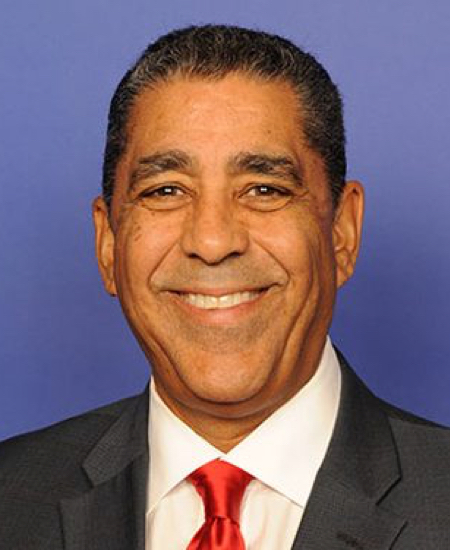
Rep. Adriano Espaillat
Sponsored bills
Safer Neighborhoods Gun Buyback Act of 2021 This bill authorizes the Department of Justice's Bureau of Justice Assistance (BJA) to make grants to states, local governments, or gun dealers to conduct gun buyback programs. The BJA may distribute smart prepaid cards for use by a state, local government, or gun dealer to compensate individuals who dispose of firearms. Additionally, the bill establishes a new criminal offense for using or accepting a smart prepaid card in the acquisition or transfer of a firearm or ammunition. A violator is subject to a fine, up to two years in prison, or both.
Healthy Maternity and Obstetric Medicine Act or the Healthy MOM Act This bill expands health insurance coverage availability for pregnant individuals. It requires health insurers, health insurance exchanges, and group health plans to offer a special enrollment period to pregnant individuals. The special enrollment period offered by an insurer or exchange must begin when the pregnancy is reported to the insurer or exchange. The special enrollment period offered by a group health plan must begin when the pregnancy is reported to the plan or is confirmed by a health care provider. The bill also makes pregnancy a qualifying life event for the purpose of enrolling in a federal employee health benefit plan. Additionally, a group health plan or health insurer that covers dependents must provide coverage for maternity care to all covered individuals. Any individual who is eligible for Medicaid and is, or becomes, pregnant maintains such eligibility for one year after the end of the pregnancy. The bill revises the range in which a state must establish a maximum level of family income for pregnant women and infants to be eligible for Medicaid. The upper limit of the range is eliminated and the lower limit is set to the level in place on January 1, 2014.
Equity in Neuroscience and Alzheimer's Clinical Trials Act of 2021 or the ENACT Act of 2021 This bill sets out activities and requirements to increase the participation of underrepresented populations in research and clinical trials for Alzheimer's disease and related dementias. Specifically, the National Institute on Aging (NIA) must establish and provide technical assistance to Alzheimer's research centers located in areas with higher concentrations of minority groups. These centers must establish diagnostic and treatment clinics designed to serve minority, rural, and other underserved populations; operate clinical trials; and carry out public outreach to encourage members of minority populations to participate in clinical trials and research. Additionally, the NIA must disseminate information to members of minority populations about participating in clinical trials and take other actions to enhance diversity with respect to the Alzheimer's research that it conducts or supports. The bill also directs the NIA to increase diversity among Alzheimer's researchers by encouraging the participation of individuals who are from groups that are underrepresented in clinical, behavioral, and social sciences.
Green Transportation Act This bill incorporates greenhouse gas emission reduction in various transportation-related planning activities and programs. Specifically, states and metropolitan planning organizations must address greenhouse gas emission reductions and certain other issues (e.g., public health and climate change) in long-range and other planning related to highways and public transportation. The bill also makes reducing carbon dioxide and other greenhouse gas emissions from the transportation system a national goal of the Federal-aid Highway Program. The Department of Transportation (DOT) must establish applicable performance measures and standards related to that goal. Additionally, states and metropolitan planning organizations may use certain funding available through the National Highway Trust Fund to develop standardized models and methodologies to measure and monitor transportation-related greenhouse gas emissions. DOT must collect and organize such models and methodologies in a publicly available clearinghouse and report about them to Congress. Further, DOT must establish a program to fund projects that support the reduction of greenhouse gas emissions from the surface transportation system. As part of this program, DOT must annually evaluate carbon dioxide emissions on public roads and evaluate states' progress in reducing emissions.
Northern Rockies Ecosystem Protection Act This bill designates specified National Forest System lands, National Park System lands, and public lands in Idaho, Montana, Oregon, Washington, and Wyoming as wilderness and as components or additions to existing components of the National Wilderness Preservation System. The Department of the Interior and the Department of Agriculture (USDA) must accept donations of leases or permits authorizing grazing on specified public or National Forest System lands. The bill also designates (1) specified federal lands as biological connecting corridors and as special corridor management areas; (2) segments of specified rivers and creeks in Idaho, Montana, and Wyoming as components of the National Wild and Scenic Rivers System; and (3) specified areas as wildland recovery areas. USDA shall develop a wildland recovery plan for each recovery area. A panel of independent scientists shall study roadless lands greater than 1,000 acres that are within the National Forest System in the Wild Rockies bioregion in Idaho, Montana, Oregon, Washington, or Wyoming and that are not designated as components of the National Wilderness Preservation System for their role in maintaining biological diversity in the Northern Rockies and as part of the overall forest reserve system. Any new road construction or reconstruction or timber harvest is prohibited in those lands after the evaluation without an act of Congress. Oil or gas leasing, mining, or other development which impairs the natural and roadless qualities of the land is also prohibited.

This resolution expresses support for the designation of National Foster Care Month.
21st Century Federal Writers' Project Act This bill creates a grant program in the Department of Labor to provide eligible entities with funds to assist individuals who are unemployed or underemployed in order to document in writing and images American society and the broad impacts and effects of the COVID-19 pandemic in the United States. In addition, Labor must (1) establish a repository of works developed through the grant program in which grantees submit completed works from subgrantees, including giving credit to each writer or artist, and make such works available to the public; and (2) forward the completed work to the Library of Congress to archive such material. The Library must establish an archive program in its American Folklife Center for collection and public availability, in a digital format of such written and visual works.
Secure E-Waste Export and Recycling Act This bill prohibits the export or reexport of electronic waste, such as computers, televisions, and consumer electronics, subject to certain exemptions (e.g., items that meet specific criteria designed to ensure they do not become the source of counterfeit products).
Coronavirus Frontline Workers Fair Pay Act This bill provides hazard pay, in addition to regular pay, to health care and essential workers for specified periods during the COVID-19 public health emergency. Health care workers, which include physicians and support staff, among others, are eligible for a maximum of $35,000 in aggregate hazard pay. Essential workers, as determined by the Cybersecurity and Infrastructure Security Agency, are eligible for a maximum of $25,000 in aggregate hazard pay. The Department of the Treasury must make payments to employers based on an employer's quarterly projections of the number of hours worked by eligible employees, including specified hours worked prior to the enactment of this bill. Employers must issue hazard payments to eligible employees not later than 14 days after receiving payments from Treasury. The bill establishes and provides funding for the Coronavirus Essential and High-Risk Health Care Workers Hazard Payment Fund to implement this program.