Therapeutic Fraud Prevention Act of 20 21 This bill prohibits commercial conversion therapy, which is a practice or treatment designed to change a person's sexual orientation or gender identity or otherwise change behaviors, thoughts, or expressions related to gender or sexual attraction. This prohibition does not apply to treatment that assists an individual undergoing a gender transition or facilitates identity exploration and development.
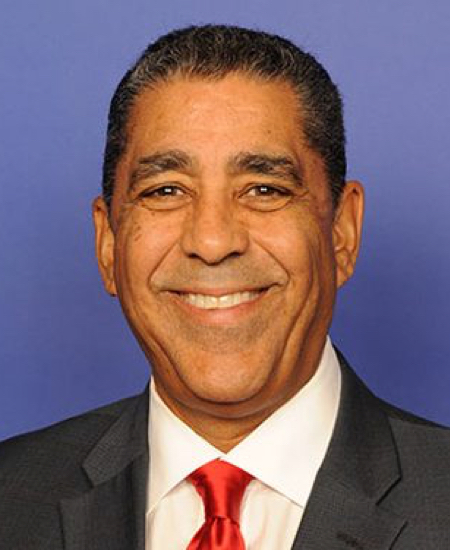
Rep. Adriano Espaillat
Sponsored bills
Ending Platform Monopolies Act This bill prohibits large online platforms, as designated by the Department of Justice or Federal Trade Commission, from offering certain products or services from another line of business that is owned or controlled by the platform. Specifically, such platforms are prohibited from owning or controlling another line of business that (1) uses the platform to sell products or services, (2) offers a product or service that the platform requires a business user to purchase or use as a condition for access to the platform, or (3) gives rise to a conflict of interest. Under the bill, a conflict of interest occurs when a platform operator's ownership or control of another line of business creates an incentive and the ability for the platform to provide an advantage to the platform's own products or services over those of a competitor on the platform, or exclude or disadvantage the products or services of a competitor on the platform. For example, under the bill, Amazon.com, Inc. may be prohibited from offering for sale on Amazon.com privately labeled products or services (e.g., Amazon Essentials, AmazonBasics, etc.) if designated as a large online platform. Finally, the bill prohibits a director, officer, employee, or agent of a platform from simultaneously serving in the same or a similar role with a formerly affiliated entity.

Platform Competition and Opportunity Act of 2021 This bill generally prohibits operators of covered platforms from acquiring the stock or other share capital or the assets of another person engaged in commerce or in any activity affecting commerce. Covered platforms are online platforms that (1) have at least 50 million U.S.-based monthly active users or at least 100,000 U.S.-based monthly active business users, (2) are owned or controlled by a person with net annual sales or a market capitalization greater than $600 billion, and (3) are critical trading partners for the sale or provision of any product or service offered on or directly related to the platform. The Federal Trade Commission or the Department of Justice must designate whether an entity is a covered platform, and both must carry out enforcement activities. The bill provides for any person (other than a foreign state and any instrumentality thereof) who is injured by an activity forbidden under the bill to recover triple damages. (A foreign state may only recover actual damages.) Further, the bill specifies the U.S. Court of Appeals for the District of Columbia Circuit as the judicial venue for a covered platform's appeals related to (1) the designation as a covered platform, (2) other administrative and enforcement proceedings, or (3) a final order issued in any district court.
Augmenting Compatibility and Competition by Enabling Service Switching Act of 2021 or the ACCESS Act of 2021 This bill requires large online platforms (e.g., YouTube, Salesforce) to facilitate consumers and businesses switching from one platform to another. Specifically, the platforms must maintain interfaces that (1) securely transfer user data to other platforms (i.e., portability), and (2) allow other platforms to connect and communicate with their systems (i.e., interoperability). The bill provides the Federal Trade Commission (FTC) and the Department of Justice with the authority to designate specific platforms to which these requirements apply. After a platform is designated, the FTC must issue standards of interoperability specific to the platform. A platform may not change its interoperability interface without petitioning the FTC, and the platform must provide to competing businesses documentation for accessing the interface. Further, the FTC must establish a technical committee to assist with the implementation of these requirements. The bill provides the FTC with authority to enforce these requirements including through recovery of civil penalties and injunctive relief.
Protecting Older Workers Against Discrimination Act of 2021 This bill revises the evidentiary standard for age discrimination by establishing an unlawful employment practice when the complaining party demonstrates that age or participation in an investigation, proceeding, or litigation related to an age discrimination claim was a motivating factor for an adverse practice, even though other factors also motivated the practice (thereby allowing what are commonly known as mixed motive claims). The bill (1) permits the complaining party to rely on any type or form of admissible evidence, which need only be sufficient for a reasonable trier of fact to find that an unlawful practice occurred; and (2) declares that the complaining party shall not be required to demonstrate that age or retaliation was the sole cause of the employment practice (thereby rejecting the Supreme Court's decision in Gross v. FBL Financial Services, Inc. , which requires the complainant to prove that age was the but-for cause for the employer's decision). The bill applies this evidentiary standard to other employment discrimination and retaliation claims, including claims under the Civil Rights Act of 1964, the Americans With Disabilities Act of 1990, and the Rehabilitation Act of 1973. In a claim in which age discrimination is shown, but where the employer demonstrates that it would have taken the same action absent the motivating factor of age, the bill authorizes courts to grant declaratory and injunctive relief, but prohibits the court from awarding damages or issuing an order requiring any admission, reinstatement, hiring, promotion, or payment. This limitation also applies to claims of discrimination based on disability. The bill also includes reporting requirements for the Equal Employment Opportunity Commission and the Department of Labor.
Healthy Future Students and Earth Pilot Program Act of 2021 This bill establishes a pilot program for providing 100% plant-based food and milk options in school meals. The Department of Agriculture must award up to 50 grants to school food authorities. Recipients may use funds for activities including training food service personnel on serving 100% plant-based options and covering additional costs of buying plant-based foods and milks.
Vanessa Guillén Military Justice Improvement and Increasing Prevention Act This bill modifies the process and policy related to the disposition of charges and convening of courts-martial for certain sexual assault cases and other specified offenses under the Uniform Code of Military Justice (UCMJ). Among other elements, the bill provides that the determinations on the preferral, disposition, and referral of charges for specified offenses under the UCMJ must be made by a commissioned officer of the Armed Forces who is designated as a court-martial convening authority (in grade O-6 or higher) and who is available for detail as trial counsel, has significant trial experience, and is outside the chain of command of the member subject to the charges.
Municipal IDs Acceptance Act This bill directs financial regulatory agencies to update specified guidance to include municipal identification cards as acceptable forms of identification for purposes of verifying the identity of a bank customer.
Puppy Protection Act of 2021 This bill requires the Department of Agriculture to expand standards that govern the humane handling, care, treatment, and transportation of animals to include new requirements for commercial dog dealers. Specifically, the standards must require dog dealers to provide to dogs adequate housing, exercise, and veterinary care; appropriate and nutritious food; continuous access to potable water; and meaningful socialization with humans and compatible dogs for at least 30 minutes each day. The standards must also include requirements for breeders to use safe breeding practices and make all reasonable efforts to find humane placement for retired breeding dogs.
This joint resolution nullifies the Oil and Natural Gas Sector: Emission Standards for New, Reconstructed, and Modified Sources Review rule published by the Environmental Protection Agency on September 14, 2020. The rule finalized amendments to new source performance standards under the Clean Air Act for the oil and natural gas sector, such as an amendment that removed limitations on methane emissions from such sector.