

Jaime's Law This bill establishes background check requirements for the sale and transfer of ammunition. Specifically, the bill prohibits a licensed importer, manufacturer, or dealer from transferring ammunition to an unlicensed individual prior to submitting a background check through the National Instant Criminal Background Check System. It also establishes penalties for violations. (Currently, background checks are required under these circumstances for the transfer of firearms, but not for ammunition.) Additionally, it prohibits an ammunition transfer between private parties (i.e., unlicensed individuals) unless a licensed importer, manufacturer, or dealer first takes possession of the ammunition to conduct a background check. However, this prohibition does not apply to certain ammunition transfers, such as a gift between spouses in good faith.
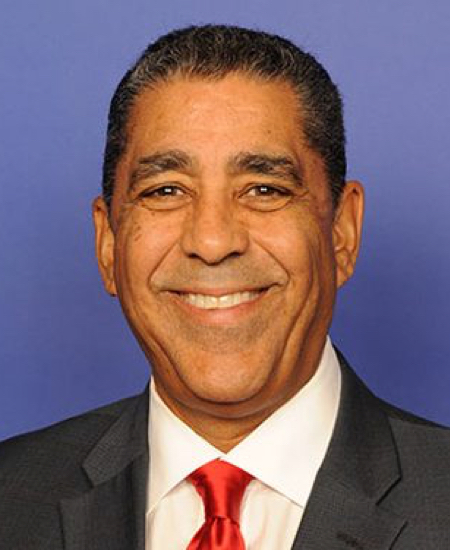
Rep. Adriano Espaillat
Sponsored bills
Green New Deals for Cities Act of 2021 This bill authorizes the Department of Housing and Urban Development to provide funding to states, local governments, or Native American nations to carry out Green New Deal projects, such as projects to clean up pollution, climate adaptation measures, or conservation projects on family farms. In order to receive such funding, a state, local government, or Native American nation must have a local Green New Deal program proposal and meet other requirements as specified by the bill. A proposal must contain certain commitments, including a commitment to zero greenhouse gas emissions by 2030 through a fair and just transition for all communities and workers.
Gay and Trans Panic Defense Prohibition Act of 2021 This bill generally prohibits a federal criminal defendant from asserting, as a defense, that the nonviolent sexual advance of an individual or a perception or belief of the gender, gender identify or expression, or sexual orientation of an individual excuses or justifies conduct or mitigates the severity of an offense.
Maddy summaryHR 2584, the Judiciary Act of 2021, would change the structure of the U.S. Supreme Court by increasing the number of associate justices from eight to twelve. This bill directly affects the Supreme Court's composition and operations, requiring a quorum of eight justices instead of six to conduct business. The key provision amends Title 28 of the U.S. Code to reflect these numerical changes to the Court's membership and quorum requirements. This is a procedural change to the Court's statutory structure, not a policy affecting the public.
Keep Americans Safe Act This bill establishes a new criminal offense for the import, sale, manufacture, transfer, or possession of a large capacity ammunition feeding device (LCAFD). The bill does not prohibit certain conduct with respect to an LCAFD, including the following: importation, sale, manufacture, transfer, or possession related to certain law enforcement efforts, or authorized tests or experiments; importation, sale, transfer, or possession related to securing nuclear materials; and possession by a retired law enforcement officer. The bill permits continued possession of, but prohibits sale or transfer of, a grandfathered LCAFD. Newly manufactured LCAFDs must display serial number identification and the date of manufacture. Additionally, the bill allows a state or local government to use Edward Byrne Memorial Justice Assistance Grant Program funds to compensate individuals who surrender an LCAFD under a buy-back program.
Hate Crime Victim Assistance Act of 2021 This bill establishes new grant programs to support state and local efforts to combat hate crimes and assist hate crime victims. Specifically, the Department of Justice (DOJ) must award grants for (1) hate crime information and assistance websites and hate crime hotlines, and (2) education and training programs to solve and prevent hate crimes. Additionally, DOJ must establish, in the Office for Victims of Crime, a grant program to support programs and activities for victims of hate crimes.
Immigrants' Mental Health Act of 2021 This bill directs Customs and Border Protection (CBP) to take steps to address mental health issues among immigrants and CBP agents and officers. It also restricts the sharing of mental health information for use in certain immigration proceedings. CBP shall develop training to enable its agents and officers to (1) identify mental health issues and risk factors in immigrants and refugees, (2) provide crisis intervention using a trauma-informed approach, and (3) better manage work-related stress and psychological pressures. CBP shall assign at least one qualified mental or behavioral health expert to each Border Patrol station, port of entry, checkpoint, forward operating base, secondary inspection area, and short-term custody facility. The Department of Health and Human Services may not provide to the Department of Homeland Security information about the mental health of an alien that was obtained by a mental health professional while the alien was in federal government custody if the information will be used for (1) an asylum determination, (2) an immigration hearing, or (3) a deportation hearing.
Law Enforcement Protection Act of 2021 This bill includes armor-piercing, concealable weapons in the definition of firearm under the National Firearms Act.
Khalid Jabara and Heather Heyer National Opposition to Hate, Assault, and Threats to Equality Act of 2021 or the Jabara-Heyer NO HATE Act of 2021 This bill creates grants for state and local governments to combat hate crimes. It also authorizes additional penalties for hate crime offenses. Specifically, it establishes grants for states to create state-run hate crimes reporting hotlines. It also authorizes grants for states and local governments to implement the National Incident-Based Reporting System and to conduct law enforcement activities or crime reduction programs to prevent, address, or respond to hate crimes. Finally, in the case of an individual convicted of a hate crime offense and placed on supervised release, the bill allows a court to order that the individual participate in educational classes or community service as a condition of supervised release.
Health, Opportunity, and Personal Empowerment Act of 2021 or the HOPE Act of 2021 This bill establishes two Health, Opportunity, and Personal Empowerment (HOPE) pilot projects to improve economic security for individuals who meet income or other requirements. The Department of Health and Human Services (HHS), the Department of Agriculture, and the Department of Housing and Urban Development must collaborate on the projects. The first project provides awards to certain government entities to assist eligible individuals in establishing HOPE accounts through banks, credit unions, or governmental agencies. HOPE accounts must (1) provide access to specified financial services and information on public benefits, health insurance, and other topics; and (2) facilitate activities such as applying for government benefits and filing taxes. HHS must hold a competition to award contracts to private businesses and nonprofits to develop technology applications and other tools for HOPE accounts. The second pilot project provides grants that allow government and nonprofit organizations to enter voluntary agreements with eligible individuals to carry out long-term plans related to improving economic security and upward mobility.