

Responsibility and Integrity in Security Clearance Act or the RISC Act This bill revokes the security clearance of a family member or financial associate of the President that was granted contrary to the determination or recommendation of an agency, including the Federal Bureau of Investigation. A subsequent background investigation and agency adjudication is required before such an individual may be granted a security clearance. In addition, the White House Chief of Staff must notify Congress if the President or any other individual grants a security clearance to a family member or financial associate of the President contrary to the determination or recommendation of an agency. The notification must be made in writing no later than five days after the decision to grant the clearance.
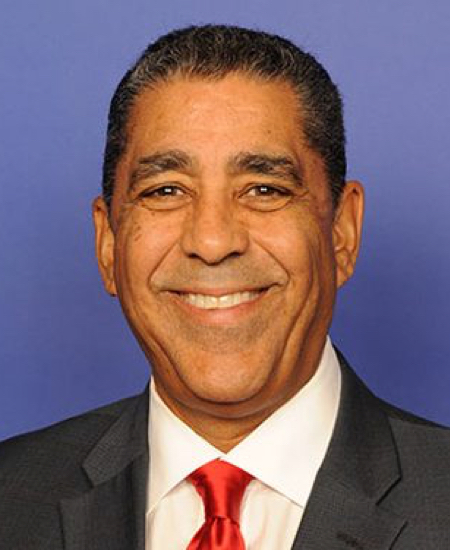
Rep. Adriano Espaillat
Sponsored bills
This resolution recognizes the harm associated with restraints in schools. It also encourages local and state governments to prohibit the use of physical restraints on young children in schools.
Lymphedema Treatment Act This bill provides for Medicare coverage of lymphedema compression treatment items. Specifically, the bill provides for coverage of standard and custom fitted gradient compression garments and other approved items that are prescribed by a physician or other specified health care professional to treat lymphedema.
Maddy summaryHR 9302, the Resilient Transit Act of 2022, creates a new federal grant program to help state and local transit authorities fund projects that make public transportation systems more resilient to climate impacts like flooding, wildfires, and extreme weather. The grants cover specific activities such as installing flood barriers, upgrading drainage systems, adding backup power, monitoring temperature extremes, and assessing vulnerabilities to future climate events. The bill authorizes $300 million annually from 2023 through 2026 specifically for these resilience improvements, with 97.15% of funds distributed based on need and 2.85% for other purposes. This directly affects public transit agencies in communities facing climate-related infrastructure risks, providing targeted funding to protect critical transportation services.
New York-New Jersey Watershed Protection Act This bill requires the U.S. Fish and Wildlife Service to establish the New York-New Jersey Watershed Restoration Program, a nonregulatory program, to coordinate restoration and protection activities among government entities and conservation partners throughout the watershed. The bill also establishes the New York-New Jersey Watershed Restoration Grant Program, a voluntary grant and technical assistance program, to provide competitive matching grants to certain entities to implement restoration and protection activities for the watershed.
Prevent All Soring Tactics Act of 2022 or the PAST Act of 2022 This bill addresses the practice of soring horses. The soring of horses includes various actions taken on horses' limbs to produce higher gaits that may cause pain, distress, inflammation, or lameness. Specifically, the bill expands soring regulation and enforcement at horse shows, exhibitions, sales, and auctions, including by establishing a new system for inspecting horses for soring. In addition, the bill increases penalties for violations.
This bill requires the Federal Bureau of Investigation and the Department of State to report to Congress on the death of Shireen Abu Akleh. The report shall also be made available to the public on the State Department's website. (Abu Akleh was a U.S. citizen and journalist who was shot and killed in the city of Jenin in the West Bank in May 2022. At the time of her shooting, Israeli security forces and Palestinians were trading fire in the area.)
Healthy Meals, Healthy Kids Act This bill reauthorizes and expands (1) child nutrition programs, including the National School Lunch Program (NSLP) and other institutional food service programs; and (2) the Special Supplemental Nutrition Program for Women, Infants, and Children (WIC).
Asunción Valdivia Heat Illness and Fatality Prevention Act of 2022 This bill directs the Occupational Safety and Health Administration to promulgate a standard that requires employers to implement certain measures for protecting workers from heat stress and related illnesses or injuries. Heat stress refers to the load of heat that a person experiences due to sources of heat or heat retention (including metabolic heat, environmental factors, and clothing or personal protective equipment) or the presence of heat in a work setting. Further, if an employer cannot reduce exposure to heat stress below hazardous levels through engineering controls (e.g., heat shields and insulation) or personal protective equipment (e.g., heat reflective clothing), the employer must implement a program that mitigates such exposure through access to appropriate hydration and cool-down spaces, acclimatization policies, and periodic paid rest breaks. Additionally, the bill establishes requirements concerning judicial review, implementation, enforcement, recordkeeping, and whistle-blower protections related to the standard. The bill also requires the Department of Labor to include questions about heat-related illness and injury in the National Agricultural Workers Survey (an employment-based, random-sample survey of U.S. crop workers that collects demographic, employment, and health information).
This concurrent resolution expresses opposition to the application of criminal laws to pregnancy outcomes and affirms that people deserve access to high-quality health care without fear of reprisal or punishment.