

Maddy summaryHR 396, the Closing the Bump Stock Loophole Act of 2023, defines "bump stock" as any device or modification that increases the firing rate of a semi-automatic weapon to mimic a machine gun. The bill amends federal tax and firearms laws to classify bump stocks as prohibited devices under the National Firearms Act, requiring existing owners to register them within one year of enactment. It directly affects individuals who currently own bump stocks by mandating registration to avoid future possession prohibitions. The law takes effect immediately for new sales but provides a one-year grace period for existing owners to comply with registration requirements.
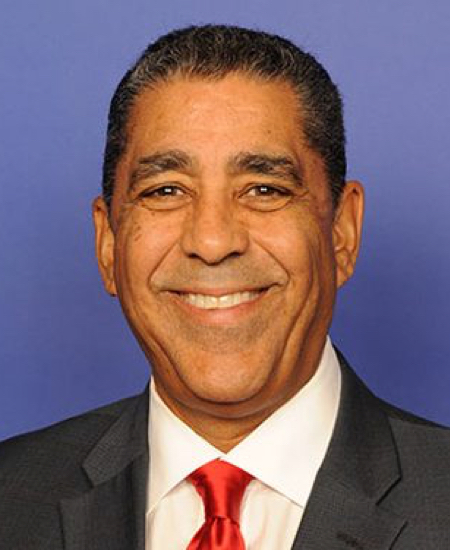
Rep. Adriano Espaillat
Sponsored bills
Maddy summaryHRES 36 is a symbolic resolution supporting Korean American Day, introduced by multiple House members on January 13, 2023. It honors the 120th anniversary of the 1903 arrival of the first large wave of Korean immigrants to the U.S. and recognizes Korean Americans' contributions to U.S. society, economy, and the U.S.-South Korea alliance. The resolution urges all Americans to observe Korean American Day to appreciate these contributions but does not create new laws or affect any specific group through policy changes. It is a commemorative measure without binding requirements.
Maddy summaryHRES 30 is a ceremonial House resolution recognizing two milestones: the 94th anniversary of Dr. Martin Luther King, Jr.'s birth (January 15, 1929) and the 40th anniversary of the federal Martin Luther King, Jr. Holiday (observed January 16, 2023). It contains no policy changes or binding requirements, as it is purely commemorative. The resolution urges the House to observe both dates and encourages the public to honor Dr. King’s legacy and his vision of equality. It does not affect any individuals, groups, or government programs.
Maddy summaryHR 350, the SANTOS Act, requires candidates for the U.S. House of Representatives or Senate to disclose their educational background, military service (if any), and employment history as part of their official campaign filings. This directly affects all federal election candidates by mandating these specific personal details be included in their required campaign designations. Candidates who knowingly provide false information about these details face penalties of up to $100,000 in fines, one year in prison, or both. The law applies to elections held on or after its enactment date.
Maddy summaryHR 308, the Rosa Parks Day Act, would designate Rosa Parks Day as a legal public holiday for federal employees and government operations. The bill amends Title 5 of the U.S. Code to add "Rosa Parks Day" to the list of federal holidays, placing it after Thanksgiving Day. This change would require federal offices to close on this designated day, affecting federal employees and standard government operations. The bill does not create new programs or alter existing laws beyond the holiday designation.
Maddy summaryThis bill amends the tax code to deny corporations a tax deduction for certain executive bonuses exceeding $1 million. It directly affects large publicly traded companies that pay top executives (including those in the top 3 highest-paid officers) compensation reported under SEC rules. The key mechanism expands the definition of "covered individual" to include more executives and requires corporations to report compensation details to prevent tax avoidance through indirect payment methods. The change applies to taxable years starting after December 31, 2022, making such bonuses non-deductible for tax purposes.
Maddy summaryThis bill proposes a constitutional amendment to extend voting rights to U.S. citizens aged 16 or older in all federal elections, while repealing the 26th Amendment (which set the voting age at 18). It would directly affect 16- and 17-year-old citizens by granting them the right to vote in presidential, congressional, and other federal elections. The amendment requires Congress to pass laws enforcing this change, and it must be ratified by three-fourths of state legislatures within seven years to take effect. The proposal does not alter voting eligibility for state or local elections, which remain governed by existing laws.
Public Housing Emergency Response Act This bill authorizes additional assistance from the Public Housing Capital Fund to public housing agencies (PHAs) based upon capital needs as determined by the PHA's most recent physical needs assessment. The physical needs assessment identifies work that a PHA would need to undertake to bring its units up to certain energy conservation standards and other standards.
Maddy summaryH.J.Res. 14 proposes amending the U.S. Code to require the President to issue an annual proclamation designating a day as "Democracy Day." The proclamation would call on state and local governments, educational institutions, and the public to observe the day with programs and activities promoting democratic values. It does not fix a specific date (though the preamble references January 6 as a potential day), leaving the annual designation to the President's discretion. The bill directly affects the President and state/local authorities by establishing a formal mechanism for nationwide civic observance of democracy.
This joint resolution proposes a constitutional amendment authorizing Congress and the states to (1) regulate and impose reasonable viewpoint-neutral limitations on the raising and spending of money by candidates and others to influence elections; and (2) regulate and enact public campaign financing systems, including those designed to restrict the influence of private wealth by offsetting the raising and spending of money by candidates and others with increased public funding. The amendment grants Congress and the states the power to implement and enforce this amendment by legislation. They are allowed to distinguish between natural persons and corporations or other artificial entities created by law, including by prohibiting such entities from spending money to influence elections.