

Maddy summaryThe Puppy Protection Act of 2023 sets new standards for businesses that sell dogs (dealers), directly affecting pet stores and breeders operating under the Animal Welfare Act. It requires specific housing with space allowances based on dog size (e.g., 12-30 square feet per dog), temperature control (45-85°F), clean food twice daily, and daily exercise or socialization with humans/dogs for at least 30 minutes. The bill also mandates annual veterinary exams including dental care, strict breeding limits (e.g., age restrictions, maximum 2 litters in 18 months), and efforts to place retired breeding dogs in homes instead of selling them to other breeders. Regulations must be finalized within 18 months of enactment.
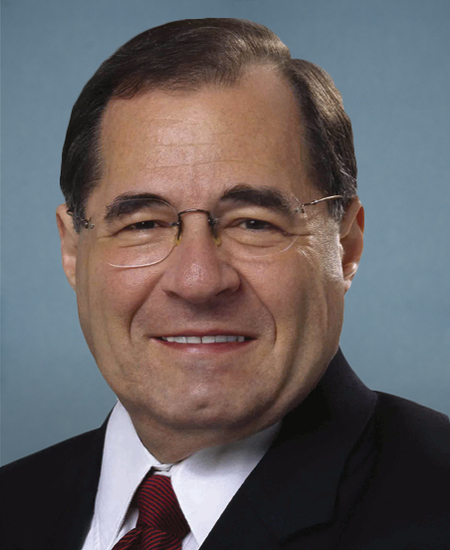
Rep. Jerrold Nadler
Sponsored bills
Maddy summaryThe Ending PUSHOUT Act of 2023 aims to reduce discriminatory school discipline practices that disproportionately push students of color, particularly girls of color, out of school. It requires schools to collect detailed data on disciplinary actions disaggregated by race, ethnicity, gender identity, disability status, and other factors to identify patterns of overuse and discrimination. The bill provides grants to schools to implement trauma-informed practices, restorative approaches, and mental health supports instead of exclusionary discipline, while prohibiting out-of-school suspensions for minor infractions in early grades and banning practices like corporal punishment and certain restraints. It also establishes a joint task force with diverse representation to study discipline disparities and recommend solutions to prevent students from being pushed out of schools. The legislation seeks to create safer school environments by addressing the root causes of discipline issues rather than relying on punitive measures.
Maddy summaryHR 2665 delays Medicaid payment reductions for safety net hospitals by two years, changing the effective date from 2024 to 2026 under Section 1923(f)(7)(A) of the Social Security Act. This bill directly affects hospitals that serve high numbers of low-income and uninsured patients, providing them with additional time before facing reduced federal Medicaid payments. The key mechanism is a technical amendment to existing law, postponing an already scheduled payment adjustment without altering funding levels or eligibility. As a procedural bill, it does not create new programs or change hospital requirements.
Maddy summaryHR 2630, the Safe Step Act, requires group health plans and health insurance issuers to establish a clear, transparent process for patients or their doctors to request exceptions to medication step therapy protocols. These protocols typically force patients to try cheaper drugs first before covering more expensive alternatives. The bill mandates that plans must approve exceptions when prior treatments failed, delay would cause serious harm, a treatment is unsafe, or a patient is stable on a previously approved drug, with strict 72-hour (or 24-hour in emergencies) decision timelines. It also requires plans to publish the exception process online and limit documentation requests to only necessary medical information. This law directly affects health insurers, employers offering health plans, and patients using step therapy for prescription drugs.
Maddy summaryThis bill requires the Census Bureau to create a new separate category in the Current Population Survey for "Postsecondary Nondegree Awardees" within one year of enactment. It directly affects individuals who hold a high school diploma plus a recognized non-degree credential (like a trade certificate), but not an associate or bachelor's degree, by changing how their educational attainment is tracked. The key mechanism is mandating this specific data category to better measure vocational education outcomes. This change impacts how workforce data is collected and reported, not the vocational programs themselves.
This bill directs the Federal Aviation Administration (FAA) to establish an Impacted Communities Advisory Committee. The committee must provide advice and recommendations to the FAA on community needs, plans, and strategies with respect to areas that include noise policy; community engagement; noise, pollution, and health mitigation for communities close to airports and communities away from airports; and integration of new or emerging technologies.
Noise Data Collection Act This bill requires the Federal Aviation Administration (FAA) to annually report to Congress the estimated number of individuals in the United States who are exposed to certain levels of aviation noise. Specifically, the report must include estimates for the number of individuals exposed to aviation noise at each of the following day-night average sound levels (DNLs): 65 dBA, 55 dBA, and 46 dBA. In addition, the FAA's initial report must include an estimate of the number of individuals exposed to aviation noise at these levels for each year during the period beginning on January 1, 2010, and ending on the last day of the year preceding the year for which the first report is submitted. The DNL noise metric reflects a person's cumulative exposure to sound over a 24-hour period, expressed as the noise level for the average day of the year on the basis of annual aircraft operations.
Aircraft Ownership Transparency Act of 2023 This bill requires the Federal Aviation Administration (FAA) to obtain the identity of all beneficial owners of a covered entity prior to approving an aircraft certificate of registration. A covered entity refers to a person, trust, association, copartnership, corporation, or other public or private entity. A beneficial owner refers to a natural person who directly or indirectly (1) exercises control over the covered entity, or (2) has an interest in or receives substantial economic benefits from the covered entity's assets. Specifically, the FAA must require a covered entity seeking an aircraft certificate of registration to identify each beneficial owner by providing the owner's name and current street address; a unique identifying number from a U.S. passport or a driver's license issued by a state (or a copy of a passport issued by a foreign country if those documents are unavailable); the owner's nationality; and the make, model, and serial number of the aircraft to be registered. The covered entity must also disclose any beneficial owner of the covered entity who is a foreign person. A foreign person is an individual who is not (1) a U.S. citizen, or a (2) non-U.S. national ( alien under federal law) lawfully admitted for permanent residence into the United States.
Peer-Reviewed Report on Measuring Metrics and Thresholds This bill requires the Department of Transportation to enter into an agreement with the National Academies of Sciences, Engineering, and Medicine to produce a report that identifies and recommends a system of measuring aviation noise. This measurement system must, with a highly reliable relationship, categorize noise levels to determine compatibility for residential areas and high annoyance areas based on appropriate metrics. In addition, it must (1) have a highly reliable relationship between projected noise exposure and surveyed reactions of individuals, and (2) be applied uniformly in measuring noise at airports and the surrounding area.
Air Traffic Noise and Pollution Expert Consensus Act of 2023 This bill requires the Federal Aviation Administration to enter into an arrangement with the National Academies of Sciences, Engineering, and Medicine to examine and report on the various health impacts of air traffic noise and pollution.