

Israel Relations Normalization Act of 2021 This bill requires the Department of State to take certain actions promoting the normalization of relations between Israel, Arab states, and other relevant countries and regions. Specifically, the State Department must develop a strategy on expanding and strengthening the Abraham Accords (the term used to refer collectively to agreements between Israel and the United Arab Emirates and between Israel and Bahrain marking the public normalization of relations between the two Arab countries and Israel). The strategy must include a description of how the U.S. government will encourage further normalization of relations with Israel. In addition, the State Department must report on options for U.S. international efforts to promote the strengthening of ties between Israel, Arab states, and other relevant countries and regions. The State Department must also report on the status of the normalization of relations with Israel, including information on (1) laws that punish individuals for people-to-people relations with Israelis (i.e., anti-normalization laws), and (2) evidence of steps taken by Arab governments toward permitting or encouraging normalized relations between their citizens or residents and Israeli citizens.
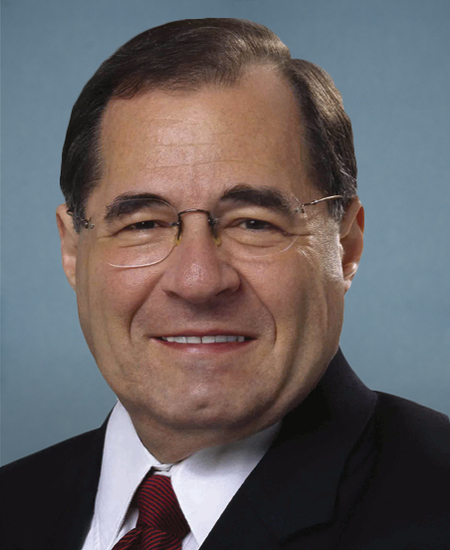
Rep. Jerrold Nadler
Sponsored bills
Veteran Families Health Services Act of 2021 This bill addresses fertility treatments, counseling, and other health-related programs for veterans and members of the Armed Forces. Specifically, the bill requires the Department of Defense (DOD) and the Department of Veterans Affairs (VA) to provide fertility treatments and counseling to covered veterans and active duty service members or a spouse, partner, or gestational surrogate of such veteran or service member. A covered veteran or service member is a former or current member of the Armed Forces who has an infertility condition, unless it is demonstrable that the individual was completely infertile prior to serving in the Armed Forces. In the case of in vitro fertilization treatment, DOD and the VA may not furnish more than three completed cycles or six attempted cycles, whichever occurs first. DOD must establish procedures related to gamete retrieval and storage. Additionally, DOD must provide service members with the opportunity to cryopreserve and store their gametes prior to deployment to a combat zone or a hazardous duty assignment. DOD and the VA must share best practices and facilitate referrals for the furnishing of fertility treatment and counseling to eligible individuals. Fertility counseling and treatment are included within authorized VA medical services. The VA may pay the adoption expenses (for up to three adoptions) for a covered member who is enrolled in the VA health care system. The VA must facilitate specified reproduction and infertility research conducted collaboratively by DOD and the Department of Health and Human Services.
Save our Stages Extension Act This bill extends to March 11, 2023, the time frame during which Shuttered Venue Operators Grant recipients may use grant funds to cover their expenses. These grants provide funds to certain types of entities in the arts and entertainment industry affected by the COVID-19 pandemic. Currently, a recipient may use such funds to cover expenses incurred between March 1, 2020, and December 31, 2021.
Stopping Harmful Offers on Platforms by Screening Against Fakes in E-commerce Act or the SHOP SAFE Act This bill makes an electronic commerce platform liable for infringement of a registered trademark by a third-party seller of goods that implicate health and safety unless the platform takes certain actions. Specifically, the platform may be contributorily liable if the seller uses a counterfeit mark in connection with selling, offering, or advertising such goods on the platform. The platform may avoid such liability by taking certain actions before the infringing act, including (1) requiring the seller to have a registered agent or a verified address for service of process in the United States, (2) verifying the seller's identity and contact information, (3) requiring the seller to agree to not use counterfeit marks with goods sold on the platform, (4) implementing procedures for trademark owners to request the removal of listings for counterfeit goods, and (5) implementing policies to remove and ban repeat offenders. A person who knowingly makes a material misrepresentation in a request to a platform to take down a seller listing (because the listing allegedly uses a counterfeit mark and implicates health and safety concerns) shall be civilly liable to the seller injured by the resulting improper takedown. If a person makes 10 or more such improper takedown requests, the platform may sue on behalf of the sellers who consent to the platform's lawsuit. A party suing under this bill may choose to receive statutory damages (as opposed to actual damages) of $2,500-$75,000 for each improper request, depending on the circumstances of the case.
Stop Stalling Access to Affordable Medications This bill makes it an unfair method of competition to submit an objectively baseless petition to the Food and Drug Administration (FDA) in an attempt to interfere with a competitor's application for market approval of a drug. The bill authorizes the Federal Trade Commission to sue an individual or entity that submits such a petition to the FDA. A party found liable in such a lawsuit shall be subject to civil penalties, such as a fine of up to $50,000 for each day that the FDA spent reviewing the baseless petition.
Affordable Prescriptions for Patients Through Promoting Competition Act of 2021 This bill prohibits product hopping by drug manufacturers and authorizes the Federal Trade Commission to sue in court or institute administrative proceedings to enforce this prohibition. Generally, product-hopping describes a situation where, when the patents on a reference drug (or biological product) expire, the manufacturer switches to a follow-on product that is covered by a later-expiring patent. Under this bill, a follow-on product is a changed, modified, or reformulated version of the reference drug that shares an indication (what the drug is used for) with the reference drug. The bill presumes product hopping has occurred when a reference drug manufacturer engages in a hard switch or a soft switch . A hard switch occurs when, after receiving notice of an application for Food and Drug Administration (FDA) approval to market a generic (or biosimilar) version of the reference drug, the manufacturer markets a follow-on product and (1) the FDA withdraws approval of the reference drug at the manufacturer's request, or (2) the manufacturer announces the withdrawal or discontinuance of the reference drug or destroys the drug's inventory in a manner that impedes generic competitors. Furthermore, the bill presumes that a soft switch occurred if a reference drug manufacturer (1) markets a follow-on product, and (2) takes actions that disadvantage the reference drug relative to that follow-on product in a way that impedes competition from a generic drug. A drug manufacturer may rebut these presumptions by demonstrating that its conduct was not intended to limit competition.
Preserve Access to Affordable Generics and Biosimilars Act This bill authorizes the Federal Trade Commission (FTC) to initiate proceedings against parties to any agreement resolving or settling a patent infringement claim in connection with the sale of a drug or biological product. Such an agreement is presumed to have anticompetitive effects and is a violation of this bill if the filer of the generic drug or biosimilar application receives anything of value and agrees to limit or forego research, development, manufacturing, marketing, or sales of the generic drug or biosimilar. An agreement is exempted if the only consideration granted to the generic manufacturer is (1) the right to market its product prior to the expiration of any statutory exclusivity, (2) a payment for reasonable litigation expenses, or (3) a covenant not to sue on any claim that the generic drug or biosimilar infringes a patent. An agreement is also exempt if the agreement's pro-competitive benefits outweigh the anticompetitive effects. When a generic or biosimilar drug manufacturer enters into an agreement with another drug manufacturer related to the manufacturing, marketing, or sale of a drug, the manufacturers must certify that the material they have given the FTC concerning the agreement contains the complete agreement and any agreements related to that main agreement, including descriptions of any oral agreements or representations. The bill imposes penalties for violations of this bill, including the forfeiture of the 180-day marketing exclusivity period for a generic drug.
Eliminating a Quantifiably Unjust Application of the Law Act of 2021 or the EQUAL Act of 2021 This bill eliminates the federal sentencing disparity between drug offenses involving crack cocaine and powder cocaine. Currently, different threshold quantities of crack cocaine and powder cocaine (e.g., 28 grams of crack cocaine and 500 grams of powder cocaine) trigger the same statutory criminal penalties. This bill eliminates the lower quantity thresholds for crack cocaine offenses. Under the bill, the same threshold quantities of crack cocaine and powder cocaine trigger the same statutory criminal penalties. The change applies to future cases and cases pending on the date of enactment. With respect to past cases, the bill authorizes a sentencing court to impose a reduced sentence on a defendant who was convicted or sentenced for a specified crack cocaine offense before this bill's enactment. A defendant does not have to be present at the sentence reduction hearing. Finally, the bill prohibits the reduction of a sentence that was previously reduced.
This bill expresses the sense of the House of Representatives that Congress and the President should examine and support ways to expand access to contraceptives.
Medically Tailored Home-Delivered Meals Demonstration Pilot Act of 2021 This bill requires the Centers for Medicare & Medicaid Services to establish a demonstration program to allow hospitals to provide medically tailored, home-delivered meals to Medicare beneficiaries who have a diet-impacted disease (e.g., kidney disease) and have daily living limitations. Participating hospitals must (1) retain a physician, registered dietitian or nutrition professional, or clinical social worker to screen, monitor, and coordinate services for individuals who receive meals through the program; and (2) contract with experienced organizations for meal delivery. Hospitals may choose to also provide meals to an individual's primary caregiver or to a dependent under the age of 18 who resides in the same household.