Emergency Price Stabilization Act of 2022 This bill creates the Sub-Task Force on Emergency Price Stabilization under the White House Supply Chains Disruption Task Force. The new task force must monitor the price of essential goods and services, investigate corporate price increases, make recommendations to the President, and report plans and research to the public. The bill also grants the President the authority to enact or adjust price controls and regulations in accordance with these recommendations.
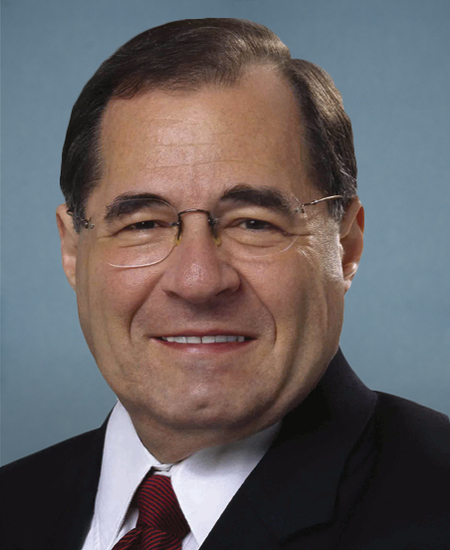
Rep. Jerrold Nadler
Sponsored bills
Harriet Tubman Bicentennial Commemorative Coin Act This bill directs the Department of the Treasury to mint and issue 50,000 $5 gold coins, 400,000 $1 silver coins, and 750,000 half-dollar clad coins emblematic of the legacy of Harriet Tubman as an abolitionist. The Secretary may issue coins under this bill only during the period of January 1, 2024, through December 31, 2024. All surcharges received by Treasury from the sale of such coins must be paid equally to the National Underground Railroad Freedom Center in Cincinnati, Ohio, and The Harriet Tubman Home, Inc. in Auburn, New York, for the purpose of accomplishing and advancing their missions.
National World War II Memorial Commemorative Coin Act This bill directs the Department of the Treasury to mint and issue up to 50,000 $5 coins, 400,000 $1 silver coins, and 750,000 half-dollar clad coins in commemoration of the National World War II Memorial in the District of Columbia. The design of the coins shall be emblematic of the memorial and the service and sacrifice of American soldiers and civilians during World War II. All surcharges received from the sale of such coins shall be paid to the Friends of the National World War II Memorial to support the National Park Service in maintaining and repairing the memorial, and for educational and commemorative programs.
Assault Weapons Ban of 2022 This bill makes it a crime to knowingly import, sell, manufacture, transfer, or possess a semiautomatic assault weapon (SAW) or large capacity ammunition feeding device (LCAFD). The prohibition does not apply to a firearm that is (1) manually operated by bolt, pump, lever, or slide action, except for certain shotguns; (2) permanently inoperable; (3) an antique; (4) only capable of firing rimfire ammunition; or (5) a rifle or shotgun specifically identified by make and model. The bill also exempts from the prohibition the following, with respect to a SAW or LCAFD: importation, sale, manufacture, transfer, or possession related to certain law enforcement efforts, or authorized tests or experiments; importation, sale, transfer, or possession related to securing nuclear materials; and possession by a retired law enforcement officer. The bill permits continued possession, sale, or transfer of a grandfathered SAW, which must be securely stored. A licensed gun dealer must conduct a background check prior to the sale or transfer of a grandfathered SAW between private parties. The bill permits continued possession of, but prohibits sale or transfer of, a grandfathered LCAFD. Newly manufactured LCAFDs must display serial number identification. Newly manufactured SAWs and LCAFDs must display the date of manufacture. The bill also allows a state or local government to use Edward Byrne Memorial Justice Assistance Grant Program funds to compensate individuals who surrender a SAW or LCAFD under a buy-back program.

No Tax Deductions for Workplace Harasser Buyouts Act This bill modifies the tax deduction for trade or business expenses to deny a deduction for payments made to any employee in connection with the termination of employment if a factor in the termination was sexual assault, sexual harassment, sexual misconduct, or workplace harassment based on race, color, national origin, religion, sex, disability, or other specified factors.
Ending Secrecy About Workplace Harassment Act This bill requires every employer that must submit to the Equal Employment Opportunity Commission (EEOC) an Employer Information Report EEO-1 to separately report on an annual basis the number of settlements reached by the employer involving workplace harassment. The bill also requires the EEOC and the Government Accountability Office to report information relating to claims of discrimination.
Billionaire Minimum Income Tax Act This bill imposes a minimum tax on individual taxpayers whose net worth for the taxable year exceeds $100 million. The tax is equal to 20% of the sum of a taxpayer's taxable income, plus net unrealized gains for the taxable year. The tax may not exceed 40% of the amount by which the taxpayer's net worth exceeds $100 million.
Original Slavery Remembrance Day Resolution of 2021 This resolution supports the designation of a Slavery Remembrance Day and condemns slavery and its progenies.
Protect Sexual and Reproductive Health Act of 2022 This bill requires the Department of Health and Human Services (HHS) to undertake activities to promote access to sexual and reproductive health and well-being. The bill renames HHS's Office of Population Affairs as the Office of Sexual and Reproductive Health and modifies its responsibilities. Among other activities, the office must develop and implement a strategy to promote sexual and reproductive health and well-being. This strategy must include recommendations to integrate sexual and reproductive health equity and reproductive justice into federal programs. HHS must also award grants for improving access to sexual and reproductive health care to nonprofit or community-based organizations that assist individuals seeking abortion services through programs that are unbiased and medically and factually accurate. Grant funds may not be used to pay for abortion services. Additionally, HHS and the Director of the White House Gender Policy Council must jointly establish an interagency task force to coordinate and promote federal programs and activities related to sexual and reproductive health and well-being.
American Families United Act This bill authorizes the Department of Homeland Security (DHS) or the Department of Justice (DOJ) to exercise discretion in certain immigration cases. The bill also removes certain requirements related to birthright citizenship. Under this bill, DOJ or DHS may, on a case-by-case basis, exercise discretion by declining to remove an alien or bar an alien from entering the United States to prevent hardship for the alien's U.S. citizen spouse, parent, or child. However, DOJ or DHS may not exercise this discretion if the alien is removable or inadmissible due to certain grounds, including specified crime- and security-related grounds. The bill also removes certain requirements related to birthright citizenship for a child born outside of the United States to one U.S. citizen parent and one alien parent. Specifically, the bill removes a provision that requires the U.S. citizen parent to be physically present in the United States for at least five years before the child's birth in order for the child to acquire U.S. citizenship at birth.