

Maddy summaryHR 1244 authorizes Congress to award a gold medal collectively to Africans and their descendants who were enslaved in the U.S. from 1619 to 1865, recognizing their contributions to America's economic foundation. The bill directs the Treasury Secretary to design and strike the medal, which will be permanently displayed at the Smithsonian's National Museum of African American History & Culture. It also permits the sale of bronze duplicates to cover costs, with proceeds going to the U.S. Mint. This is a commemorative measure, not a policy change, focusing on symbolic recognition of historical contributions.
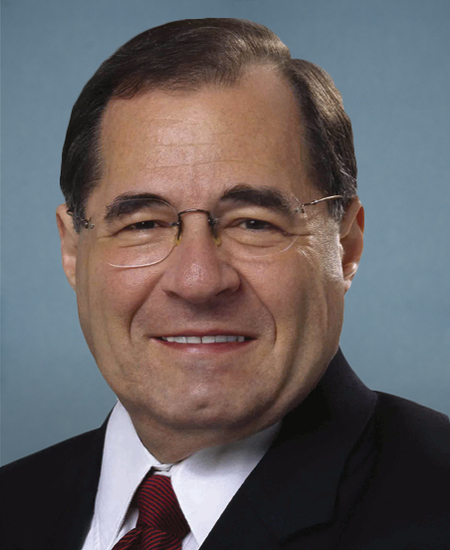
Rep. Jerrold Nadler
Sponsored bills
Maddy summaryThe Richard L. Trumka Protecting the Right to Organize Act of 2023 strengthens workers' rights to organize unions by making it harder for employers to interfere with organizing efforts. Key provisions include changing the definition of "employee" to make it more difficult to classify workers as independent contractors, prohibiting employers from threatening to permanently replace striking workers, and requiring employers to provide voter lists for union elections. The bill also creates a new electronic voting system for union elections, strengthens whistleblower protections for workers reporting labor violations, and increases penalties for unfair labor practices. These changes directly affect workers seeking to form unions, employers who may interfere with organizing, and labor organizations. The bill aims to make it easier for workers to exercise their right to collective bargaining under the National Labor Relations Act.
Maddy summaryHR 1204, the Protect Access to Justice for Veterans Act, limits attorney fees for veterans pursuing claims related to water contamination at Camp Lejeune, North Carolina. It caps fees at 20% for claims resolved within 180 days and 33.3% for later settlements or judgments. All settlement funds must be placed into a trust account for the veteran, with attorneys required to notify the veteran and deliver their share promptly before receiving payment. Violations, such as charging excessive fees, can result in fines up to $5,000.
Maddy summaryHR 1202, the REDI Act, amends the Higher Education Act to allow medical and dental residents to temporarily pause federal student loan payments without accruing interest during their internship or residency programs. This directly affects borrowers with federal student loans who are enrolled in qualifying medical or dental training programs. The key provision adds a new rule (paragraph 6) ensuring these borrowers qualify for a deferment period where they don't pay principal and interest accrues at 0%. The change modifies existing loan rules to explicitly include medical/dental residents under the "in-school" deferment category. This policy change provides immediate financial relief during a critical training phase for healthcare professionals.
Maddy summaryHR 1187, the Civil Aviation Security and Safety Act of 2023, requires the FAA to overhaul aircraft registration to prevent security risks. It mandates that aircraft owners provide personal details (name, address, date of birth, license, and photos), verifies applicants against sanctions lists, and bans registration for sanctioned individuals or entities. The bill also requires the FAA to address specific registration abuses like fictitious owners, false addresses, and unverified ownership transfers. These changes directly affect aircraft owners, dealers, and the FAA, with new verification processes and fees to cover security costs, all aimed at enhancing national security and safety.
Humane and Existing Alternatives in Research and Testing Sciences Act of 2022 [ sic ] or the HEARTS Act of 2022 [ sic ] This bill establishes a center within the National Institutes of Health (NIH) and requires other activities to promote alternatives to using animals in research and testing. The duties of the center include developing nonanimal research models (e.g., advanced cell cultures and advanced imaging systems) and training scientists about the methods. Additionally, if a federal department or agency or federally funded research entity uses animals for research and testing, it must develop and update plans for reducing such uses and periodically report on the number and types of animals that they use to the center. The center must establish a standard process for entities to submit and update their plans and reports and for making the plans and reports publicly available. The NIH must also provide incentives for the use of nonanimal research and generally ensure that nonanimal alternatives are considered when reviewing and approving research applications and proposals. Further, NIH applications for research grants must include an assurance that nonanimal methods for carrying out the research are unavailable.
Maddy summaryThis bill requires retail electric suppliers to generate 80% of their electricity from renewable sources by 2029 and 100% by 2030. It also mandates that vehicle manufacturers sell 80% zero-emission vehicles by 2029 and 100% by 2030. Additionally, large agricultural corporations must implement regenerative practices on 50% of their land by 2026, increasing to 100% by 2030. The legislation provides tax incentives for businesses making these transitions and requires annual reporting on compliance with these new standards. Businesses failing to meet these requirements may lose certain tax deductions under this law.
Maddy summaryHR 1134, the People Over Pentagon Act of 2023, would reduce the U.S. Department of Defense's 2024 budget by $100 billion. It directly affects the Pentagon's funding, though it specifically preserves spending for the Defense Health Program, military personnel, and civil service pay and benefits. The bill mandates this cut while directing the Secretary of Defense to consider a 2021 Congressional Budget Office report on managing a smaller defense budget. It does not specify where the savings would be redirected, only requiring reallocation to address non-military national security priorities.
Maddy summaryThe Department of Peacebuilding Act of 2023 would establish a new Cabinet-level Department of Peacebuilding within the executive branch of the U.S. government. The department would include multiple offices focused on domestic and international peacebuilding, violence prevention, peace education, and conflict resolution, with specific offices dedicated to areas like peace education, domestic activities, international activities, technology, arms control, and human rights. It would create a Secretary of Peacebuilding position and require the department to develop policies addressing root causes of violence, promote nonviolent conflict resolution, and collaborate with existing federal agencies. The bill would mandate annual reports on progress toward peace in the United States and require consultation with other departments on matters related to conflict prevention and peacebuilding.
Safe and Quiet Skies Act of 2023 This bill sets forth requirements for commercial air tour flights. Among other requirements, the bill prohibits tour flights within a half mile of military installations, national cemeteries, national wilderness areas, national parks, and national wildlife refuges; prohibits tour flights from operating at an altitude of less than 1,500 feet; requires tour flights over occupied areas (e.g., residential, commercial, and recreational areas) to be no louder than 55dbA; and allows states and localities to impose additional requirements that are stricter than the minimum federal requirements.