

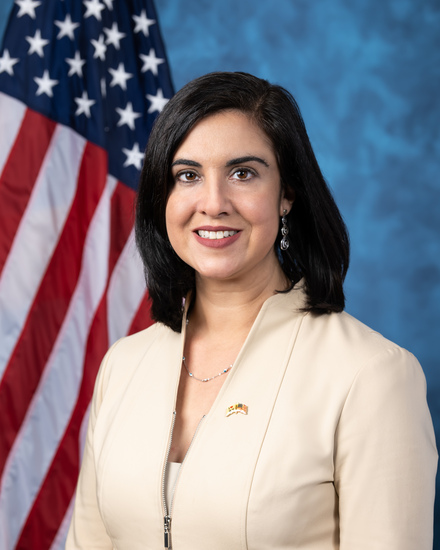
Photo of Nicole Malliotakis
R United States House · District 11 · New York On the 2026 ballot

Rep. Nicole Malliotakis

Compare
Total votes
2,837
all sessions
Attendance
98%
43 missed
Near the chamber average
With party
93%
of cast votes
Near the chamber average
Bipartisan score
4%
crosses aisle rarely
Near the chamber average
Sponsored
1,281
bills & resolutions
Higher than 77% of chamber peers
Committees
4
assignments
1,281 bills and resolutions

Sponsored bills

Total
1,281
Primary
136
Co-sponsor
1,145
This page
1,281
matching current filters
Co-sponsor HR 2309
In committee · United States House · Co-sponsor
Medicare and Medicaid Fraud Prevention Act

Maddy summaryThis bill requires states to verify that Medicaid providers and suppliers are not deceased during enrollment and at least quarterly while enrolled. Starting January 1, 2027, states must check the federal Death Master File (a government database of deceased individuals) as part of provider onboarding and revalidation. The law directly affects all entities billing Medicaid for services, aiming to prevent fraud where deceased individuals' identities might be used. It creates a concrete, ongoing screening mechanism to ensure only active providers participate in the program.

In committee Mar 24, 2025 1 co-sponsor
Co-sponsor HR 2257
In committee · United States House · Co-sponsor
National Fallen Firefighters Memorial Coin Act

Maddy summaryHR 2257 authorizes the U.S. Mint to produce three commemorative coins (a $5 gold coin, a $1 silver coin, and a half-dollar) to honor fallen firefighters, with specific quantity limits and specifications. The bill requires a surcharge ($35 for gold, $10 for silver, $5 for half-dollar) on each coin sold, which is directed entirely to the National Fallen Firefighters Foundation to support its programs. The coins must be issued in 2026, will be legal tender, and the government must recover all costs through sales before distributing funds to the Foundation. This is a commemorative coin program, not a direct legislative policy change affecting broader public programs.

In committee Mar 21, 2025 1 co-sponsor
Primary HR 2265
In committee · United States House · Lead sponsor
No Foreign Election Interference Act

Maddy summaryHR 2265, the "No Foreign Election Interference Act," targets tax-exempt organizations (like nonprofits) with significant assets or revenue ($500,000+ assets or $200,000+ annual income) that accept contributions from foreign nationals and then fund political committees. It imposes a penalty of twice the contribution amount for any such "disqualified" political contribution and revokes tax-exempt status after a third violation. The bill applies to organizations receiving foreign funds during an 8-year window before making political contributions, effective January 1, 2026. This directly affects larger nonprofits that might receive foreign funding and channel it toward U.S. political activities.

In committee Mar 21, 2025 0 co-sponsors
Primary HR 2266
In committee · United States House · Lead sponsor
RETIREES FIRST Act

Maddy summaryThis bill raises the income threshold at which Social Security benefits become taxable for retirees. It increases the base amount from $32,000 to $34,000 for single filers (and $68,000 for joint filers), with annual inflation adjustments starting in 2026. Retirees with combined income below these new thresholds will no longer have 85% of their Social Security benefits included in taxable income. The bill funds this tax relief by reallocating non-security discretionary spending, excluding security-related appropriations, and requires annual reports on these reallocations. The changes apply to taxable years beginning after December 31, 2025.

In committee Mar 21, 2025 0 co-sponsors
Co-sponsor HR 2230
In committee · United States House · Co-sponsor
Independent Programmers Tax Incentive Act

Maddy summaryThis bill creates a tax credit for cable, satellite, and internet-based video distributors (like streaming services) that carry content from independent video producers. Distributors can claim a credit equal to the lesser of their actual license fees paid for carrying independent programming or $0.10 per average monthly subscriber, with a maximum of $0.30 per subscriber. It also requires the Federal Communications Commission to submit biennial reports to Congress on how many independent programmers are being carried and for how long, to help assess the program's effectiveness. The credit applies to agreements where distributors carry independent content to at least 40% of their subscribers, targeting small, non-corporate video producers who aren't owned by major networks or distributors.

In committee Mar 18, 2025 1 co-sponsor
Co-sponsor HR 2199
In committee · United States House · Co-sponsor
Restore Protections for Dialysis Patients Act

Maddy summaryThis bill (HR 2199) prevents private health insurance plans from discriminating against patients with end-stage kidney disease (ESRD) who require dialysis. It amends the Social Security Act to prohibit plans from treating dialysis coverage differently than other medical services or applying network restrictions that disproportionately harm ESRD patients. The law clarifies that plans cannot deny or limit benefits for dialysis based on a patient’s diagnosis, while preserving a plan’s right to choose which dialysis providers are in their network. It directly affects ESRD patients and their private health insurance coverage, ensuring dialysis is treated equally with other covered medical services. The bill does not require plans to include specific dialysis providers but stops them from unfairly restricting access to necessary care.

In committee Mar 18, 2025 1 co-sponsor
Co-sponsor HR 2232
In committee · United States House · Co-sponsor
Protecting Access to Ground Ambulance Medical Services Act of 2025

Maddy summaryThis bill delays two Medicare billing deadlines for ground ambulance services from 2025 to 2028. It amends the Social Security Act to extend the timeline for implementing specific billing rules under Section 1834(l). The change directly affects Medicare ambulance providers by postponing compliance deadlines for billing requirements. No new services or funding are created - only a technical extension of existing timelines.

In committee Mar 18, 2025 1 co-sponsor
Co-sponsor HR 2198
In committee · United States House · Co-sponsor
To amend the Internal Revenue Code of 1986 to restore the taxable REIT subsidiary asset test.

Maddy summaryThis bill changes a tax rule for Real Estate Investment Trusts (REITs) that use taxable subsidiaries. It increases the percentage limit for assets held in these subsidiaries from 20% to 25% of a REIT's total assets, directly affecting REIT companies that operate through such subsidiaries. The key provision amends the Internal Revenue Code to restore this higher asset threshold, which had been reduced earlier. The change applies to taxable years starting after December 31, 2025.

In committee Mar 18, 2025 1 co-sponsor
Co-sponsor HR 2214
In committee · United States House · Co-sponsor
DRUG Act

Maddy summaryThis bill prohibits pharmacy benefit managers (PBMs) from receiving payments tied to prescription drug prices or rebates starting January 1, 2027. Instead, PBMs may only charge flat, itemized fees for actual services performed (e.g., claim processing), not based on drug costs or discounts. It directly affects PBMs and health insurance plans by requiring compensation to be decoupled from drug pricing, while allowing rebates to be passed through to lower net drug costs. The law aims to reduce conflicts of interest in PBM operations without changing drug pricing itself.

In committee Mar 18, 2025 1 co-sponsor
Primary HR 2213
In committee · United States House · Lead sponsor
Medical Supply Chain Resiliency Act

Maddy summaryThe Medical Supply Chain Resiliency Act (HR 2213) establishes a framework for the U.S. to form agreements with foreign countries that commit to reliable medical supply chains during emergencies. It allows the President to negotiate "trusted trade partner agreements" that reduce trade barriers (like duties and quotas) for medical goods with countries meeting specific criteria, such as maintaining open trade during health crises and protecting intellectual property. These agreements require Congressional review and approval, with ongoing monitoring to ensure partners uphold commitments. The bill directly affects U.S. trade policy, foreign governments seeking partnerships, and the medical supply industry by aiming to diversify sources and secure critical products like pharmaceuticals and medical devices.

In committee Mar 18, 2025 0 co-sponsors
Showing 291 to 300 of 1,281 bills
Previous 1 … 29 30 31 … 129 Next