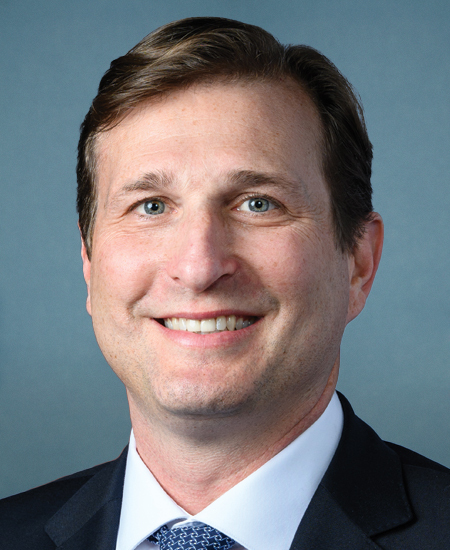
Photo of Daniel S. Goldman
D United States House · District 10 · New York

Rep. Daniel S. Goldman

Compare
Total votes
1,879
all sessions
Attendance
92%
154 missed
Lower than 95% of chamber peers
With party
97%
of cast votes
Near the chamber average
Bipartisan score
2%
crosses aisle rarely
Near the chamber average
Sponsored
1,474
bills & resolutions
Higher than 97% of chamber peers
Committees
5
assignments
1,474 bills and resolutions

Sponsored bills

Total
1,474
Primary
66
Co-sponsor
1,408
This page
1,474
matching current filters
Co-sponsor HR 3876
In committee · United States House · Co-sponsor
Access to Genetic Counselor Services Act of 2023

Maddy summaryThis bill requires Medicare to cover genetic counseling services provided by licensed genetic counselors at 85% of the physician payment rate. It defines "genetic counselor" as a state-licensed professional (or meeting federal criteria in non-licensing states) and mandates a new billing modifier for these services starting January 1, 2024. Medicare beneficiaries seeking genetic counseling would gain expanded access to these services under this coverage. The policy change applies to services furnished on or after the effective date, with implementation via interim rule.

In committee Dec 17, 2024 1 co-sponsor
Co-sponsor HR 3646
In committee · United States House · Co-sponsor
Menstrual Equity For All Act of 2023

Maddy summaryThe Menstrual Equity For All Act of 2023 requires free menstrual products to be available at no cost in public schools, colleges, correctional facilities, and federal buildings. It makes menstrual products covered by Medicaid, prohibits taxes on these products, and provides funding through social services programs to help low-income individuals access menstrual products. The bill directly affects students (K-12 and college), incarcerated people, homeless individuals, employees (in businesses with 100+ workers), Medicaid beneficiaries, and people receiving Temporary Assistance for Needy Families (TANF). Key provisions include amending school funding to require free products, creating college grant programs for menstrual product distribution, and adding menstrual products to Medicaid coverage and social services programs.

In committee Dec 17, 2024 1 co-sponsor
Co-sponsor HR 3589
In committee · United States House · Co-sponsor
Affordability is Access Act of 2023

Maddy summaryHR 3589, the Affordability is Access Act of 2023, requires health insurance plans to cover FDA-approved over-the-counter birth control without cost-sharing (like copays or deductibles). It directly affects millions of people who use contraception, particularly low-income individuals and those in areas with limited access to reproductive health services ("contraceptive deserts"). The bill clarifies that existing insurance coverage rules under the Affordable Care Act apply to over-the-counter contraceptives, and directs the FDA to expedite reviews for over-the-counter status. Retailers must not block access to these products but may refuse sales if payment isn’t provided.

In committee Dec 17, 2024 1 co-sponsor
Co-sponsor HR 3481
In committee · United States House · Co-sponsor
FAMILY Act

Maddy summaryThe FAMILY Act (HR 3481) would establish a national paid family and medical leave insurance program administered by the Social Security Administration. Eligible workers would receive wage replacement benefits (up to 85% of average earnings, with a maximum of $4,000 monthly) for up to 60 caregiving days per 12-month benefit period for qualifying reasons like caring for a sick family member, personal serious health conditions, or responding to domestic violence. The program would be funded through 0.2% payroll taxes from employees and employers (with self-employed individuals paying 0.4%), with benefits coordinated with existing state programs. The law includes protections against employer retaliation for taking leave and requires employers to maintain health coverage during leave periods.

In committee Dec 17, 2024 1 co-sponsor
Co-sponsor HR 3432
In committee · United States House · Co-sponsor
Telemental Health Care Access Act of 2023

Maddy summaryHR 3432, the Telemental Health Care Access Act of 2023, expands Medicare coverage for mental and behavioral health services delivered via telehealth. It removes geographic restrictions that previously limited telehealth coverage to rural areas and explicitly adds "behavioral health services" to the list of covered telehealth services under Medicare Part B. The bill requires the Secretary of Health and Human Services to submit a report within one year on utilization of these services, including recommendations on fraud prevention and funding needs for oversight. This change directly affects Medicare beneficiaries seeking remote mental/behavioral health care and the providers who deliver it.

In committee Dec 17, 2024 1 co-sponsor
Co-sponsor HR 3421
In committee · United States House · Co-sponsor
Medicare for All Act

Maddy summaryThe Medicare for All Act would establish a single-payer national health insurance program providing comprehensive coverage to all U.S. residents without cost-sharing. It would replace current private insurance and government programs like Medicare and Medicaid with a unified system covering all medically necessary services including hospital care, prescription drugs, mental health services, reproductive care, long-term care, and preventive services. The bill prohibits private insurers from offering duplicate coverage and requires providers to participate without charging patients for covered services. Implementation would occur over a two-year transition period, with a "Medicare Transition Buy-In" option allowing people to enroll before full implementation.

In committee Dec 17, 2024 1 co-sponsor
Co-sponsor HR 3194
In committee · United States House · Co-sponsor
U.S. Citizenship Act

Maddy summary# Summary of Proposed Immigration Legislation This comprehensive immigration bill proposes sweeping reforms across multiple areas of U.S. immigration policy. The key provisions can be categorized as follows: ## Family Immigration Reforms - Expands eligibility for family-based visas - Creates new pathways for family reunification - Reforms the "child out" rule for H-4 visa holders who age out - Establishes new procedures for sponsors of unaccompanied children ## Employment-Based Immigration - Increases diversity visas from 55,000 to 80,000 - Creates new categories for doctoral STEM graduates - Eliminates per-country limits for employment-based visas - Addresses visa backlogs by creating new categories for beneficiaries with priority dates over 10 years old - Increases visa numbers for certain employment-based categories (e.g., 23.55% instead of 28.6% for certain categories) - Creates a Regional Economic Development Immigrant Visa Pilot Program (10,000 visas annually) ## Diversity and Integration Programs - Creates a United States Citizenship and Integration Foundation to promote citizenship preparation - Establishes pilot programs for immigrant integration at state and local levels - Creates English as a Gateway to Integration grant program ($100 million for 2024-2025) - Creates Workforce Development and Shared Prosperity grant program ($100 million for 2024-2025) - Requires in-state tuition rates for refugees, asylees, and certain special immigrants - Waives English requirements for seniors applying for naturalization ## Immigration Court Reforms - Increases immigration judge numbers by 55 annually through 2028 - Creates a right to counsel for vulnerable individuals (children, victims of abuse, etc.) - Establishes an Immigration Counsel Fund with a $25 surcharge on immigration fees - Requires all noncitizens to receive legal orientation programs - Modernizes court technology for improved efficiency - Creates procedures for ensuring court appearance compliance ## Refugee and Asylum Processing - Expands alternatives to detention for family units - Improves processing for asylum seekers - Creates programs to facilitate safe and efficient repatriation - Establishes reintegration support for repatriated individuals ## Naturalization and Citizenship - Creates citizenship pathways for U.S. high school graduates - Waives English requirements for seniors - Creates a National Citizenship Promotion Program - Establishes naturalization ceremonies at historic locations The bill aims to create a more efficient immigration system, address backlogs in immigration courts, promote immigrant integration, create clearer pathways to citizenship, and reform both family-based and employment-based immigration systems. It represents a comprehensive approach to modernizing U.S. immigration policy.


In committee Dec 17, 2024 1 co-sponsor
Co-sponsor HR 3086
In committee · United States House · Co-sponsor
Find It Early Act

Maddy summaryHR 3086, the "Find It Early Act," requires health insurance plans to cover breast cancer screenings with no cost-sharing for certain individuals at higher risk of breast cancer. The bill affects people with increased risk (based on medical criteria or dense breast tissue) or those needing screening due to factors like age, race, ethnicity, or family history. Key provisions mandate coverage for 2D/3D mammograms, ultrasounds, MRI, and other technologies without frequency limits for these groups. This applies to group health plans, Medicare, Medicaid, TRICARE, and VA healthcare systems starting January 1, 2024. The law aims to improve early detection by removing financial barriers to necessary screenings.

In committee Dec 17, 2024 1 co-sponsor
Co-sponsor HR 2940
In committee · United States House · Co-sponsor
PASTEUR Act

Maddy summaryThe PASTEUR Act establishes a new subscription payment model to incentivize development of new antimicrobial drugs for resistant infections. It creates a Committee on Critical Need Antimicrobials and a Subscription Contract Office to manage payments based on specific drug characteristics like treating multi-drug resistant infections, novel mechanisms of action, and oral administration. Under this model, the government would pay drug developers up to $3 billion over 10 years for qualifying drugs, with payments tied to requirements like ensuring drug availability, reporting resistance data, and developing appropriate use plans. The bill aims to address the lack of new antimicrobial drugs by changing the funding model to reward drugs that meet specific clinical and public health needs.

In committee Dec 17, 2024 1 co-sponsor
Co-sponsor HR 2909
In committee · United States House · Co-sponsor
Preventing Illegal Weapons Trafficking Act of 2023

Maddy summaryThe Preventing Illegal Weapons Trafficking Act of 2023 requires federal agencies to develop a strategy within 120 days to intercept machinegun conversion devices - parts designed to convert regular firearms into machineguns. The strategy must include better coordination between federal and local law enforcement, training for state and local police to identify these devices, and tracking their origins to identify trafficking patterns. It also amends tax law to allow forfeiture of proceeds from illegal machinegun trafficking and mandates that the Attorney General include specific data on machinegun conversion devices in the annual firearms trafficking report. This law directly affects federal agencies (like the ATF and DHS) and state/local law enforcement through new coordination, reporting, and data-collection requirements.

In committee Dec 17, 2024 1 co-sponsor
Showing 801 to 810 of 1,474 bills
Previous 1 … 80 81 82 … 148 Next