

Maddy summaryHR 2429 requires the Secretary of Transportation to create and implement a 10-year campus modernization plan for the U.S. Merchant Marine Academy within 180 days. The bill directs the modernization of outdated facilities - including new training labs, a safety training pool, updated athletic facilities, and infrastructure upgrades like electrical systems and accessibility improvements - to support midshipmen training for maritime careers and national defense. It authorizes $1.02 billion in funding (starting in 2026) for phased construction and renovations over 10 years, prioritizing facilities needed for Coast Guard licensing exams, physical readiness, and campus safety. The plan directly affects the academy’s midshipmen, faculty, and operations by replacing aging infrastructure that currently hinders training.
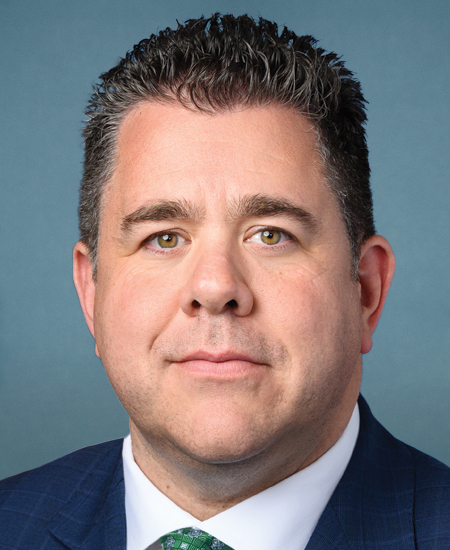
Rep. Nick LaLota
Sponsored bills
Maddy summaryThe Providing Veterans Essential Medications Act requires the Department of Veterans Affairs to reimburse State homes or provide medications directly for certain high-cost drugs used by veterans in State-run nursing homes. A medication is defined as high-cost if its price (including a 3% fee) exceeds 8.5% of the VA's monthly payment for the veteran's care at that home. This applies specifically to State homes that provide such medications to veterans under VA contracts. The bill ensures veterans receive essential medications without financial burden on the State homes, using clear cost thresholds to determine eligibility.
Maddy summaryHRES 254 is a non-binding resolution recognizing the 250th anniversary of the United States Marine Corps, to be observed on November 10, 2025. The resolution honors the Corps' founding at Tun Tavern in Philadelphia on November 10, 1775, its history of service in major conflicts, and its values of honor, courage, and commitment. It encourages public participation in commemorative events and local recognition of Marines' contributions to national defense.
Maddy summaryHR 2381, the SCREENS for Cancer Act of 2025, reauthorizes and updates the National Breast and Cervical Cancer Early Detection Program (NBCCEDP). It directly affects low-income, uninsured, or underinsured women across all 50 states, territories, and tribal communities by expanding access to breast and cervical cancer screenings, diagnostic services, and patient navigation support. Key provisions include updating program language to emphasize prevention alongside detection and control, adding specific strategies to reduce disparities, and appropriating $235 million annually for fiscal years 2026-2030. The bill also requires a GAO study by 2027 to assess program eligibility, service trends, and barriers to screening access.
Maddy summaryThe Safer Skies Act of 2025 requires specific smaller airlines to adopt enhanced security screening protocols currently used by larger carriers. It mandates that "covered air carrier operations" - defined as airlines operating under certain FAA rules, offering individual seats with public schedules, using planes with more than nine passenger seats, and not using TSA checkpoints - to follow the Aircraft Operator Standard Security Program (49 CFR §1544.101(a)) within 360 days of the bill's enactment. The Transportation Security Administration must revise its rules to enforce this requirement. This directly affects regional and private charter airlines that currently skip TSA checkpoint screening but serve the public with scheduled passenger flights.
Maddy summaryHRES 249 is a symbolic resolution recognizing the 204th anniversary of the War of Greek Independence (commencing March 25, 1821). It commemorates this historical event and affirms shared democratic values between the United States and Greece. The resolution highlights Greece's strategic role in the Eastern Mediterranean, its NATO partnership, and the contributions of the Greek-American community, without creating new policies or affecting any specific group. It was introduced on March 25, 2025, and referred to the Foreign Affairs Committee.
Maddy summaryThe Unity through Service Act of 2025 establishes an Interagency Council on Service (Section 2) composed of senior federal officials from departments including Defense, State, Labor, and Education. The Council advises the President on coordinating military, national, and public service recruitment strategies, developing joint marketing initiatives, and assessing service program impacts (Section 2(c)). It requires annual reports to Congress on service strategies, a joint report on integrating military and national service recruitment within four years (Section 5), and a study on advertising effectiveness and vaccine requirements' impact on retention (Section 6). The bill directly affects federal agencies managing military, Peace Corps, and national service programs by mandating cross-agency coordination and reporting, without authorizing new funding (Sections 8-9).
Maddy summaryHR 2311, the Pakistan Democracy Act, imposes U.S. sanctions on Pakistani military and government officials who undermine democracy or wrongfully detain political figures. Specifically, it requires sanctions within 180 days on General Asim Munir (Pakistan’s Army Chief) and identifies individuals involved in the persecution of Imran Khan or other political detainees, barring them from U.S. entry via visa inadmissibility. The bill mandates the President to certify to Congress for waivers, requiring proof that military rule has ended and political detainees are freed. It defines key terms like "knowingly" and "foreign person" to clarify eligibility for sanctions. The law directly affects targeted Pakistani officials and their immediate family members, with no mention of broader economic or diplomatic measures.
Maddy summaryHR 2296, the National Weather Service Communications Improvement Act, requires the National Weather Service (NWS) to replace its internal instant messaging system (NWSChat) with a commercial cloud-based solution by October 1, 2027. The new system must accommodate future growth, support increased users, be user-friendly, and resemble common commercial platforms. Funding up to $3 million annually from 2026-2029 will cover this upgrade, sourced from existing NWS operational budgets. This bill directly affects NWS personnel who rely on internal communications for weather forecasting and warnings.
Maddy summaryThis bill (HR 2199) prevents private health insurance plans from discriminating against patients with end-stage kidney disease (ESRD) who require dialysis. It amends the Social Security Act to prohibit plans from treating dialysis coverage differently than other medical services or applying network restrictions that disproportionately harm ESRD patients. The law clarifies that plans cannot deny or limit benefits for dialysis based on a patient’s diagnosis, while preserving a plan’s right to choose which dialysis providers are in their network. It directly affects ESRD patients and their private health insurance coverage, ensuring dialysis is treated equally with other covered medical services. The bill does not require plans to include specific dialysis providers but stops them from unfairly restricting access to necessary care.