This resolution expresses the sense of the House of Representatives that (1) lesbian, gay, bisexual, transgender, queer, intersex, and asexual (LGBTQIA+) rights are human rights and protected by the U.S. Constitution; (2) LGBTQIA+ Pride Month should be celebrated; and (3) all Americans should be treated equally regardless of sexual orientation or gender identity.
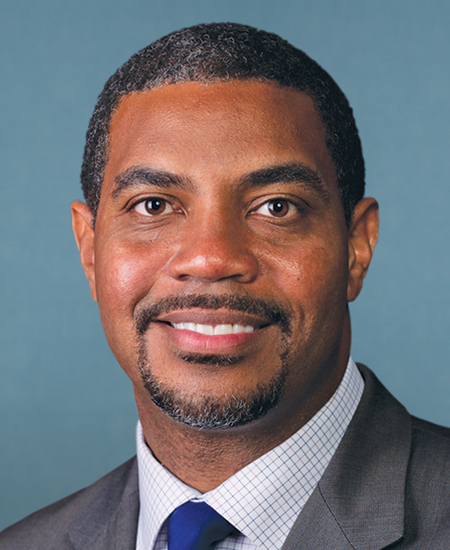
Rep. Steven Horsford
Sponsored bills
Maddy summaryHRES 437 is a symbolic House resolution designating June 4, 2021, as "National Gun Violence Awareness Day" and June 2021 as "National Gun Violence Awareness Month." It does not create new laws or policies but calls on the public to wear orange, increase awareness of gun violence, and focus on community safety efforts during summer months. The resolution references statistics on gun deaths and honors Hadiya Pendleton, a 15-year-old victim of gun violence, to highlight the issue. It has no direct legal effect on individuals or communities but aims to promote public discussion.
Visitor Visa Wait Time Reduction Act This bill requires the Department of State to report to Congress on the average waiting time to get a visitor visa interview at each diplomatic or consular post. For each post where the average waiting time is longer than 300 days, the State Department must temporarily reassign personnel at that post to shorten the waiting time.
Strengthen and Tackle Opportunities to Prevent Violence Act of 2022 or the STOP Violence Act of 2022 This bill allows funds under the Antiterrorism and Emergency Assistance Program to be used for efforts to prepare against mass violence and protect public assembly facilities.
Latonya Reeves Freedom Act of 2022 This bill prohibits government entities and insurance providers from denying community-based services to individuals with disabilities that require long-term service or support that would enable such individuals to live in the community and lead an independent life. Specifically, these entities may not discriminate against such individuals in the provision of community-based services by such actions as imposing prohibited eligibility criteria, cost caps, or waiting lists or failing to provide a specific community-based service. Additionally, community-based services must be offered to individuals with such disabilities prior to institutionalization. Institutionalized individuals must be notified regularly of community-based alternatives. The bill requires the Department of Justice to issue regulations requiring government entities and insurance providers to offer community-based long-term services to individuals with such disabilities who would otherwise qualify for institutional placement. Government entities must ensure sufficient availability of affordable, accessible, and integrated housing that is not a disability-specific residential setting or a setting where services are tied to tenancy. Regulations shall also (1) require government entities and insurance providers to perform self-evaluation on current services, policies, and practices and concerning compliance with requirements of this bill; and (2) require government entities to submit a transition plan. The bill provides funds for FY2022 for the Department of Health and Human Services to provide technical assistance with respect to transition plans. The bill allows civil actions by individuals subjected to, or about to be subjected to, a violation of its requirements.

Porch Pirates Act of 2022 This bill extends federal criminal penalties for obstruction of correspondence and theft of stolen mail matter (which apply to U.S. Postal Service mail) to matter (e.g., packages) sent or delivered by private or commercial interstate carriers.
Defending Ukraine Sovereignty Act of 2022 This bill authorizes security assistance for Ukraine, requires sanctions against Russia if it escalates hostilities in or against Ukraine, and addresses related issues. The bill (1) authorizes the Department of Defense to use various authorities to provide and expedite the delivery of defense articles to support Ukraine's armed forces, (2) allows the President to exercise drawdown authority to provide defense articles to Ukraine, and (3) authorizes the Department of State to provide International Military Education and Training assistance to Ukraine. The President must periodically determine whether Russia's government is significantly escalating hostilities in or against Ukraine and whether such an escalation has the aim or effect of undermining Ukraine's government or interfering with Ukraine's sovereignty or territorial integrity. If the President determines that Russia's government has engaged in such escalation, the President must impose sanctions on (1) certain government officials, including Russia's president and prime minister; (2) certain Russian financial institutions; (3) entities involved in certain transactions involving Russian debt; (4) entities (and corporate officers of such entities) involved in constructing or operating Russia's Nord Stream 2 natural gas pipeline; and (5) certain entities involved in Russian resource extraction industries. The President may terminate such sanctions after certifying to Congress that Russia's government has taken certain actions, such as entering into an agreed settlement with Ukraine's legitimate democratic government. The bill also authorizes Radio Free Europe/Radio Liberty to explore opening new bureaus to reach new audiences on Russia's periphery. The State Department must establish an initiative to deepen and foster ties with the Baltic states.
Ending Homelessness Act of 2021 This bill expands the housing choice voucher program and provides assistance to homeless individuals and families. Specifically, the bill provides FY2022-2025 funding for the expansion of the housing choice voucher program for certain extremely low income families. Furthermore, beginning in FY2026, the bill creates and funds an entitlement to housing choice vouchers for certain extremely low income families. Eligibility for the entitlement expands annually, extending to low-income families by FY2030. The bill also reduces the geographic area used to calculate an area's fair market rent for purposes of voucher payment standards and prohibits the use of criminal history in determining eligibility for certain housing assistance. Additionally, the bill prohibits housing discrimination on the basis of a renter's source of income or a renter's veteran status. The bill also provides additional FY2022-FY2026 funding for the Department of Housing and Urban Development (HUD) to assist the homeless, including to award emergency relief grants in jurisdictions with the highest need and award grants to provide outreach and coordinate services. Furthermore, the bill provides additional FY2022-FY2026 funding for the Housing Trust Fund, which provides affordable housing for extremely low-income and very low-income families. While this additional funding is available, HUD must ensure that priority for occupancy in assisted units is given to individuals and families who are homeless. Finally, the bill permanently reauthorizes certain homeless assistance grants and makes permanent the U.S. Interagency Council on Homelessness.
Housing is Infrastructure Act of 2021 This bill generally addresses housing affordability and infrastructure. The bill authorizes the Department of Housing and Urban Development (HUD) to provide grants, programs, and other support related to public housing, affordable housing preservation and construction, and mortgage access. The bill also establishes and funds the National Investment Authority (NIA) which must design, finance, and implement a strategy of long-term national economic growth and development. The NIA must select projects that coordinate investment of public and private capital in equitable, inclusive, and sustainable growth of the economy. Furthermore, the bill establishes the National Infrastructure Bank (NIB) to implement the strategy by engaging in credit market activities that support public and private investment in critical public infrastructure projects. The bill gives the NIA bond issuing authority and authorizes the Board of Governors of the Federal Reserve System to purchase these bonds. The Federal Reserve must lend funds on a short-term basis upon the request of the NIB and other subsidiaries. Additionally, the Department of the Treasury must provide for a line of credit not to exceed 100% of the NIA's total assets. Finally, the bill (1) authorizes HUD to provide support for fair housing organizations, and (2) requires consultation with a fair housing enforcement organization as part of an application for certain housing grants or funds.
Economic Inclusion Civil Rights Act of 2021 This bill modifies the prohibition against intentional racial discrimination in the context of economic activity such as employment, contracts, or other commercial transactions. Specifically, the bill makes an action that has a discriminatory effect a violation of section 1977 of the Revised Statutes. Further, a plaintiff may prove intentional discrimination by showing only that the discriminatory intent was a motivating factor in the alleged violation. Under current law, a plaintiff must prove that the harm would not have occurred but for the defendant's unlawful conduct. Additionally, standing shall not be limited to victims who were parties to, or third-party beneficiaries of, a contract with the defendant. The bill provides for a right to jury trial and no joint-action waiver or pre-dispute arbitration agreement shall be enforceable with respect to any alleged violation. The bill provides for a four-year statute of limitations.