

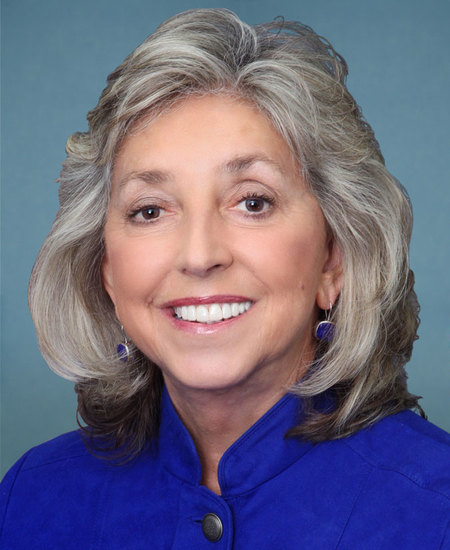
Photo of Dina Titus
D United States House · District 1 · Nevada On the 2026 ballot

Rep. Dina Titus

Compare
Total votes
2,837
all sessions
Attendance
96%
119 missed
Lower than 92% of chamber peers
With party
97%
of cast votes
Near the chamber average
Bipartisan score
1%
crosses aisle rarely
Near the chamber average
Sponsored
2,683
bills & resolutions
Higher than 97% of chamber peers
Committees
8
assignments
2,683 bills and resolutions

Sponsored bills

Total
2,683
Primary
132
Co-sponsor
2,551
This page
2,683
matching current filters
Co-sponsor HR 2905
In committee · United States House · Co-sponsor
Ensuring Agency Service Quality Act

Maddy summaryHR 2905, the Ensuring Agency Service Quality Act, requires federal executive agencies and military departments to maintain specific staffing levels as defined by law, overriding prior provisions. It mandates that agency heads notify Congress within seven days if they cannot meet these required staffing levels, providing an explanation for the shortfall. The bill directly affects all executive agencies and military departments covered under Title 5 of the U.S. Code. Its key mechanism is the new staffing requirement combined with the mandatory noncompliance reporting process to Congress.

In committee Apr 10, 2025 1 co-sponsor
Co-sponsor HR 2888
In committee · United States House · Co-sponsor
Stopping a Rogue President on Trade Act

Maddy summaryHR 2888, the "Stopping a Rogue President on Trade Act," terminates specific executive orders imposing tariffs (EOs 14257, 14193, and 14194) and requires congressional approval for new tariffs or trade restrictions. It directly affects the President, who can no longer unilaterally impose or increase tariffs without Congress passing a joint resolution approving the action. Key mechanisms include mandating a formal joint resolution process for tariff decisions (with limited exceptions for existing antidumping duties and trade agreements) and applying expedited congressional procedures. This bill shifts authority from the executive branch to Congress for major trade policy changes.

In committee Apr 10, 2025 1 co-sponsor
Co-sponsor HR 2859
In committee · United States House · Co-sponsor
Child Care Nutrition Enhancement Act of 2025

Maddy summaryHR 2859, the Child Care Nutrition Enhancement Act of 2025, adds a 10-cent per meal reimbursement to the Child and Adult Care Food Program (CACFP) for meals served to children in licensed childcare settings. This change directly affects childcare providers, including family and group day care homes and centers participating in CACFP, starting after the bill's enactment. The bill amends existing law to require this additional payment for every meal and supplement served under the program. The increase applies to all qualifying meals served after the effective date, without altering existing reimbursement tiers or eligibility rules.

In committee Apr 10, 2025 1 co-sponsor
Co-sponsor HR 2818
In committee · United States House · Co-sponsor
Early Childhood Nutrition Improvement Act

Maddy summaryHR 2818, the Early Childhood Nutrition Improvement Act, updates federal child care nutrition program rules to improve administration and reduce burdens. It requires annual eligibility reviews for for-profit child care centers (Section 2), overhauls how "serious deficiency" findings are handled (Section 3), and allows up to 3 meals per day for children in extended care (Section 4), including a study on third-meal reimbursement. The bill also creates an advisory committee (Section 6) to reduce paperwork for providers, parents, and states, focusing on streamlining applications, digital documentation, and eliminating duplicative State requirements. These changes directly affect child care centers, family day care homes, and state agencies administering the program.

In committee Apr 10, 2025 1 co-sponsor
Co-sponsor HR 2864
In committee · United States House · Co-sponsor
Veterans for Mustangs Act

Maddy summaryThis bill amends the Wild Free-Roaming Horses and Burros Act to change how the Bureau of Land Management manages horse and burro populations. It requires using fertility control vaccines as the first priority method for population management, replacing previous steps. Crucially, it directs the Secretary to prioritize recruiting and training military veterans for these fertility control tasks, including through the PZP applicator certification program, with veterans receiving appropriate compensation. This directly affects wild horse and burro populations through new management methods and military veterans through new training and contracting opportunities under the program.

In committee Apr 10, 2025 1 co-sponsor
Co-sponsor HJRES 91
In committee · United States House · Co-sponsor
Relating to a national emergency by the President on April 2, 2025.

Maddy summaryH.J. Res. 91 terminates the national emergency declared by the President on April 2, 2025, under Executive Order 14257. The resolution ends this emergency status by invoking Section 202 of the National Emergencies Act (50 U.S.C. 1622). This action would halt the use of emergency powers associated with the declaration, such as special authorities or funding mechanisms. The bill directly affects federal agencies and the executive branch by removing the legal basis for operating under the emergency framework.

In committee Apr 9, 2025 1 co-sponsor
Co-sponsor HR 2762
In committee · United States House · Co-sponsor
Expanding Access to Family Planning Act

Maddy summaryHR 2762 establishes a new Title X Clinic Fund to expand federal funding for family planning clinics. It appropriates $512 million annually (2026-2035) for clinic grants and $50 million for infrastructure like construction and equipment. The bill requires clinics receiving this funding to provide nondirective pregnancy counseling, ensuring patients receive neutral information about all options - including prenatal care, adoption, and termination - upon request. This directly affects Title X clinics nationwide and the low-income patients they serve, primarily by increasing financial support and standardizing counseling practices.

In committee Apr 9, 2025 1 co-sponsor
Co-sponsor HR 2763
In committee · United States House · Co-sponsor
American Family Act

Maddy summaryThe American Family Act (HR 2763) establishes a new refundable child tax credit that provides monthly payments to eligible families with children. It would pay $300 per month for each child under age 6 and $360 per month (120% of $300) for each child age 6 or older, with income limits of $150,000 for joint filers and $112,500 for other filers. The bill creates a "period of presumptive eligibility" to determine eligibility for monthly payments, allowing families to receive advance payments based on information from previous tax returns. This would directly affect millions of families with children who meet the income requirements, providing more consistent financial support throughout the year rather than an annual tax credit.

In committee Apr 9, 2025 1 co-sponsor
Primary HR 2799
In committee · United States House · Lead sponsor
Closing the Bump Stock Loophole Act of 2025

Maddy summaryHR 2799, the Closing the Bump Stock Loophole Act of 2025, prohibits the sale, possession, and modification of devices that increase the firing rate of semi-automatic firearms to mimic machine guns (commonly called "bump stocks"). It specifically bans manual, power-driven, or electronic devices designed to speed up firing, as well as modified firearms that achieve this effect. Owners of pre-existing modified firearms must register them within 120 days of the law's enactment, with exemptions for government entities and firearms already lawfully modified and registered before the bill passes. The bill does not restrict standard semi-automatic firearms or require registration of unmodified guns.

In committee Apr 9, 2025 0 co-sponsors
Co-sponsor HR 2764
In committee · United States House · Co-sponsor
Tax Cut for Workers Act of 2025

Maddy summaryThis bill expands the Earned Income Tax Credit (EITC) for low-income workers by lowering the minimum age to claim the credit from 25 to 19 (with exceptions for students, former foster youth, and homeless youth), removing the maximum age limit of 65, and doubling the credit percentage from 7.65% to 15.3%. It also increases the income thresholds for eligibility, raising the phaseout starting point from $4,220 to $9,820 for single filers and $5,280 to $11,610 for joint returns. The credit amounts and income limits will now adjust annually for inflation using specific Consumer Price Index (CPI) benchmarks. Additionally, taxpayers can elect to use their prior year’s earned income to calculate the credit if it was higher than the current year’s, effective for 2026 tax returns.

In committee Apr 9, 2025 1 co-sponsor
Showing 571 to 580 of 2,683 bills
Previous 1 … 57 58 59 … 269 Next