This resolution commends domestic and international efforts to combat human immunodeficiency virus/acquired immunodeficiency syndrome (HIV/AIDS) and calls for additional actions to address the disease.
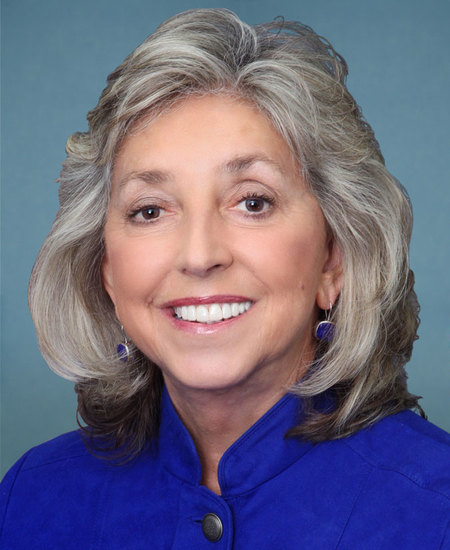
Rep. Dina Titus
Sponsored bills
This bill allows the Department of Transportation (DOT) to increase the federal share for projects under the Congestion Mitigation and Air Quality Improvement Program that primarily benefit environmental justice communities (i.e., low-income or minority communities). DOT must also evaluate whether the current apportionment method is appropriate for achieving program goals.
Armed Forces Transgender Dependent Protection Act This bill expands the policy of the Office of Special Needs within the Department of Defense to address transgender dependents. Specifically, the bill codifies the definition of a medical or educational special need to include gender dysphoria. Under the bill, the policy of the office must prohibit the assignment of a military family with special needs to a permanent duty location where the law restricts medically necessary treatment for a medical or educational special need. A member who is serving at a location when such a law is established may elect to be reassigned.
Improving Access to Medicare Coverage Act of 2021 This bill deems an individual receiving outpatient observation services in a hospital as an inpatient for purposes of satisfying the three-day inpatient hospital-stay requirement with respect to Medicare coverage of skilled nursing facility services.
This resolution reaffirms the commitment of the United States to the independence, territorial integrity, and sovereignty of Uzbekistan. It also recognizes Uzbekistan's progress in recent years on important political, economic, democratic, and social reforms.
United States Army Rangers Veterans of World War II Congressional Gold Medal Act This bill provides for the award of a single Congressional Gold Medal to the U.S. Army Rangers Veterans of World War II in recognition of their dedicated service during World War II.
Computer Science for All Act of 2021 This bill establishes a program through which the Department of Education must award grants to states, local educational agencies, and eligible tribal schools to serve as models for national replication of computer science education expansion efforts. Grant recipients must use these funds for certain activities, including training teachers to teach computer science and expanding access to high-quality learning materials and online options.
Veteran Education Empowerment Act This bill reauthorizes through FY2029 and otherwise revises a Department of Education (ED) grant program for student veteran centers. Specifically, ED must make grants to institutions of higher education (IHEs) or consortia of IHEs to establish, maintain, improve, or operate a student veteran center. A student veteran center is a dedicated space on a campus that provides students who are veterans or members of the Armed Forces with (1) a lounge or meeting space for themselves, their spouses or partners, their children, and veterans in the community; and (2) a centralized office for student veteran services that serves as a single point of contact to coordinate comprehensive support services for student veterans.
Reproductive Rights are Human Rights Act of 2021 This bill directs the Department of State to include in its annual reports on human rights in countries receiving U.S. development and security assistance a discussion of the status of reproductive rights in each country. This must include whether a country has adopted and enforced policies to (1) promote access to contraception and accurate, nondiscriminatory family planning and sexual health information; (2) provide services to ensure safe and healthy pregnancy and childbirth; (3) expand or restrict access to safe abortion services; and (4) prevent and treat sexually transmitted diseases. For each country, the reports shall also contain (1) data concerning pregnancy-related injuries and deaths; and (2) a description of the nature and extent of discrimination and violence against women, girls, and LGBTQI+ individuals in health care settings and the relevant government's response to such actions.
Global Pandemic Prevention and Biosecurity Act This bill establishes a task force and requires the Department of State and the U.S. Agency for International Development (USAID) to take specified measures to respond to and prevent zoonotic (animal-to-human) disease outbreaks. Specifically, the bill establishes the Global Zoonotic Disease Task Force to ensure an integrated approach to preventing, detecting, preparing for, and responding to zoonotic spillover and zoonotic disease outbreaks that may pose a threat to global health security. The bill directs the State Department and the USAID to work with international stakeholders on measures that include (1) preventing zoonotic spillover events, (2) preventing degradation and fragmentation of forests and other ecosystems to minimize interactions between wildlife and human populations, and (3) strengthening global capacity for detection of zoonotic diseases with pandemic potential. Further, the USAID must develop and publish a strategy for food security, global health, and biodiversity protection, including information about zoonotic disease surveillance. To help implement and finance the strategy, the USAID must establish a Conservation Corps to provide Americans eligible for service abroad to deliver technical and strategic assistance. The bill also authorizes a program within the USAID to prevent spillover events, epidemics, and pandemics through specified activities.