

Displaced Afghan Women and Girls Education Act of 2022 This bill provides certain educational resources to certain displaced Afghan women and girls domiciled in the United States. For example, the bill (1) requires such displaced Afghan women and girls to receive in-state tuition rates at public institutions of higher education, and (2) provides funding for and establishes the Displaced Afghan Women and Girls Scholarship Grant.
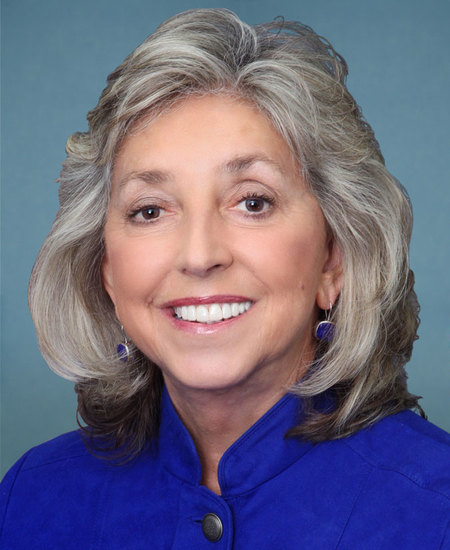
Rep. Dina Titus
Sponsored bills
Commercial Advertisement Loudness Mitigation Modernization Act of 2022 or the CALM Modernization Act of 2022 This bill applies certain requirements concerning the volume of commercials to video streaming services that are supported by advertisements (e.g., Hulu). It also modifies enforcement related to those requirements. Current law requires commercials transmitted via broadcast, cable, and satellite television to have the same average volume as the underlying programming. Under this bill, the Federal Communications Commission must apply through rulemaking similar requirements to ad-supported video streaming services. The bill also modifies enforcement of requirements for moderating the volume of commercials. The commission currently uses a complaint-driven enforcement process. Under this bill, the commission must treat violations of the requirements as violations of the Communications Act of 1934. Additionally, the bill makes rebuttable a presumption that deems a broadcast television station, cable operator, or other multichannel video programming distributor in compliance with the requirements if it appropriately installs and uses certain equipment and software to moderate the volume of commercials. The Government Accountability Office must report on the effectiveness of the requirements, and the commission's enforcement of them, in moderating the volume of commercials.
Don Young Veterans Advancing Conservation Act This bill requires the National Oceanic and Atmospheric Administration (NOAA) to establish the Veterans Advancing Conservation Grant Program to award grants, on a competitive basis, to facilitate the training and employment of veterans for marine and coastal conservation activities (e.g., coral restoration and rehabilitation). NOAA must coordinate with the Department of the Interior and the Department of Veterans Affairs to implement the program.
Supporting American Printed Circuit Boards Act of 2022 This bill establishes a business tax credit for the purchase of printed circuit boards manufactured in the United States. It also provides financial incentives for entities that invest in facilities and equipment in the United States for manufacturing (or research and development of) printed circuit boards.
United States Innovation and Competition Act of 2021 This bill addresses U.S. technology and communications, foreign relations and national security, domestic manufacturing, education, trade, and other matters. Among other provisions, the bill provides funding for FY2022-FY2026 to support U.S. semiconductor manufacturing, research and development, and supply chain security; provides funding for wireless supply chain innovation; establishes a Directorate for Technology and Innovation in the National Science Foundation; extends through 2025 the authority of the National Aeronautics and Space Administration (NASA) to lease its non-excess real property and related personal property; authorizes various programs and policies related to space exploration; authorizes various international affairs programs and activities, including foreign assistance for the Indo-Pacific region; requires federal infrastructure programs to provide for the use of materials produced in the United States; imposes sanctions on China for cybersecurity and human rights abuses; requires the Department of Health and Human Services to consider national security risks associated with sensitive genetic information; includes initiatives related to elementary and secondary education, including those to increase computer science education; contains provisions related to higher education, including those reauthorizing through FY2027 international education programs and addressing China's influence on institutions of higher education; modifies and expands the schedule for graduated merger filing fees; prohibits federal funding for the Wuhan Institute of Virology; requires the U.S. Trade Representative to take certain actions related to digital trade and censorship practices; and extends through 2027 the Generalized System of Preferences.
Respect, Advancement, and Increasing Support for Educators Act of 2022 or the RAISE Act of 2022 This bill allows eligible educators (i.e., any elementary or secondary teacher and any early childhood educator) a refundable tax credit of $1,000 plus an additional amount (based upon a specified student poverty ratio) for eligible educators employed at a qualifying school (i.e., a public elementary or secondary school that is eligible for certain federal assistance or is funded by the Bureau of Indian Education), or an early childhood education program for children receiving certain federal assistance. The bill also increases the amount of the tax deduction for the expenses of elementary and secondary school teachers and expands such credit to include early childhood educators. The bill provides additional funding to local educational agencies that maintain or increase the salaries of their teachers.
Pride in Mental Health Act This bill expands programs that prevent and treat child abuse and neglect to address issues facing youth who are lesbian, gay, bisexual, transgender, queer or questioning, nonbinary, or gender-variant members of indigenous communities (e.g., Two Spirit). Specifically, these programs include (1) research and reporting requirements, (2) providing technical assistance, (3) grants to states and local agencies to train child-welfare personnel, and (4) community-based prevention-service grants. The bill also establishes a grant program to provide mental and behavioral health resources for such youth, including trauma-informed care.
Advancing Equity Through the Arts and Humanities Act of 2022 This bill establishes an Advancing Equity Through the Arts and Humanities Program to increase engagement with public and nonprofit entities (including faith-based and community-based organizations that serve and are led by people of color) in supporting arts and humanities projects that directly combat systemic racism through the arts and humanities. The National Endowment for the Arts and the National Endowment for the Humanities shall carry out this program. The bill also provides for a competitive grant program for the creation and expansion of programs to support public and nonprofit arts and humanities organizations that directly combat systemic racism through the arts and humanities.
Stop Sexual Harassment in K-12 Act This bill outlines the role and duties of Title IX coordinators in elementary and secondary schools, including by requiring local educational agencies to increase the number of full-time employees designated to serve as a Title IX coordinator per specified student population. The bill also creates a grant program to train teachers and staff on how to respond to signs of sexual harassment and assault of students and requires the Department of Education to develop a sexual violence climate survey.
Protecting Semiconductor Supply Chain Materials from Authoritarians Act This bill establishes an interagency working group to address semiconductor supply chain issues caused by Russia's attack on Ukraine. The working group must report to Congress on issues including (1) the impact of Russia's attack on Ukraine on the supply of various materials, including palladium, neon gas, and helium; (2) the attack's impact on supply chains and the global economy; and (3) recommendations for legislative steps that Congress can take to further bolster the supply of materials for the semiconductor supply chain that have been curtailed by Russia's actions. The working group must also report annually to Congress on future geopolitical developments that could severely disrupt global semiconductor supply chains in ways that could harm the United States.