

Supporting Every at-Risk Veteran In Critical Emergencies Act of 2021 or the SERVICE Act of 2021 This bill authorizes the Office of Community Oriented Policing Services within the Department of Justice to make grants to support the creation and operation of veterans' response teams in state, local, and tribal law enforcement agencies.
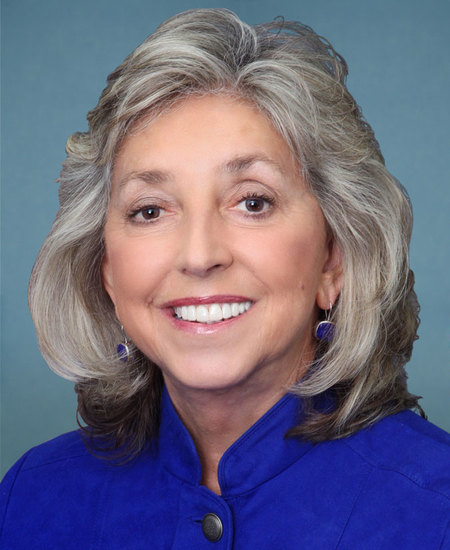
Rep. Dina Titus
Sponsored bills
Firearms Retailer Code of Conduct Act of 2021 This bill establishes requirements for federal firearms licensees (e.g., gun dealers) and their employees regarding certain business practices, training, and certification. It also prohibits licensees from transferring firearms to certain individuals, including straw purchasers, gun traffickers, intoxicated individuals, or individuals at risk of harming themselves or others.
Fair Adjudications for Immigrants Act This bill narrows the scope of certain crime-based grounds for barring or removing an alien from the United States. (Generally, a conviction for certain crimes, such as a crime that carries a term of incarceration of a certain length, may constitute grounds for denying an individual certain immigration benefits.) The bill redefines the term conviction to exclude convictions that have been dismissed, expunged, deferred, annulled, invalidated, withheld, vacated, or pardoned. The term must also exclude adjudications where a court issued a recommendation against removal, an order of probation without entry of judgment, or a similar disposition. In addition, any reference to a term of imprisonment or sentence must, unless otherwise provided (1) only consider the period of incarceration ordered by a court, and (2) exclude any suspended portion of a sentence. Currently, for immigration purposes, a term of incarceration includes any part of the sentence that was suspended. These provisions pertaining to the definition of conviction and terms of imprisonment shall apply to convictions and judgments entered either before or after this bill's enactment. Furthermore, certain crime-based grounds for barring or removing an alien shall not apply if the sentencing court issues a recommendation that the alien not be removed on the basis of the conviction.
Fostering Overseas Rule of law and Environmentally Sound Trade Act of 2021 or the FOREST Act of 2021 This bill restricts certain commodities produced on illegally deforested land from accessing the U.S. market. Specifically, the bill prohibits the importation of any product made wholly or in part of a covered commodity produced from illegally deforested land. The bill outlines requirements for import declarations of covered commodities. The U.S. Trade Representative (USTR) must, within 30 days, publish (1) an initial list of covered commodities that consists of palm oil, soybeans, cocoa, cattle, rubber, and wood pulp; and (2) an initial list of covered products that are defined by the bill in accordance with the Harmonized Tariff Schedule. These lists must be updated at least on an annual basis. Further, the USTR must identify foreign countries without adequate and effective protection against illegal deforestation caused by the production of commodities that are likely to enter the United States. The USTR must develop an action plan that includes benchmarks for each identified country. Additionally, the bill creates an interagency working group to provide advice and recommendations to the USTR, U.S. Customs and Border Protection, and other relevant agencies. The bill provides funding to assist foreign governments in combating illegal deforestation. The bill also includes illegal deforestation as a specified unlawful activity under a federal financial crime statute. The bill establishes a federal procurement preference for commodities that are not produced from land subject to deforestation.
Closing the Bump Stock Loophole Act of 2021 This bill subjects bump stocks to regulation under federal firearms laws. Specifically, the bill adds bump stocks to the list of firearms subject to regulation (e.g., registration and licensing requirements) under the National Firearms Act. Additionally, it includes bump stocks in the list of firearms subject to regulation (e.g., background check requirements) under the Gun Control Act of 1968.
Reduce Financial Barriers to Immigration and Citizenship Act of 2021 This bill prohibits the Department of Homeland Security (DHS) from charging fees for certain immigration applications (or petitions), requires DHS to provide fee waivers to certain applicants, and addresses related issues. DHS may not impose fees for certain applications for or related to (1) asylum or refugee status, (2) special immigrant juvenile status, (3) U or T non-immigrant visas (victims of certain crimes such as human trafficking), (4) the Violence Against Women Act, (5) special immigrant status for Afghan or Iraqi nationals employed by the U.S. government, or (6) immigration-related fee waivers. DHS must also waive immigration-related application fees for an applicant who receives a means-tested benefit or meets certain conditions related to financial hardship. However, DHS is not required to provide fee waivers for applications for certain employment-based immigration benefits. Receipt of a fee waiver may not be used as a factor (1) for determining whether an alien should be considered a public charge, or (2) when considering an affidavit of support filed by a sponsor. The bill also requires all collected immigration-related adjudication fees to be used only to fund the adjudication and administration of immigration benefits and naturalization.
Gun Trafficker Detection Act This bill requires gun owners to report the theft or loss of a firearm to law enforcement. It imposes civil monetary penalties on a violator.
Lifting Immigrant Families Through Benefits Access Restoration Act of 2021 or the LIFT the BAR Act of 2021 This bill repeals certain limits on the eligibility of noncitizens who lawfully reside in the United States for federal means-tested programs, including Medicaid, the Children's Health Insurance Program (CHIP), programs funded through Temporary Assistance for Needy Families (TANF) grants, Supplemental Security Income (SSI), and certain nutrition and housing programs.
Supreme Court Term Limits and Regular Appointments Act of 2021 This bill establishes staggered, 18-year terms for Supreme Court Justices and limits the Senate's advice and consent authority in relation to the appointment of Justices. Specifically, the bill requires the President to appoint a Supreme Court Justice every two years. If the appointment of a Justice would result in more than nine Justices on the Court, then the nine most junior Justices shall make up the panel of Justices exercising judicial power in cases and controversies. Further, any Justice who has served a total of 18 years is deemed retired from regular service and may continue to serve as a Senior Justice. Senior Justices may continue to perform judicial duties assigned to them by the Chief Justice. However, no Justice appointed before the date of enactment shall be counted towards such panel, nor shall they be required to retire from regular active service. In the event of a vacancy on the Court, the Chief Justice must assign the Justice most recently designated as a Senior Justice to serve on the Court until the appointment of a new Justice. Additionally, the Senate's advice and consent authority is waived if the Senate does not act within 120 days of a Justice's nomination.
Afghan and Iraqi Allies Resettlement Improvement Act This bill addresses the settlement of Afghan and Iraqi special immigrant visa (SIV) holders. (Generally, SIV holders are individuals who received visas due to their work with the U.S. Armed Forces in Iraq or Afghanistan.) The Department of Health and Human Services must survey long-term outcomes, such as employment, housing, and educational attainment, of SIV holders as part of its annual survey of refugees. The Department of State must implement additional ways to deliver information in certain languages (i.e., Dari, Pashto, or Urdu) to prospective SIV holders about resettlement in the United States to assist with their adjustment process. The State Department and the Department of Defense must jointly establish a temporary program to offer SIV holders employment as translators, interpreters, and cultural awareness instructors.