

This resolution expresses the sense of the House of Representatives that (1) lesbian, gay, bisexual, transgender, queer, intersex, and asexual (LGBTQIA+) rights are human rights and protected by the U.S. Constitution; (2) LGBTQIA+ Pride Month should be celebrated; and (3) all Americans should be treated equally regardless of sexual orientation, sex characteristics, or gender identity.
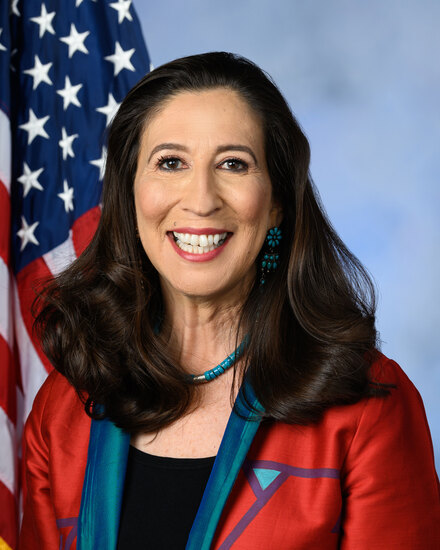
Rep. Teresa Leger Fernandez
Sponsored bills
Maddy summaryHRES 561 is a non-binding House resolution opposing state laws that criminalize access to essential health care. It specifically condemns using criminal penalties against people for pregnancy outcomes (such as miscarriages), seeking abortion or contraception, or receiving gender-affirming care, and disapproves of punishing health care providers or supporters for facilitating such care. The resolution affirms that patients deserve access to reproductive and gender-affirming health services without fear of prosecution or discrimination. It emphasizes that criminalizing these health care decisions violates patient rights and ethical provider obligations, without creating new legal requirements.
Maddy summaryHR 4422 (Global Respect Act) requires the President to publicly identify foreign officials responsible for violence, torture, or arbitrary detention against LGBTQI individuals and block their entry to the U.S., including revoking visas for them and their immediate families. It mandates annual reporting to Congress on the list of sanctioned individuals, the reasons for additions/removals, and efforts to coordinate with other countries on similar sanctions. The bill also updates U.S. human rights reporting requirements to explicitly include data on violence and discrimination against LGBTQI people worldwide. These measures aim to increase accountability for human rights violations against LGBTQI individuals without advocating for specific policy outcomes.
Maddy summaryHR 4340, the Therapeutic Fraud Prevention Act of 2023, prohibits paid providers from offering conversion therapy - defined as any commercial service attempting to change a person's sexual orientation or gender identity - and bans advertising that claims such therapy is effective or harmless. It directly affects therapists, counselors, or organizations offering paid conversion therapy services, including those advertising such services. Key provisions make it unlawful to provide, advertise, or facilitate paid conversion therapy, with enforcement led by the Federal Trade Commission (FTC) under consumer protection laws and allowing states to pursue civil actions. The bill explicitly excludes supportive care for gender transition or identity exploration from its definition of prohibited therapy.
This resolution expresses support for (1) equal rights and protections for all people, regardless of actual or perceived sexual orientation, gender identity, or sex characteristics; and (2) the designation of LGBTQI+ Equality Day to commemorate Supreme Court decisions handed down on June 26 in 2003, 2013, and 2015. The resolution also acknowledges the need for further legislation to ensure that people in the United States are free from all forms of discrimination on the basis of actual or perceived sexual orientation, gender identity, or sex characteristics.
Maddy summaryThis bill amends federal water infrastructure funding rules to better support Indian tribes. It allows the Secretary to reduce or waive a tribe's required financial contribution (non-Federal share) for water projects if that contribution would cause financial hardship. Tribes receiving federal grants for water infrastructure improvements directly benefit from this change. The provision specifically adds a waiver mechanism to existing law, shifting more cost responsibility to the federal government when tribes face budget constraints. This creates a more flexible funding approach for tribal water management projects.
Maddy summaryHR 3519, the Hot Foods Act of 2023, amends the Food and Nutrition Act of 2008 to allow Supplemental Nutrition Assistance Program (SNAP) benefits to be used for hot foods or hot food products ready for immediate consumption at participating retailers. This change directly affects SNAP recipients who purchase such hot foods and retailers that sell them. The key provision removes the previous exclusion of hot foods from SNAP eligibility, while adding a limit that no more than 50% of a retailer's total gross sales from SNAP can come from hot foods. The bill clarifies that hot foods can be purchased for home or immediate consumption, aligning SNAP rules with current retail practices for prepared foods.
Maddy summaryThe SAFE Act of 2023 extends a 2018 law that prohibits slaughtering animals for human consumption to include horses, donkeys, and other equine animals, such as ponies. It amends Section 12515 of the Agriculture Improvement Act of 2018 by updating the language to replace "dog or cat" with "dog, cat, or equine" in both the section title and the main prohibition. This change directly affects the livestock industry and slaughter facilities by banning the processing of equines for food. The bill modifies existing law without adding new enforcement mechanisms, closing a gap in animal protection.
Maddy summaryHR 4285, titled the Protect Vulnerable Immigrant Youth Act, would amend the Immigration and Nationality Act to remove numerical caps on certain employment-based visas. Specifically, it changes two sections to add a new visa category (J) to the list of categories exempt from annual numerical limits, allowing more employment-based visas to be issued without current restrictions. This change would directly affect employers and foreign workers seeking employment-based visas under the newly designated category (J), though the bill does not specify what the (J) category entails. The bill focuses solely on adjusting visa allocation rules rather than addressing youth protection or other aspects implied by its title.
Maddy summaryThe Bonding Reform and Taxpayer Protection Act of 2023 requires oil and gas operators on federal lands and National Wildlife Refuge System lands to provide financial assurances (bonds) before starting surface-disturbing activities to cover reclamation costs. It sets minimum bond amounts of $150,000 per activity or $500,000 per state (adjusted for inflation), and mandates both interim and final reclamation plans for all operations. The bill also establishes a $0.10 per barrel fee on oil and gas production from federal lands to fund orphaned well plugging and reclamation, and creates annual inspection fees based on the number of wells (ranging from $700 to $9,800 annually). These provisions aim to ensure taxpayers aren't left bearing the cost of reclamation when operators fail to meet their obligations.