

Water Data Act This bill requires federal departments and agencies involved in water resources management to jointly develop and implement a National Water Data Framework and establish an interagency council, advisory committee, and grant program. Specifically, the bill requires the departments to jointly develop and implement a National Water Data Framework for integrating, sharing, and using water data to support water resources management and access. The departments must (1) develop and adopt common national standards for water data, (2) integrate water data and tools through common approaches to data infrastructure and platforms, and (3) harmonize and align water data policies and programs. The bill further requires these departments to establish an interagency Water Data Council to support the development and implementation of the framework. The bill also requires the Department of the Interior to establish an Advisory Committee on Water Information to advise Interior, the departments, and the council on the framework. The advisory committee members must include those involved in water-related activities across different sectors (e.g., state and local governments, Indian Tribes, water agencies, private sector entities, and nonprofit organizations). Finally, the bill requires Interior to establish a Water Data Grant Program in coordination with the council for nonfederal entities to carry out the purposes of this bill.
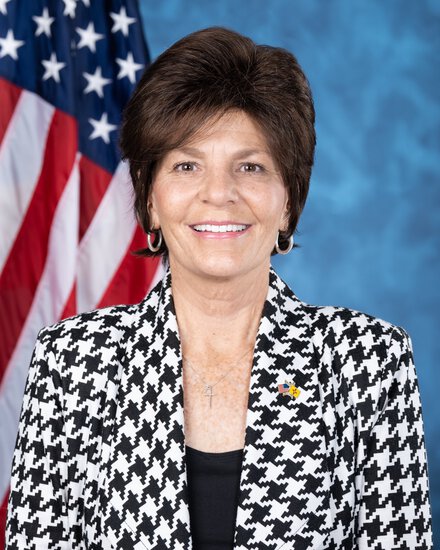
Rep. Yvette Herrell
Sponsored bills
Rio Grande Water Security Act This bill requires the Department of the Interior to develop and implement an integrated water resources management plan (i.e., the Basin Plan) for the Rio Grande Basin and reauthorizes an irrigation infrastructure grant program for Rio Grande Pueblos tribes. Specifically, Interior must convene a working group of designated federal agencies to collaborate with the Basin States (Colorado, New Mexico, and Texas), Indian tribes, local governments, irrigation districts, and other partners to develop and implement a plan for improving the basin's water security and quality, river and watershed health, and resilience to drought. The plan must include (1) project recommendations for updating reservoir operations, increasing water conservation, and improving infrastructure; (2) a list of potential changes that may be needed to existing federal authorities to implement the plan; and (3) a 30-year implementation time line. After the plan is submitted to Congress, relevant agencies may implement recommended projects. Agencies may also waive cost-sharing requirements for projects that demonstrate significant public benefits. The bill also reauthorizes an irrigation infrastructure grant program that permits the Bureau of Reclamation to provide grants and enter into agreements with the Rio Grande Pueblos tribes for repairing and replacing Pueblo irrigation infrastructure to (1) increase water use efficiency and agricultural productivity, (2) conserve water, and (3) enhance water management.
Promoting Cross-b order Energy Infrastructure Act This bill establishes a new process for approving the construction and operation of energy infrastructure across an international border of the United States and replaces the existing process established under specified executive orders. Specifically, this bill requires a person to obtain a certificate of crossing before constructing, connecting, operating, or maintaining a border-crossing facility for the import or export of oil, natural gas, or electricity across an international border. A certificate must be obtained from the Federal Energy Regulatory Commission (FERC) for a facility consisting of oil or natural gas pipelines or the Department of Energy (DOE) for an electric transmission facility. As a condition of issuing a certificate, DOE must require that an electric transmission facility be constructed, connected, operated, or maintained consistent with specified policies and standards. FERC and DOE must meet a deadline for issuing a certificate as set forth by this bill. The bill also requires FERC to meet a deadline for approving applications to import or export natural gas to or from Canada or Mexico.
Family Integrity to Reform Elections Act or the FIRE Act This bill prohibits the use of campaign funds to compensate the immediate family member of a candidate or an individual holding federal office. It also requires disclosure of payments made to immediate family members. Specifically, the bill prohibits an authorized committee of a candidate or any other political committee that is established, maintained, or controlled by a candidate or an individual holding federal office from directly or indirectly compensating the immediate family member of the candidate or individual for services provided to or on behalf of the committee. The prohibition does not apply to a political committee of a political party. Next, the bill requires a political committee to report on disbursements to an immediate family member of the candidate or the individual holding federal office. Finally, the bill requires any penalty for a violation of the bill to be imposed on the candidate or the individual holding federal office if the candidate or individual involved knew of the violation. Further, it prohibits the committee involved from reimbursing the candidate or individual for the penalty.
Military Spouse Hiring Act This bill expands the Work Opportunity Tax Credit (WOTC) to include the hiring of a qualified military spouse. (The WOTC permits employers who hire individuals who are members of a targeted group such as qualified veterans, ex-felons, or long-term unemployment recipients to claim a tax credit equal to a portion of the wages paid to those individuals.) A qualified military spouse is any individual who is certified by the designated local agency as being (as of the hiring date) a spouse of a member of the Armed Forces.
Countering Atrocities through Currency Accountability Act of 2022 This bill requires financial institutions and agencies to take specified special measures regarding foreign financial activity if the Department of the Treasury concludes that the measures are necessary to address human rights violations. These measures are applied upon a finding that a jurisdiction (or a financial institution, transaction, or type of account involving a jurisdiction) is of primary humanitarian concern. The measures include additional recordkeeping and reporting of transactions, beneficial ownership information, and information relating to payable-through accounts and correspondent accounts. If Treasury finds a payable-through or correspondent account involves foreign human rights violations, then Treasury is allowed to prohibit or impose conditions on that account. The bill establishes additional due diligence requirements for financial institutions managing a bank account or a correspondent account of a foreign person. Finally, Treasury must determine if the Xinjiang Uyghur Autonomous Region in China qualifies as a jurisdiction subject to the additional measures established by the bill.
Prohibition of Agricultural Land for the People's Republic of China Act This bill requires the President to prohibit nonresident aliens, foreign businesses, and agents associated with China's government from (1) purchasing agricultural (including ranching) real estate located in the United States, or (2) participating in Department of Agriculture programs that are unrelated to food and safety regulatory requirements.
Stopping Home Office Work's Unproductive Problems Act of 2022 or the SHOW UP Act of 2022 This bill requires each executive agency to reinstate the telework policies that were in place on December 31, 2019. Agencies may not implement expanded telework policies unless the Office of Personnel Management certifies that such policies, among other requirements, will have a positive effect on the agency's mission and operational costs.
Military Spouse Tax Act This bill provides that a spouse of a service member may retain their personal residence or domicile for purposes of taxation. The bill authorizes a service member and the spouse of the member to elect to use the following locations for purposes of taxation: the residence or domicile of the member, the residence or domicile of the spouse, or the permanent duty station of the member.
Prohibiting Abortion Industry's Lucrative Loopholes Act This bill expands the prohibition on the sale or purchase of human fetal tissue in interstate commerce to include any payments associated with the transportation, implantation, processing, preservation, quality control, or storage of such tissue.