

Students Before Unions Act This bill requires local educational agencies, as a condition of receiving certain elementary and secondary school emergency relief subgrants, to publicly disclose negotiations with labor organizations (e.g., teacher unions) that are related to providing in-person instruction.
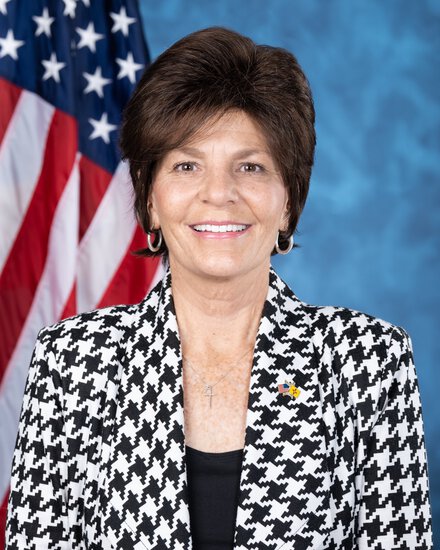
Rep. Yvette Herrell
Sponsored bills
This resolution expresses the sense of the House of Representatives that the United States should support, and not limit access to, all domestic sources of energy development in an effort to achieve full energy security, including by expanding use of renewable and alternative energy sources, and increasing domestic oil production.
Protecting New Mexico's Jobs and Public Education System Act This bill exempts New Mexico from provisions of specified orders that suspend oil or gas drilling in federal lands or waters. On January 27, 2021, the President issued an executive order that includes a moratorium on new oil or gas leases on public lands or in offshore waters. This bill exempts New Mexico from such moratorium. On January 20, 2021, the Department of the Interior issued a secretarial order that includes a suspension on the authority of its bureaus and offices to issue any onshore or offshore fossil fuel authorization, including permits to drill. This bill exempts New Mexico from the suspension.
Protecting American Energy Production Act This bill prohibits the President from declaring a moratorium on the use of hydraulic fracturing unless Congress authorizes the moratorium. The bill also expresses the sense of Congress that states should maintain primacy for the regulation of hydraulic fracturing for oil and natural gas production on state and private lands.
Hearing Protection Act This bill removes silencers from the definition of firearms for purposes of the National Firearms Act. It also treats persons acquiring or possessing a firearm silencer as meeting any registration and licensing requirements of such Act. The Department of Justice must destroy certain records relating to the registration, transfer, or making of a silencer. The bill also revises the definitions of firearm silencer and firearm muffler under the federal criminal code and includes such items in the 10% excise tax category.
Concealed Carry Reciprocity Act This bill establishes a federal statutory framework to regulate the carry or possession of concealed firearms across state lines. Specifically, an individual who is eligible to carry a concealed firearm in one state may carry or possess a concealed handgun (other than a machine gun or destructive device) in another state that allows its residents to carry concealed firearms. It sets forth requirements for the lawful concealed carry across state lines. The bill preempts most state and local laws related to concealed carry and establishes a private right of action for a person adversely affected by interference with a concealed-carry right established by this bill.
This resolution calls on the President to abandon the One China policy in favor of one that recognizes Taiwan as an independent country that is not a part of China. The resolution also urges the President to bolster diplomatic and economic relations between the United States and Taiwan through specified means.
Safety and Opportunity for Girls Act of 2021 This bill addresses protections related to sex and sex-segregated spaces. Sex is defined as sex determined solely by a person's reproductive biology and genetics at birth. The bill prohibits construing the provisions of title IX of the Education Amendments of 1972 in a manner that would require forgoing the maintenance of sex-segregated spaces (such as bathrooms) and of sex-segregated athletic or academic programs by educational institutions.
Telehealth Modernization Act This bill modifies requirements relating to coverage of telehealth services under Medicare. Specifically, the bill extends certain flexibilities that were initially authorized during the public health emergency relating to COVID-19 (i.e., coronavirus disease 2019). Among other things, the bill allows (1) rural health clinics and federally qualified health centers to serve as the distant site (i.e., the location of the health care practitioner); (2) the home of a beneficiary to serve as the originating site (i.e., the location of the beneficiary) for all services (rather than for only certain services); and (3) all types of practitioners to furnish telehealth services, as determined by the Centers for Medicare & Medicaid Services.
Main Street Tax Certainty Act This bill makes permanent the tax deduction for qualified business income. (Under current law, the deduction expires after December 31, 2025.) Qualified business income is defined as the net amount of qualified items of income, gain, deduction and loss with respect to any trade or business, excluding capital gains or losses, dividends, interest income, or income earned outside the U.S.