This resolution honors the life and legacy of Captain Michael D'Angelo Garigan for his lifelong commitment to his community and over three decades of service in law enforcement.
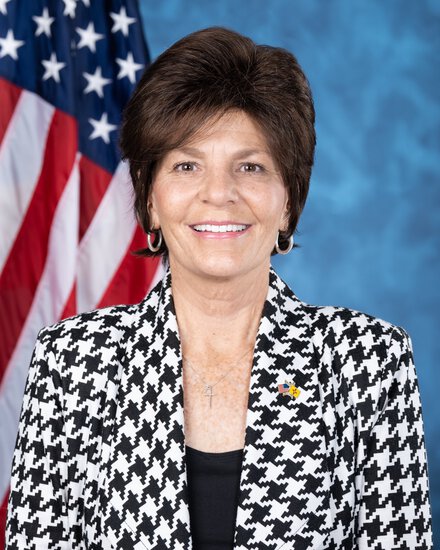
Rep. Yvette Herrell
Sponsored bills
This resolution recognizes law enforcement agencies and officers for their tireless work to protect us and make our communities safer. It also condemns calls to defund, disband, dismantle, or abolish the police.
Maximum Pressure Act This bill expands sanctions and economic penalties on Iran. It also restricts the President from unilaterally lifting or waiving the sanctions or penalties and increases congressional oversight of them. Specifically, the bill requires the President to impose visa- and asset-blocking sanctions. Additionally, it modifies existing sanctions, including by (1) providing statutory authority for executive orders imposing sanctions; (2) applying sanctions to additional sectors of Iran's economy; and (3) broadening sanctionable conduct to cover, for example, assisting Iran with the acquisition of ballistic missiles and the complicity of Iranian officials in human rights violations in specified countries. The bill also requires reporting on licenses that authorize activities subject to sanctions. The bill prohibits U.S. representatives at the International Monetary Fund from voting to allow Iran's access to special drawing rights (a currency support tool) and places restrictions on financial transactions with Iran. The restrictions include requiring domestic financial institutions to implement special measures with respect to foreign financial institutions that conduct significant transactions connected to the Instrument in Support of Trade Exchanges (a European mechanism that bypasses U.S. sanctions when carrying out trade with Iran). The Department of State must maintain the Islamic Revolutionary Guard Corps' designation as a terrorist organization and must designate Ansharallah (or Houthis), which operates in Syria, as a foreign terrorist organization. The bill also requires reports on U.S. sanctions concerning Iran, the status of Iran's nuclear weapons program, and other matters.
Sunshine for Regulatory Decrees and Settlements Act of 2021 This bill establishes transparency and public accountability standards for federal agencies with respect to (1) certain civil actions seeking to compel agency action, and (2) related consent decrees and settlement agreements. For example, an agency must publish a complaint filed against it within 15 days. Additionally, settlement proceedings must be conducted through mediation or an alternative dispute resolution program of the court, and those proceedings must include intervening parties. The bill also creates a presumption in favor of a motion to intervene in settlement proceedings. Further, at least 60 days prior to entering a consent decree or settlement agreement, an agency must publish, and accept and respond to public comment on, the proposed agreement or decree. An agency also must provide the court with the administrative record, a summary of the public comments, and access to the record of any public hearings on the proposed decree or agreement. The Department of Justice, or the agency litigating a matter independently, must certify to the court its approval of certain terms included in an agreement or decree, including terms that convert a discretionary authority into a nondiscretionary duty. A court may not approve a consent decree or settlement agreement unless the agency has sufficient time and procedures to comply with federal administrative procedures, other rulemaking statutes, and applicable executive orders. Finally, courts must review a consent decree or settlement if an agency files a motion to modify the decree or agreement on the basis of changed facts or circumstances.

District of Columbia-Maryland Reunion Act This bill cedes the District of Columbia to Maryland after Maryland's acceptance of the retrocession. Furthermore, the bill declares that the National Capital Service Area in the District shall not be ceded and relinquished to Maryland and shall continue to serve as the permanent seat of the federal government. The bill maintains the exclusive legislative authority and control of Congress over the area. Finally, excluding the District Building, the area shall include the principal federal monuments, the White House, the U.S. Capitol, the U.S. Supreme Court Building, the federal executive, legislative, and judicial office buildings located adjacent to the Mall and the U.S. Capitol, including any federal real property affronting or abutting such area, such as the Department of Housing and Urban Development and the Department of Energy buildings.
Restoring Environments, Soils, Trees, and Operations to develop the Rural Economy Act of 2021 or the RESTORE Act of 2021 This bill requires the Department of Agriculture (USDA), at the request of a governor of a state, to select a forest landscape in the state on which to conduct a forest landscape project. For a project, USDA must carry out one or more specified management activities, including installing fuel breaks, conducting controlled burns, and removing dead trees.
Drug Cartel Terrorist Designation Act This bill directs the Department of State to designate the Reynosa/Los Metros faction of the Gulf Cartel and the Cartel Del Noreste faction of Los Zetas as foreign terrorist organizations and to submit a detailed report on those drug cartels and any other cartels it may identify. Based on this report, the State Department must designate as a foreign terrorist organization any such identified cartel (or faction thereof) that meets certain criteria for designation as a foreign terrorist organization.
Competition in Professional Baseball Act This bill removes the limited exemption from the antitrust laws for professional baseball clubs. For purposes of this bill, the term antitrust laws means laws to protect against unlawful restraints and monopolies (Clayton Act) and to protect against unfair methods of competition (Federal Trade Commission Act).
Silencers Help Us Save Hearing Act or the SHUSH Act This bill modifies the treatment of silencers under federal statutes governing the sale, transfer, and possession of firearms. Specifically, it removes silencers from the list of firearms subject to regulation (i.e., registration and licensing requirements) under the National Firearms Act (NFA). Additionally, it excludes a muffler or silencer from the list of firearms subject to regulation (e.g., background check requirements) under the Gun Control Act of 1968 (GCA). Finally, the bill does the following: preempts state or local laws that tax or regulate firearm silencers, specifies that a person who lawfully acquires or possesses a silencer under provisions of the GCA meets the registration and licensing requirements of the NFA, eliminates mandatory minimum prison terms for a crime of violence or drug trafficking offense in which a defendant uses or carries a firearm equipped with a silencer or muffler, and permits active and retired law enforcement officers to carry a concealed silencer.
We Will Not Comply Act This bill prohibits discrimination based on an individual's COVID-19 vaccination status. Specifically, the bill bars certain commercial businesses from discriminating on the basis of an individual's COVID-19 vaccination status. In addition, the bill generally prohibits using federal funds to establish or enforce COVID-19 vaccination requirements. Further, federal funds may not be used to compel an individual with a religious objection to vaccinations to receive a vaccine. The bill also prohibits federal funding of educational institutions that require an individual to receive a COVID-19 vaccine to participate in academic or extracurricular activities. Additionally, a public school or public college may not deny access to the school or college based on whether an individual has received a vaccine, including the COVID-19 vaccine. Furthermore, air carriers may not deny an individual access to air transportation solely on the basis of COVID-19 vaccination status. The bill also prohibits proof of a COVID-19 vaccine as a condition of receiving a U.S. passport. The bill establishes a private right of action for individuals who have been discriminated against based on COVID-19 vaccine status or failure to comply with a requirement to wear a face covering.