

Maddy summaryThis bill creates a new Department of Homeland Security (DHS) joint task force specifically focused on stopping opioid trafficking at the border, particularly fentanyl and synthetic opioids. It allows DHS to partner directly with private sector organizations (like pharmaceutical or logistics companies) to temporarily assign their employees to the task force, with the private companies covering all costs - without requiring standard federal advisory committee processes. The bill also requires DHS to collaborate with other federal, state, local, tribal, and international agencies on this effort and to report annually on resource gaps and how well the task force is coordinating with others. The primary effect is to enhance DHS's border security operations targeting opioid smuggling through new private-sector partnerships and interagency coordination.
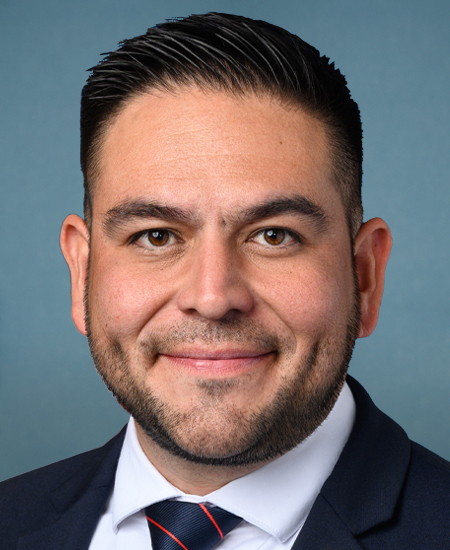
Rep. Gabe Vasquez
Sponsored bills
Tribal Gaming Regulatory Compliance Act This bill allows the Ysleta del Sur Pueblo and Alabama-Coushatta tribes to conduct gaming activities on their land in Texas if certain conditions are met. Currently, the Ysleta del Sur Pueblo and Alabama-Coushatta Indian Tribes of Texas Restoration Act prohibits the tribes from conducting gaming activities on their land if those activities are prohibited by Texas law. The bill repeals those provisions and instead applies the Indian Gaming Regulatory Act (IGRA) to gaming activities on Indian lands of the tribes.
Maddy summaryThis bill requires that AM radio receivers be included as standard equipment in all new motor vehicles (such as cars and trucks) sold in the United States, with a rule to be issued by the Department of Transportation within one year. The rule must ensure AM radio is easily accessible on the dashboard and allows manufacturers to use digital AM radio technology instead of traditional AM. During the one-year period between the bill's enactment and the rule's effective date, manufacturers must clearly label vehicles without AM radio. The bill also directs a study to evaluate whether an alternative system could deliver emergency alerts as reliably as AM radio across the country, especially during crises.
This resolution acknowledges the 14th anniversary of the end of the war in Sri Lanka and urges the United States to work with the United Nations to establish an international mechanism for accountability for the grave crimes committed during the war. The resolution also encourages the promotion of universally accepted democratic principles on the island of Sri Lanka, including by using the referendum process to ensure that all ethnicities are equitably represented.
Maddy summaryThis bill establishes federal standards for labor-management cooperation between public safety employers (state and local governments) and public safety workers (law enforcement officers, firefighters, and emergency medical services personnel). It requires the Federal Labor Relations Authority to determine if states substantially provide rights like collective bargaining, union representation, and binding arbitration for these workers. States found lacking would need to follow federal bargaining procedures after a two-year transition period or following the next legislative session. The bill explicitly respects existing state laws that provide comparable or better rights to public safety workers. It also prohibits strikes or work stoppages that would disrupt emergency services.
Enhancing COPS Hiring Program Grants for Local Law Enforcement Act This bill allows funds under the Community Oriented Policing Services grant program to be used to provide bonuses for the recruitment and retention of law enforcement officers or career law enforcement officers.
National Law Enforcement Officers Remembrance, Support and Community Outreach Act This bill directs the Department of Justice (DOJ) to establish a National Law Enforcement Officers Remembrance, Support, and Community Outreach Program. The bill further directs DOJ to award a grant under the program to the National Law Enforcement Officers Memorial Fund for the expenses associated with community outreach, public education, and officer safety and wellness programs operated by the of the National Law Enforcement Officers Memorial Fund and National Law Enforcement Museum.
Maddy summaryThe FIGHT Act (HR 2742) amends the Animal Welfare Act to specifically target animal fighting events, such as cockfighting, by defining "rooster" as any male chicken over six months old and banning the live broadcasting (simulcasting) of such events. It prohibits using the postal service or interstate transport to move roosters for animal fighting purposes and adds civil enforcement tools allowing citizens to sue violators after a 60-day notice period. Fines up to $5,000 per violation may be imposed, and property used in animal fighting ventures can be seized. These changes strengthen enforcement against animal fighting by expanding legal remedies for the public and authorities.
Maddy summaryHR 2723 (Local Farms and Food Act of 2023) reforms the Local Agriculture Market Program to support local food systems. It extends funding periods to 2024-2028, increases annual funding to $75 million for program grants and $30 million for partnerships, and creates simplified application processes for projects under $100,000. The bill defines "food hub" to include businesses aggregating and distributing local food products, and adds new project categories like farmers market staff support and food safety equipment. It directly affects small local farms, food hubs, and rural communities by improving access to grants and reducing administrative barriers for market development.
Maddy summaryThe PAST Act of 2023 amends the Horse Protection Act to ban specific devices used to cause pain (soring) in horses at shows, particularly affecting Tennessee Walking Horses, Racking Horses, and Spotted Saddle Horses. It defines prohibited "action devices" (like boots or chains causing friction) and requires licensed, conflict-free inspectors at events to enforce rules. The bill increases penalties for violations to up to $5,000 fines or 3 years in jail, and mandates longer disqualifications for repeat offenses (180 days → 1 year → 3 years). Horse show organizers, exhibitors, and participants must comply with these new inspection and penalty requirements.