

This bill increases the annual limit on the tax credit for qualified railroad track maintenance expenses (also referred to as the short line railroad tax credit) and expands eligibility for claiming the credit. Under current law, the tax credit is limited each tax year to $3,500 multiplied by the sum of the number of miles of railroad track owned or leased by the taxpayer (miles owned or leased) and the number of railroad track miles assigned to the taxpayer by a Class II or III railroad (miles assigned). This bill increases the annual limit to $6,100 multiplied by the sum of miles owned or leased and miles assigned. The $6,100 amount used in the calculation of the tax credit limit is adjusted for inflation for tax years beginning after 2025. The bill also expands eligibility for the tax credit to include gross expenses for maintaining railroad tracks owned or leased as of January 1, 2024. Under current law, the tax credit is limited to gross expenses for maintaining railroad tracks owned or leased as of January 1, 2015.
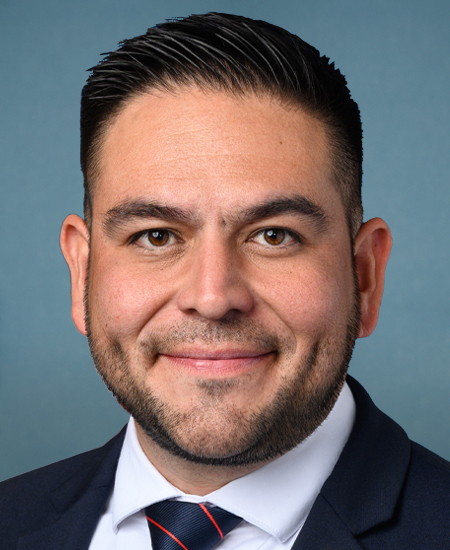
Rep. Gabe Vasquez
Sponsored bills
Maddy summaryHR 488, the Combating Cartels on Social Media Act of 2025, requires the Department of Homeland Security, Department of Justice, and Department of State to jointly assess how transnational criminal organizations use social media platforms and messaging services for recruitment and illicit activities near U.S. borders. Within 180 days of enactment, they must submit a report detailing such usage and current countermeasures. By one year after enactment, the agencies must develop a national strategy focused on improving interagency coordination, enhancing intelligence analysis, and conducting youth outreach in border communities to counter cartel recruitment. The strategy must include privacy and civil liberties protections, with annual progress reports to Congress for five years. The bill does not authorize new law enforcement powers or funding.
Maddy summaryThe Prevent Tariff Abuse Act amends the International Emergency Economic Powers Act to prohibit the President from using emergency powers to impose tariffs or import quotas on goods entering the U.S. It adds a specific provision stating the President cannot impose duties, tariffs, or quotas under this law. This directly limits the executive branch's authority during emergencies, preventing the use of emergency powers for trade restrictions. The bill does not affect other trade policies or the President's other emergency authorities.
Maddy summaryThe TRUST in Congress Act requires current and new Members of Congress, along with their spouses and dependent children, to place certain investments - such as stocks, commodities, and derivatives - into a blind trust within 90 to 180 days of taking office. It excludes U.S. Treasury securities and widely held mutual funds from this requirement and exempts investments tied to a spouse’s or dependent child’s primary job. Members must certify the trust’s setup to the House Clerk or Senate Secretary within 15 days, with these records posted publicly online. The act also prohibits dissolving such trusts until 180 days after a member leaves office.
Maddy summaryHR 285, the Advanced Border Coordination Act of 2025, requires the Department of Homeland Security to establish at least two Joint Operations Centers along the southern border within six months of enactment. These centers will enable coordinated operations between federal (including DHS, Defense, and Justice), state, local, and tribal law enforcement agencies to address threats like drug trafficking, human trafficking, illegal border crossings, and weapons seizures. Key mechanisms include centralized communication for field operations, shared information protocols, personnel deployment tracking, and annual reporting to Congress on center operations, resource use, and communication gaps. The bill directly affects border agencies and tribes participating in these coordinated efforts, aiming to improve interagency collaboration without specifying new enforcement powers.
Maddy summaryHR 82, the Social Security Fairness Act of 2023, repeals two provisions that reduce Social Security benefits for certain government workers. It eliminates the Government Pension Offset (GPO), which cuts spousal or survivor benefits for people with pensions from jobs not covered by Social Security (like federal or state government roles), and the Windfall Elimination Provision (WEP), which lowers retirement benefits for those with similar pensions. The law takes effect for benefits paid after December 2023, requiring the Social Security Administration to adjust benefit calculations to remove these reductions. This change directly affects public-sector employees who previously had their Social Security benefits reduced due to their government pensions.
Maddy summary# Summary of the EXPLORE Act Legislative Text This is a comprehensive legislative text (likely the "EXPLORE Act" - Enhancing Recreation Opportunities for People of All Abilities, and Veterans) that establishes several key initiatives to improve outdoor recreation access across Federal lands. ## Key Focus Areas: ### 1. Accessibility for People with Disabilities (Title II - Access America) - Requires comprehensive assessments of outdoor recreation facilities on Federal lands within 5 years - Mandates development of 3 new accessible trails per region for each agency (Forest Service, National Park Service, BLM, USFWS) within 1 year - Requires development of 2 new accessible recreation opportunities per region within 1 year - Requires making accessibility information available on public websites within 7 years - Requires development of accessible features including trail bridges, parking, and restrooms ### 2. Military and Veterans Programs - Requires educational materials for military members/veterans on accessing Federal lands free of charge within 2 years - Establishes Military Veterans Outdoor Recreation Liaisons within relevant agencies within 1 year - Requires a National Strategy for Military and Veteran Recreation within 1 year - Creates a pilot program for veteran employment in conservation positions - Promotes partnerships with organizations providing outdoor recreation for veterans ### 3. Youth Access - Requires a strategy to increase youth recreation visits to Federal lands within 2 years - Extends the "Every Kid Outdoors" program until September 30, 2031 - Focuses on increasing opportunities for underserved youth ### 4. Recreation Permitting Modernization (Title III) - Defines special recreation permits and establishes fee structures - Creates categories for different types of recreation permits - Establishes a process for application and review of permits - Includes provisions for multijurisdictional trips across different Federal lands The legislation aims to improve access to outdoor recreation for people with disabilities, veterans, and youth while modernizing the permitting process for recreational activities on Federal lands. It requires specific timelines for implementation and includes detailed definitions and requirements for each component of the bill.
Maddy summaryThe Women’s Suffrage National Monument Location Act (HR 1318) authorizes the placement of a monument on the National Mall to honor the women’s suffrage movement and the 19th Amendment. The bill specifies that the monument must be located within a designated area on the National Mall known as the "Reserve," bypassing standard requirements for monument locations under existing law. This legislation sets the physical site for a monument already authorized by previous law (Public Law 116-217), without creating new policy or altering commemorative regulations beyond the location.
Washington, D.C. Admission Act This bill provides for the establishment of the State of Washington, Douglass Commonwealth, and its admission into the United States. The state is composed of most of the territory of the District of Columbia (DC), excluding a specified area that encompasses the U.S. Capitol, the White House, the U.S. Supreme Court building, federal monuments, and federal office buildings adjacent to the National Mall and the U.S. Capitol. The excluded territory shall be known as the Capital and serve as the seat of the government of the United States, as provided for in Article I of the Constitution. The state may not impose taxes on federal property except as Congress permits. The bill provides for the DC Mayor to issue a proclamation for the first elections to Congress of two Senators and one Representative of the state. The bill eliminates the office of Delegate to the House of Representatives. The bill applies current DC laws to the state. DC judicial proceedings and contractual obligations shall continue under the state’s authority. The bill also provides for specified federal obligations to transfer to the state upon its certification that it has funds and laws in place to assume the obligations. These include maintaining a retirement fund for judges and operating public defender services. The bill establishes a commission that is generally comprised of members who are appointed by DC and federal government officials to advise on an orderly transition to statehood.
Maddy summaryThis bill, HR 1097 (Everett Alvarez, Jr. Congressional Gold Medal Act of 2023), authorizes the award of a Congressional Gold Medal to Everett Alvarez, Jr., in recognition of his service as a U.S. Navy pilot and Vietnam War prisoner of war. It directly honors Alvarez, who was the first U.S. pilot shot down in the Vietnam War, spent over 8.5 years in captivity, and later served in the Peace Corps and Veterans Administration. The bill’s key mechanism is directing the U.S. Mint to strike a gold medal bearing his name and image, with bronze duplicates available for sale to cover costs. It does not create new policies or affect any group beyond the honoree.