

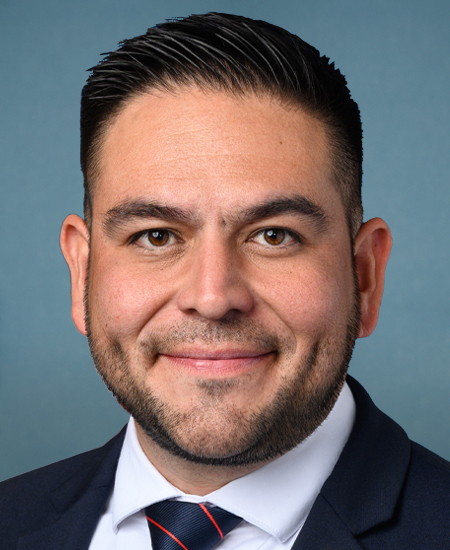
Photo of Gabe Vasquez
D United States House · District 2 · New Mexico On the 2026 ballot

Rep. Gabe Vasquez

Compare
Total votes
1,879
all sessions
Attendance
100%
9 missed
Higher than 78% of chamber peers
With party
92%
of cast votes
Lower than 90% of chamber peers
Bipartisan score
4%
crosses aisle rarely
Higher than 89% of chamber peers
Sponsored
690
bills & resolutions
Near the chamber average
Committees
6
assignments
690 bills and resolutions

Sponsored bills

Total
690
Primary
63
Co-sponsor
627
This page
690
matching current filters
Co-sponsor HR 1151
In committee · United States House · Co-sponsor
Freedom to Invest in Tomorrow’s Workforce Act

Maddy summaryThis bill expands 529 college savings account flexibility by allowing funds to cover costs for industry-recognized postsecondary credentials, not just traditional degrees. It defines "qualified expenses" to include tuition/fees for recognized credential programs (like certifications or apprenticeships), required testing fees, and continuing education needed to maintain credentials. To qualify, programs must meet specific criteria, such as appearing on state lists under the Workforce Innovation and Opportunity Act or being listed in VA or Defense directories. The change applies to 529 distributions made after the law's enactment, giving families more options to use these accounts for job-focused training.

In committee Feb 7, 2025 1 co-sponsor
Co-sponsor HR 1061
In committee · United States House · Co-sponsor
Protecting Sensitive Locations Act

Protecting Sensitive Locations Act This bill prohibits immigration enforcement actions within 1,000 feet of a sensitive location except in exigent circumstances, such as the imminent risk of death, violence, or physical harm to any person. Sensitive locations include  health care facilities; schools and school bus stops; places that provide assistance for people such as children, pregnant women, and abuse victims; child care facilities; places that provide disaster or emergency services; places of worship; courthouses and lawyers’ offices; facilities used as polling places; certain labor union facilities; and public assistance offices. The prohibition shall apply to Department of Homeland Security officers and agents, as well as state employees pursuing immigration enforcement actions. If an enforcement action is carried out in violation of this prohibition (1) no information resulting from the action may be entered into the record in a resulting removal proceeding, and (2) the affected individual may move to immediately terminate such a proceeding. U.S. Immigration and Customs Enforcement and U.S. Customs and Border Protection shall annually report to Congress about enforcement actions taken at sensitive locations in the preceding year.

In committee Feb 6, 2025 1 co-sponsor
Co-sponsor HR 1065
In committee · United States House · Co-sponsor
Protect Our Letter Carriers Act of 2025

Protect Our Letter Carriers Act of 2025 This bill requires or authorizes certain actions related to the U.S. Postal Service (USPS). The bill requires the Department of Justice to appoint an assistant U.S. attorney in each judicial district to coordinate and supervise the investigation and prosecution of various crimes related to postal services (for example, assault on a postal service employee, breaking into a post office, or obstruction of mails). The bill also requires the U.S. Sentencing Commission to amend sentencing guidelines to provide that the assault or robbery of a postal employee shall be treated the same as the assault of a law enforcement officer. Additionally, the bill authorizes appropriations for the USPS to install high security collection boxes and replace older versions of the universal mailbox key with electronic versions.

In committee Feb 6, 2025 1 co-sponsor
Co-sponsor HR 1105
In committee · United States House · Co-sponsor
Disaster Resiliency and Coverage Act of 2025

Maddy summaryThe Disaster Resiliency and Coverage Act of 2025 creates a federal program that provides grants to states and tribal governments to help homeowners in high-risk disaster areas make their homes more resilient. The program covers specific mitigation activities like reinforcing roofs, installing flood barriers, and creating fire-resistant features, with a $10,000 per household limit. Homeowners must have an adjusted gross income under $250,000 ($500,000 for joint returns) to qualify. The bill also includes tax benefits, allowing these grant amounts to be excluded from gross income and providing a 30% tax credit for qualifying mitigation expenditures.

In committee Feb 6, 2025 1 co-sponsor
Co-sponsor HR 1103
In committee · United States House · Co-sponsor
New Markets Tax Credit Extension Act of 2025

Maddy summaryThis bill permanently extends the New Markets Tax Credit (NMTC), a federal tax incentive that encourages private investment in low-income communities. It directly affects community development entities (CDEs) that channel capital into underserved neighborhoods for projects like housing, healthcare, and businesses. Key provisions include permanently extending the credit beyond 2025, adding annual inflation adjustments to the credit amount starting in 2026, and ensuring the credit isn't reduced by the alternative minimum tax for investments made after December 2024. The changes apply to taxable years beginning after December 2024, providing long-term stability for community development financing.

In committee Feb 6, 2025 1 co-sponsor
Co-sponsor HR 1055
In committee · United States House · Co-sponsor
CONSTRUCTS Act of 2025

Maddy summaryThe CONSTRUCTS Act of 2025 creates a federal grant program to fund training programs at community colleges and career schools focused on residential construction careers. It targets rural areas and underserved populations - including veterans, low-income individuals, and groups with historically low representation in construction - to develop skills in trades like carpentry, plumbing, electrical work, and HVAC. Grants, totaling $20 million annually from 2026-2030, require flexible scheduling, partnerships with construction employers, and plans to increase affordable housing supply through workforce development. The bill directly affects community colleges in rural or underserved regions and their students seeking residential construction careers.

In committee Feb 6, 2025 1 co-sponsor
Co-sponsor HR 1094
In committee · United States House · Co-sponsor
Amateur Radio Emergency Preparedness Act

Maddy summaryHR 1094, the Amateur Radio Emergency Preparedness Act, prevents private restrictions (such as those in homeowners associations) from blocking amateur radio operators from installing and maintaining antennas for emergency communications. The bill directly affects over 770,000 licensed amateur radio operators in the U.S. who face such restrictions on their residential property. Key provisions include overriding unreasonable restrictions, requiring reasonable safety and building code compliance for allowed rules, setting a 45-day approval period for antenna installations (with deemed approval if not acted on), and exempting small antennas (under 1 meter, flagpoles ≤43 feet, or minimal wire antennas) from prior approval. This ensures amateur radio operators can quickly establish emergency communication systems without unnecessary delays or costs during crises.

In committee Feb 6, 2025 1 co-sponsor
Co-sponsor HR 1020
In committee · United States House · Co-sponsor
BOOST Act

Maddy summaryHR 1020 (BOOST Act) creates a tax credit for homeowners in rural unserved areas to improve broadband access. It allows a 75% credit (up to $400) for purchasing signal boosters, satellite customer equipment, or ground stations used in a primary residence. The credit applies only once per household and expires after 2029, targeting areas eligible for FCC's Rural Digital Opportunity Fund. This directly affects individual homeowners in designated rural broadband gaps seeking to enhance their internet connectivity.

In committee Feb 5, 2025 1 co-sponsor
Primary HR 1038
In committee · United States House · Lead sponsor
Combating Rural Inflation Act

Combating Rural Inflation Act This bill requires the the Bureau of Labor Statistics of the Department of Labor to publish a monthly index of changes in consumer prices for individuals residing in rural communities.

In committee Feb 5, 2025 0 co-sponsors
Co-sponsor HR 999
In committee · United States House · Co-sponsor
Right to Contraception Act

Maddy summaryThis bill establishes a federal right to access contraception, protecting individuals' ability to obtain contraceptives and health care providers' ability to offer them without government interference. It prohibits states from banning or restricting contraceptive services, products, or information, including laws that force providers to deny care based on personal beliefs or limit access to specific methods. The law immediately overrides conflicting state regulations and ensures that contraception remains available regardless of factors like race, income, disability, or location. It applies to all individuals and providers, building on existing federal protections like the Affordable Care Act's coverage requirements.

In committee Feb 5, 2025 1 co-sponsor
Showing 361 to 370 of 690 bills
Previous 1 … 36 37 38 … 69 Next