

This bill prohibits the President from selling, transferring, or exporting certain defense articles or services to Israel, except in specified circumstances. Defense articles covered by the prohibition include BLU-109 bunker busting bombs, Joint Direct Attack Munition (JDAM) assemblies, and 155mm artillery ammunition. Defense services directly related to such articles are also covered. The President may sell, transfer, or export such defense articles or services to Israel if (1) a law is enacted specifying the purposes for which such articles or services may be used, and (2) Israel provides written assurances that the defense articles or services will be used for those specific statutory purposes and in a manner consistent with certain other laws, including international human rights laws.
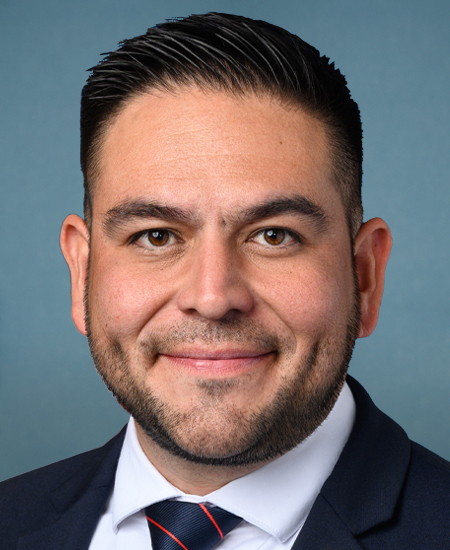
Rep. Gabe Vasquez
Sponsored bills
Maddy summaryHR 3534, the Mental Health in Schools Excellence Program Act of 2025, creates a federal program to increase the number of school-based mental health professionals. It provides federal matching funds - covering up to 50% of tuition and fees for eligible students - in partnership with graduate schools offering accredited programs in school counseling, psychology, or social work. Participating graduate institutions must match federal contributions, and priority is given to students who received Federal Pell Grants or attended specific institutions as undergraduates. The program directly affects graduate students training to become licensed school mental health providers, aiming to expand the workforce serving K-12 schools.
Maddy summaryThis bill establishes a code of conduct for Supreme Court justices, requiring them to disclose gifts, income, and potential conflicts of interest. It creates a formal process for handling complaints about justices, including a judicial investigation panel to review allegations. The bill adds specific circumstances requiring recusal, such as when a justice or family member has financial ties to a party in a case. Additionally, it mandates that parties and amicus briefs disclose any gifts given to justices and lobbying activities related to their nomination. These provisions aim to increase transparency and accountability in the Supreme Court's operations.
Maddy summaryThis bill creates two new tax credits to support homebuyers. It provides a first-time homebuyer credit of up to $50,000 for down payments on primary residences, with income limits ($150,000 single filers, $225,000 head of household, $300,000 joint filers). A separate starter home construction credit offers 15% (30% for first-time buyers) of costs for new homes under 1,200 square feet priced at or below 80% of local median home prices. The credits require repayment if the home is sold or no longer used as a primary residence within five years, with exceptions for new purchases, death, divorce, or military service.
Maddy summaryHR 3463 (COUNTER Act) expands the U.S. military's authority to counter drone threats by allowing the Department of Defense and Coast Guard to neutralize unmanned aircraft systems without being restricted by certain federal laws. It exempts related technology, procedures, and protocols from public disclosure requirements under federal and state laws, and permits military commanders to delegate these actions. The bill applies to both domestic and overseas operations, clarifying that other federal laws do not apply to U.S. military or Coast Guard activities mitigating drone threats abroad. Key changes include broadening legal authority beyond previous restrictions and extending reporting deadlines for related activities.
Maddy summaryHR 3473, the Humane Accountability Act, requires U.S. Customs and Border Protection (CBP), Immigration and Customs Enforcement (ICE), and the Office of Refugee Resettlement (ORR) to submit detailed reports to Congress about immigration detentions and facility conditions. It mandates specific data on detention numbers, removals, locations (including sensitive sites like schools), and incidents of abuse, medical care, or deaths in custody. The bill also requires advance notice to Congress before using non-traditional detention sites (such as military bases or tribal lands), including justification, capacity, and compliance plans. These reports aim to increase transparency for detainees, their families, and Congress regarding detention practices. The bill directly affects immigration detention facilities, immigrant detainees, and federal agencies managing immigration enforcement.
Stronger Communities through Better Transit Act This bill requires the Department of Transportation (DOT) to establish a grant program to support operating projects for public transportation and related service improvements, particularly in underserved communities and areas of persistent poverty. Specifically, the bill requires DOT to allocate funding under the program for urbanized areas, states, and Indian tribes that are recipients of funds under either the Federal Transit Administration's (FTA's) Urbanized Area Formula Funding program or Formula Grants for Rural Areas program. Eligible recipients may use funding for operating costs associated with projects that improve public transportation service for transit-dependent populations and support increased transit ridership (e.g., service expansion, information technology enhancements, and workforce development). DOT must apportion the funding so that recipients receive funds that are proportional to their share of operating costs. The bill also provides for an increased federal cost share for operating assistance for projects or programs carried out in areas of persistent poverty or underserved communities. DOT must set up a multimodal access measurement interface for public agencies to aid transit agencies in determining and reporting on access to jobs and essential services. A grant recipient must (1) report specific information to the FTA for inclusion in the National Transit Database, and (2) survey transit riders and non-riding residents regarding transit service improvements. Further, the bill expands the purposes of the public transportation programs to include supporting public transportation's role in combating climate change through growing/retaining transit ridership.
Maddy summaryThis bill restores a tax deduction for personal losses caused by disasters, crimes, or scams (like stolen property or damage from hurricanes). It directly affects taxpayers who filed returns before 2025 but couldn’t claim this deduction due to a prior suspension. The bill reinstates the deduction and extends the deadline to file refund claims for these losses until the tax filing deadline for the year the bill becomes law. This allows eligible individuals to claim refunds they were previously barred from receiving.
Maddy summaryHR 3392, the STOP Screwworms Act, requires the U.S. Department of Agriculture to build modular facilities for rearing sterile New World screwworm flies within 180 days of enactment. These facilities will disperse sterile flies into at-risk agricultural areas - identified based on migratory patterns and suitability for dispersal - to prevent infestations that threaten livestock. The bill authorizes $300 million in funding for construction, operation, and annual reporting to Congress on threat assessments and effectiveness. It directly affects livestock producers and agricultural regions vulnerable to screwworm fly migration, using sterile insect technique as a preventive measure.
Maddy summaryHR 3368, the "Born in the USA Act of 2025," prohibits federal funding for Executive Order 14160 (which aimed to restrict birthright citizenship for children born in the U.S.). The bill directly affects federal agencies that might implement the executive order by blocking their use of funds for that purpose. Its key provision is a funding ban targeting the executive order and any similar future policies, without changing citizenship law. The bill does not alter birthright citizenship rights but prevents federal resources from being used to enforce the controversial executive order. It is a procedural measure focused on funding, not a substantive policy change to citizenship rules.