This resolution expresses support for the principles of Transgender Day of Remembrance, memorializing the lives lost to anti-transgender violence this year.
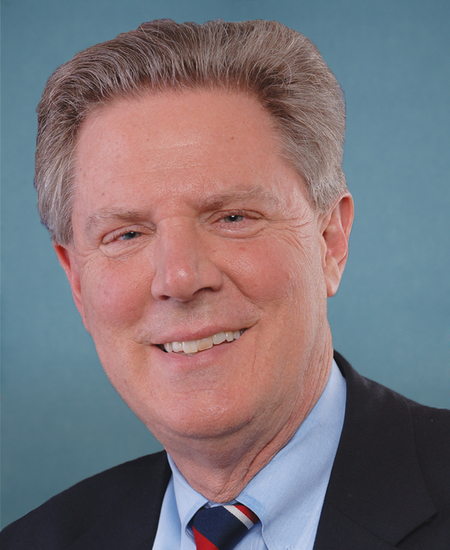
Rep. Frank Pallone, Jr.
Sponsored bills
Maddy summaryHRES 490 is a symbolic House resolution (not a law) passed on June 22, 2021, that reaffirms the U.S. commitment to supporting refugees and displaced persons globally. It highlights the scale of the global displacement crisis (over 82 million forcibly displaced people in 2020) and emphasizes the importance of the U.S. refugee resettlement program as a tool for security, diplomacy, and humanitarian aid. The resolution calls on the Secretary of State to continue robust funding, uphold U.S. leadership in refugee protection, support host countries, and meet refugee admissions goals. It directly affects U.S. foreign policy implementation and international humanitarian efforts, though it does not create new legal requirements or allocate funds.
This resolution expresses the sense of the House of Representatives that (1) lesbian, gay, bisexual, transgender, queer, intersex, and asexual (LGBTQIA+) rights are human rights and protected by the U.S. Constitution; (2) LGBTQIA+ Pride Month should be celebrated; and (3) all Americans should be treated equally regardless of sexual orientation or gender identity.
Jumpstart Our Legal Immigration System Act or the Jumpstart Act This bill makes unused employment-based and family-based immigrant visas from FY1992 through FY2021 available in subsequent fiscal years. It also makes diversity immigrant visas available to individuals who were selected for such a visa between FY2017-FY2021 but were unable to receive the visa due to certain (1) executive actions, or (2) limitations related to COVID-19. The bill also establishes supplemental fees for certain immigration-related applications.
Immigrant Witness and Victim Protection Act of 2021 This bill provides protections for certain aliens who are victims of crimes or abuse and addresses related issues. The bill removes various annual numerical limits on (1) U visas, generally for victims of a serious crime and helpful to law enforcement in prosecuting the crime; and (2) Special Immigrant Juvenile visas, generally for minors who have been abused or neglected by a parent. Applicants for certain immigration benefits, including U visas and T visas (generally for victims of severe human trafficking) shall receive work authorization on the date the application is approved or earlier. Removal shall be stayed for an alien with certain pending applications, such as an application for a T, U, or Special Juvenile Immigrant visa or for relief under the Violence Against Women Act. There shall be a presumption against detaining such an alien, which the Department of Homeland Security may rebut by establishing that (1) the alien's appearance at removal proceedings is not reasonably assured, or (2) the alien is a threat to another person or the community. The bill also prohibits making an adverse determination regarding an alien's admissibility or deportability based on information furnished by certain individuals, such as a spouse or parent who has battered the alien. Current law prohibits making an adverse determination using information furnished solely by such an individual. The bill also limits the use and publication of information provided in certain applications, including T, U, and Special Juvenile Immigrant visa applications.
Customer Non-Discrimination Act This bill prohibits discrimination based on sex, sexual orientation, and gender identity with respect to public accommodations and facilities. Specifically, the bill defines and includes sex, sexual orientation, and gender identity among the prohibited categories of discrimination or segregation. The bill expands the definition of public accommodations to include places or establishments that provide (1) exhibitions, recreation, exercise, amusement, gatherings, or displays; (2) goods, services, or programs; and (3) transportation services. Protections against discrimination based on race, color, religion, sex, sexual orientation, gender identity, or national origin shall include protections against discrimination based on (1) an association with another person who is a member of such a protected class; or (2) a perception or belief, even if inaccurate, that an individual is a member of such a protected class. The bill prohibits the Religious Freedom Restoration Act of 1993 from providing a claim, defense, or basis for challenging such protections. The bill prohibits an individual from being denied access to a shared facility, including a restroom, a locker room, and a dressing room, that is in accordance with the individual's gender identity. The bill also prohibits the provision of less favorable treatment with respect to pregnancy, childbirth or related medical conditions as compared to other physical conditions.

Fostering Overseas Rule of law and Environmentally Sound Trade Act of 2021 or the FOREST Act of 2021 This bill restricts certain commodities produced on illegally deforested land from accessing the U.S. market. Specifically, the bill prohibits the importation of any product made wholly or in part of a covered commodity produced from illegally deforested land. The bill outlines requirements for import declarations of covered commodities. The U.S. Trade Representative (USTR) must, within 30 days, publish (1) an initial list of covered commodities that consists of palm oil, soybeans, cocoa, cattle, rubber, and wood pulp; and (2) an initial list of covered products that are defined by the bill in accordance with the Harmonized Tariff Schedule. These lists must be updated at least on an annual basis. Further, the USTR must identify foreign countries without adequate and effective protection against illegal deforestation caused by the production of commodities that are likely to enter the United States. The USTR must develop an action plan that includes benchmarks for each identified country. Additionally, the bill creates an interagency working group to provide advice and recommendations to the USTR, U.S. Customs and Border Protection, and other relevant agencies. The bill provides funding to assist foreign governments in combating illegal deforestation. The bill also includes illegal deforestation as a specified unlawful activity under a federal financial crime statute. The bill establishes a federal procurement preference for commodities that are not produced from land subject to deforestation.
Supreme Court Ethics Act This bill establishes a new statutory requirement for the Judicial Conference of the United States to issue a judicial code of conduct for judges and justices of U.S. courts, including Justices of the Supreme Court. Currently, the Judicial Conference issues a code of conduct for judges of U.S. courts (but not for Justices of the Supreme Court).
Daniel Anderl Judicial Security and Privacy Act of 2021 This bill generally prohibits federal agencies and private businesses from publicly posting the personally identifiable information (e.g., home addresses) of federal judges and their immediate family members. It also (1) requires information to be removed upon written request from the federal judge concerned, (2) prohibits data brokers from purchasing or selling such information, and (3) establishes programs to protect such information at the state and local level and to enhance security for judges.
Repatriate Our Patriots Act This bill protects certain veterans of the Armed Forces from removal from the United States and provides such veterans with an expedited procedure for naturalization. The bill applies to special veterans , defined as persons who served in the active Armed Forces who were (1) honorably discharged or released; (2) not convicted of various crimes, including voluntary manslaughter, murder, rape, or terrorism; and (3) not a child abuser or pedophile. Special veterans shall not be removed from the United States, and the Department of Homeland Security (DHS) shall cancel any pending removal proceedings or orders against any such veterans. DHS shall establish a program to permit such veterans who were already removed from the United States to return to as an alien with permanent residence status. Special veterans shall be naturalized upon filing an application, paying the relevant fees, and taking an oath of allegiance. DHS shall take steps to ensure such naturalization applications are pending for no longer than 90 days.