

Maddy summaryH.J. Res. 80 would declare the Equal Rights Amendment (ERA) part of the U.S. Constitution, asserting it has been ratified by 38 states (three-fourths of the states) despite the original 1972 deadline. If passed, this resolution would formally establish the ERA as a constitutional amendment, requiring all federal and state laws to align with its gender equality protections. The bill does not create new laws but confirms the ERA's status as part of the Constitution, affecting how laws are interpreted and enforced. It is a procedural step to resolve the legal dispute over the ERA's validity after decades of debate.
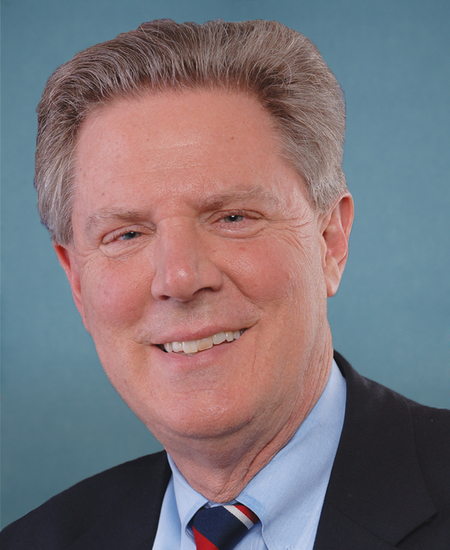
Rep. Frank Pallone, Jr.
Sponsored bills
Maddy summaryHRES 216 is a resolution condemning the leadership of the House Republican Conference for allowing a social media post that falsely questioned the immigration status and patriotism of Congressman Adriano Espaillat (Chairman of the Congressional Hispanic Caucus). The resolution specifically names House Speaker Mike Johnson, Majority Leader Steve Scalise, Majority Whip Tom Emmer, and other top Republican leaders as responsible for the post. It characterizes the post as xenophobic and inappropriate, stating such rhetoric violates the standards of conduct expected of members of Congress.
Maddy summaryThis bill blocks new U.S. defense export licenses to the United Arab Emirates (UAE) or its government agencies. It prohibits the export of specific military equipment (listed in U.S. regulations) until the President certifies the UAE is not supplying military aid to Sudan's Rapid Support Forces. The restriction applies to defense articles covered under U.S. export rules, including weapons and related technology. The bill directly affects U.S. defense exporters and the UAE government's ability to obtain new military equipment from the U.S.
Maddy summaryThis bill requires the Transportation Security Administration (TSA) to transition its workforce from a special personnel management system to the standard federal personnel system under Title 5 of the U.S. Code by December 31, 2025. It protects TSA employees by ensuring no reduction in pay, benefits, or retirement rights during the transition, while preserving collective bargaining rights for screening agents. The legislation also mandates consultation with labor unions during the process and requires several reports on workforce issues including recruitment, harassment policies, and workplace safety.
American Teacher Act This bill establishes grants to increase the minimum salary of public elementary and secondary school teachers. It also authorizes a national campaign regarding the value of the teaching profession. First, the bill directs the Department of Education (ED) to award four-year grants to state educational agencies (SEAs) and, through them, subgrants to local educational agencies to establish a minimum annual salary of $60,000 (to be adjusted annually for inflation) for these teachers. Second, the bill directs ED to award grants to eligible SEAs to provide cost-of-living adjustments to the annual base salary of teachers. Finally, the bill authorizes ED to carry out a national campaign to (1) increase awareness about the importance of teachers and the value of the teaching profession, (2) encourage secondary school and college students to consider teaching as a professional career, and (3) diversify the pool of individuals who enter the teaching profession.
Maddy summaryHR 1939, the U.S. Engagement in Sudanese Peace Act, requires the U.S. government to develop a comprehensive strategy supporting peace in Sudan, including sanctions on individuals responsible for atrocities and restrictions on arms sales to entities supporting the Rapid Support Forces (RSF) and Sudanese Armed Forces (SAF). The bill mandates reports on international crimes, violations of humanitarian aid access, and U.S. weapons used in Sudan, while directing the U.S. to advocate for unimpeded humanitarian access and support for Sudanese women and youth in peace processes. It establishes a Special Envoy for Sudan with a 5-year term and requires the President to impose sanctions on foreign persons who commit or enable genocide, war crimes, or crimes against humanity in Sudan. The legislation prohibits the sale of major defense equipment to countries supporting the RSF or SAF, with limited waiver authority, directly affecting U.S. foreign policy implementation and humanitarian efforts in Sudan.
Maddy summaryHR 1954, the "Do No Harm Act," amends the Religious Freedom Restoration Act (RFRA) to clarify that RFRA does not override specific federal laws protecting against harm. It explicitly exempts provisions related to anti-discrimination (like the Civil Rights Act), workplace protections (wages, leave, collective activity), child safety, and healthcare access from RFRA's requirements. The bill ensures RFRA cannot be used to challenge government programs or contracts that provide these essential protections. It also clarifies that RFRA applies only to disputes involving government as a party, not private disputes between individuals. This change preserves existing legal safeguards while modifying RFRA's scope.
Protecting Americans’ Social Security Data Act This bill prohibits political appointees and special government employees from accessing Social Security data systems that contain personally identifiable information about Social Security beneficiaries. Specifically, political appointees and special government employees may not access systems maintained by the Social Security Administration (SSA) that issue or record Social Security account numbers, that are used to determine eligibility for or to pay Social Security benefits, or that otherwise contain personally identifiable information about individuals receiving or applying for benefits. The bill also establishes a civil right of action for an individual whose information was negligently accessed or disclosed in violation of these provisions. The individual may bring suit against the United States if the violator was a U.S. employee or officer, or against the violator if they were not a U.S. employee or officer. Such a claim must be brought within two years of the affected individual’s discovery of the violation. Upon a finding of liability, defendants are liable for specified monetary damages. If an individual is criminally charged or subject to proposed disciplinary or adverse action by a federal or state agency for having accessed or disclosed information in violation of these provisions, SSA must notify the individual whose information was accessed or disclosed of the violation as soon as practicable. Finally, the bill requires the SSA Office of the Inspector General to investigate and report to Congress on any unauthorized access to or disclosure of information in a beneficiary data system.
Maddy summaryHR 1876, the "Keeping Our Field Offices Open Act," prevents the Social Security Administration (SSA) from closing, consolidating, or restricting access to its field offices, hearing offices, or resident stations for 180 days after enactment, with exceptions for emergencies. The bill requires the SSA Commissioner to submit a detailed report to Congress by January 2029, analyzing closure criteria, transportation burdens for elderly/disabled users, cost-benefit impacts, and plans to replace lost services. For future closures, it mandates 120 days of public notice, two public hearings, and a final report to Congress, while ensuring total office numbers don’t fall below 2025 levels. This directly affects SSA field offices, their users (including elderly and disabled individuals), and employees. The bill’s key mechanism is a procedural safeguard to ensure transparency and minimize disruption before any office changes take effect.
Maddy summaryThis bill strengthens the Voting Rights Act of 1965 by clarifying how to prove voting discrimination and expanding requirements for preclearance of voting changes. It establishes new standards for determining when voting practices dilute minority voting strength or deny/abridge voting rights, requiring plaintiffs to show specific conditions for vote dilution claims and including factors like historical discrimination and racial polarization in court analyses. The bill modifies the criteria for determining which states and political subdivisions must seek preclearance for voting changes, and adds new transparency requirements for jurisdictions to publicly disclose changes to voting qualifications, polling locations, and election districts. It directly affects states and local governments that implement voting policies, particularly those with a history of voting rights violations or that make changes to voting qualifications, procedures, or district boundaries. The bill aims to prevent discriminatory voting practices by providing clearer standards for courts and requiring greater transparency in voting rule changes.