

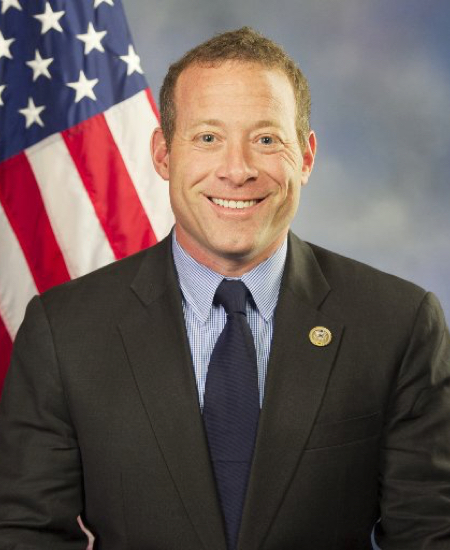
Photo of Josh Gottheimer
D United States House · District 5 · New Jersey On the 2026 ballot

Rep. Josh Gottheimer

Compare
Total votes
2,837
all sessions
Attendance
94%
174 missed
Lower than 94% of chamber peers
With party
93%
of cast votes
Lower than 94% of chamber peers
Bipartisan score
4%
crosses aisle rarely
Higher than 92% of chamber peers
Sponsored
2,786
bills & resolutions
Higher than 98% of chamber peers
Committees
7
assignments
2,786 bills and resolutions

Sponsored bills

Total
2,786
Primary
166
Co-sponsor
2,620
This page
2,786
matching current filters
Co-sponsor HR 5052
In committee · United States House · Co-sponsor
Train More Nurses Act

Maddy summaryThis bill requires the Health and Human Services and Labor Secretaries to review all federal grant programs supporting the nursing workforce and submit a report to Congress within one year. The report must include recommendations to improve specific goals: increasing nursing faculty (especially in underserved areas), creating pathways for experienced nurses to become faculty, and expanding opportunities for licensed practical nurses to become registered nurses. It does not create new funding or programs but mandates a comprehensive review of existing initiatives. The bill directly affects federal agencies managing nursing workforce grants and aims to identify ways to strengthen nursing education pipelines.

In committee Aug 26, 2025 1 co-sponsor
Co-sponsor HR 5022
In committee · United States House · Co-sponsor
No Advanced Chips for the CCP Act of 2025.

Maddy summaryThis bill would require U.S. companies to obtain both Commerce Department approval and a specific congressional joint resolution before exporting advanced AI semiconductors to China. The Commerce Secretary must first conduct an interagency review assessing national security risks, military applications, human rights concerns, and economic impacts. Congress would then need to pass a dedicated resolution approving each export, effectively giving lawmakers a veto over such transactions. The bill defines "advanced AI semiconductors" by technical thresholds (e.g., 2,400+ processing performance) and applies to all exports targeting China, including Hong Kong and Macau.

In committee Aug 22, 2025 1 co-sponsor
Co-sponsor HR 4998
In committee · United States House · Co-sponsor
SUN Act

Maddy summaryThe SUN Act (HR 4998) requires the President to submit a detailed report to Congress within 15 days whenever National Guard members are deployed domestically for non-disaster purposes under specific laws. The report must include the legal basis for the deployment, evidence of reduced violence, input from local law enforcement, total costs, and a certification that the deployment won’t interfere with disaster response capabilities. It applies to all domestic uses of the National Guard except for responses to natural disasters under the Stafford Act. The bill aims to enhance congressional oversight of military deployments on U.S. soil.

In committee Aug 19, 2025 1 co-sponsor
Primary HR 4979
In committee · United States House · Lead sponsor
Tick Identification Pilot Program Act of 2025

Maddy summaryHR 4979, the Tick Identification Pilot Program Act of 2025, allows the CDC to award grants to state health departments to create programs where residents can submit photos of ticks they encounter online. The programs must provide users with a tick species ID, disease risk estimate, and prevention advice within 72 hours, while tracking location, date, and environmental details of each encounter. States with high Lyme disease rates and strong implementation plans receive priority for funding. The initiative directly affects the public (especially in tick-prone areas) and state health agencies, focusing on improving early detection and public education through a centralized data system. The CDC will report annual data on program participation and outcomes to Congress from 2026-2029.

In committee Aug 15, 2025 0 co-sponsors
Primary HR 4980
In committee · United States House · Lead sponsor
BITE Act

Maddy summaryThe BITE Act establishes a national system to prevent diseases spread by ticks, mosquitoes, and fleas. It requires the Health Secretary to create a system with six key parts: a public vector identification service, an AI-powered early warning system using weather and habitat data, insurance claims monitoring for early outbreak detection, emergency room symptom tracking, targeted public education campaigns, and a goal to reduce Lyme disease by 25% by 2035. This system integrates human, animal, and environmental data (One Health approach) and serves both civilians and military medical facilities. The bill directly affects public health agencies, healthcare providers, and communities in areas with vector-borne diseases. Its key mechanism is using real-time data from multiple sources to predict and prevent disease outbreaks before they spread widely.

In committee Aug 15, 2025 0 co-sponsors
Primary HR 4981
In committee · United States House · Lead sponsor
Stamp Out Lyme Disease Act

Maddy summaryThis bill creates a special postage stamp that allows the public to voluntarily contribute to Lyme disease research. All money from stamp sales will go directly to the National Institute of Allergy and Infectious Diseases (NIAID) at the NIH, with proceeds specifically designated for Lyme disease and tick-borne illness research. The funds cannot be used to offset other NIH research funding, and the stamp would be available for at least six years after the law takes effect. It directly affects the public (through voluntary purchases) and NIAID (as the recipient of dedicated research funding).

In committee Aug 15, 2025 0 co-sponsors
Co-sponsor HR 1569
In committee · United States House · Co-sponsor
CATCH Fentanyl Act

Maddy summaryHR 1569, the CATCH Fentanyl Act, establishes a 5-year pilot program to test nonintrusive inspection technologies at U.S. border ports of entry. The bill requires U.S. Customs and Border Protection (CBP) to evaluate at least five technology enhancements - including AI, machine learning, and quantum sensing - to improve detection of contraband, drugs, weapons, and threats while reducing inspection wait times. Pilot projects must prioritize cost-effective solutions that integrate with existing systems, adhere to privacy protections, and report findings on performance metrics like detection rates and throughput. The program mandates detailed reports to Congress on effectiveness, implementation plans, and privacy impacts, using existing funding without new appropriations.

In committee Aug 15, 2025 1 co-sponsor
Co-sponsor HR 4948
In committee · United States House · Co-sponsor
HOV Lane Exemption Reauthorization Act

Maddy summaryThis bill extends the expiration date for a provision allowing certain vehicles to use High Occupancy Vehicle (HOV) lanes without meeting standard occupancy requirements. Specifically, it amends federal law to change the deadline from September 30, 2025, to September 30, 2031. The change directly affects drivers and vehicle operators who currently qualify for this exemption under existing rules. It is a procedural reauthorization, not a policy change, maintaining the current HOV lane exemption rules for an additional six years.

In committee Aug 13, 2025 1 co-sponsor
Co-sponsor HR 4926
In committee · United States House · Co-sponsor
Highway Funding Transferability Improvement Act

Maddy summaryHR 4926, the Highway Funding Transferability Improvement Act, increases the percentage of federal-aid highway funds that states can transfer between different transportation projects from 50% to 75%. This change directly affects state transportation departments managing federal highway funds, giving them greater flexibility to shift resources between projects like road repairs and new construction. The key provision amends Section 126(a) of Title 23, U.S. Code to allow states to reallocate a larger portion of their allocated funds without federal approval. This is a procedural adjustment to existing funding rules, not a new policy.

In committee Aug 9, 2025 1 co-sponsor
Co-sponsor HR 4945
In committee · United States House · Co-sponsor
GO Ag Act

Maddy summaryHR 4945, the GO Ag Act, creates a $5 million grant program to fund new agricultural education programs in secondary schools. It provides competitive grants (max $100,000 per school) for schools to develop new programs focused on agriculture, including curriculum, equipment, and work-based learning. To qualify, schools must show programs are new, align with regional employer needs, and include sustainable funding beyond the grant. Grantees must track student progress (including special populations) and submit annual reports on program effectiveness through 2028.

In committee Aug 8, 2025 1 co-sponsor
Showing 511 to 520 of 2,786 bills
Previous 1 … 51 52 53 … 279 Next