Original National Domestic Violence Awareness Month Resolution of 2021 This resolution supports the goals and ideals of National Domestic Violence Awareness Month. Further, it expresses the sense of the House of Representatives that Congress should continue to raise awareness of and support programs to end domestic violence.
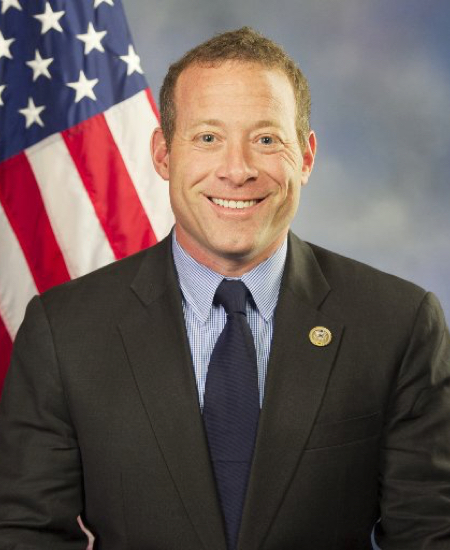
Rep. Josh Gottheimer
Sponsored bills
Public Service Freedom to Negotiate Act of 20 21 This bill provides minimum collective bargaining rights and procedures for public employees and prohibits strikes by certain public safety workers. The Federal Labor Relations Authority (FLRA) shall determine for each state whether the laws of such state substantially provide for each of the minimum standard collective bargaining rights and procedures specified by this bill, including the right of public employees and supervisory employees to self-organize, form or join a labor organization, or collectively bargain. The FLRA must issue rules and take actions to establish and administer bargaining rights and procedures for those states that do not substantially provide for them. No employers, emergency services employees, or law enforcement officers may engage in a lockout, strike, or any other organized job action that is likely to result in a measurable disruption of the delivery of emergency or public safety services. Furthermore, no labor organization may be the cause of a violation of such prohibition.
State, Local, Tribal, and Territorial Fiscal Recovery, Infrastructure, and Disaster Relief Flexibility Act This bill allows states, tribes, territories, and localities to use certain COVID-19 relief funds for new categories of spending, including for natural disasters and infrastructure projects. It also makes changes to expenditure deadlines and other aspects of this funding. Specifically, recipients may use funds for emergency relief from natural disasters and associated negative economic impacts of natural disasters. In addition, recipients may use a portion of their COVID-19 relief funds for designated infrastructure projects, such as nationally significant freight and highway projects. Furthermore, the bill allows recipients to expend COVID-19 relief funds on these types of infrastructure projects until September 30, 2026. Under current law, recipients must expend the funds by December 31, 2024. Other changes in the bill include (1) modifying eligibility and allocation requirements for funding set aside for counties and Indian tribes that are near public lands, (2) allowing Indian tribes an additional year to expend their COVID-19 relief funds, and (3) establishing a process for government entities to decline COVID-19 relief funds and requiring any declined funds to be used to reduce the federal deficit.
Financial Exploitation Prevention Act of 2021 This bill allows for the delay of the redemption of a security issued by an open-end investment management company if the company or transfer agent reasonably believes the redemption involves the financial exploitation of an individual age 65 or older or an individual age 18 or older who is unable to protect his or her own interests. Open-end investment management companies offer securities in pooled investment vehicles such as mutual funds. Additionally, the Securities and Exchange Commission must make legislative and regulatory recommendations to address the financial exploitation of such adults.
Informing Veterans on Education for Transitioning Servicemembers Act or the Informing VETS Act This bill requires the Department of Veterans Affairs to regularly promote the Veteran Readiness and Employment program by (1) sending a letter to each veteran entitled to the program that explains the educational benefits of the program, and (2) providing in each letter and online a side-by-side comparison of benefits between the program and Post-9/11 GI Bill educational assistance.
Rural Capital Access Act This bill increases federally backed leverage, or investments, available to small businesses in rural areas through Small Business Administration (SBA) programs. Specifically, the bill (1) reduces restrictions on federally backed leverage for small business investment companies (SBICs) investing in small businesses located in rural areas, and (2) allows the SBA to extend as leverage to rural business investment companies certain unexpended amounts intended for SBICs. The bill also establishes an interagency working group comprised of the SBA, the Department of Agriculture, and industry stakeholders to develop administrative and legislative recommendations to improve program coordination and capital access in rural areas.
Save Our Servicemembers Act of 2021 This bill requires the Office of the Under Secretary of Defense for Personnel and Readiness within the Department of Defense (DOD) to evaluate and standardize DOD's suicide prevention efforts. Specifically, the bill directs the Defense Suicide Prevention Office to collaborate with each military department to (1) develop and implement a process to ensure that individual nonclinical suicide prevention efforts are assessed for effectiveness, and (2) develop consistent suicide-related definitions for use throughout DOD. The bill also requires the use of such suicide-related definitions in any updated policies of DOD or each military department.
Gold Star Spouses Non-Monetary Benefits Act This bill addresses certain federal benefits for surviving spouses of members of the Armed Forces, including those who have remarried. For purposes of noncompetitive appointment to government employment, a surviving spouse of a member of the Armed Forces who was married to such member at the time they died while on active duty may be appointed as a military spouse, regardless of remarriage. Additionally, widows or widowers of certain veterans who served on active duty must be considered preference eligible for purposes of government employment, regardless of remarriage. A surviving spouse who is eligible for the gold star lapel button is entitled to commissary and exchange privileges to the same extent and on the same basis as the surviving spouse of a retired member of the uniformed services. Such spouses are also entitled, upon request, to medical and dental care provided in facilities of the uniformed services. A surviving spouse who is eligible for a gold star lapel button must be permitted to use commissary stores and certain retail facilities on the same basis as a dependent of a member of the Armed Forces on active duty. In regard to Department of Veterans Affairs (VA) benefits, the remarriage of a surviving spouse of a veteran does not bar the furnishing of non-monetary benefits to a surviving spouse who is eligible for a gold star lapel button. Such surviving spouses who are eligible for a gold star lapel button are also eligible for certain VA home loan programs.

Darren Drake Act This bill directs the Department of Homeland Security to develop and disseminate best practices for vehicle rental companies and dealers to report suspicious behavior to law enforcement at the point of sale of a rental vehicle. The best practices must include guidance on defining and identifying suspicious behavior in a manner that protects civil rights and civil liberties.
Caring for Survivors Act of 2021 This bill increases the monthly rate of dependency and indemnity compensation payable to surviving spouses through the Department of Veterans Affairs. The bill also adjusts the amount payable to surviving spouses and children of veterans who were rated as totally disabled for a period of less than 10 years before their death.