

Maddy summaryThis bill requires airlines to clearly inform passengers with disabilities about their right to request on-board wheelchairs on flights with over 60 seats, including details on when wheelchairs are available (even if lavatories aren’t accessible) and how to request them. It mandates annual staff training for airline employees on assisting passengers with disabilities and using on-board wheelchairs. Airlines failing to comply face increased civil penalties, including higher fines for not providing wheelchairs or causing harm related to mobility aids. The law directly affects passengers with disabilities traveling on larger commercial flights, ensuring clearer access to mobility support during air travel.
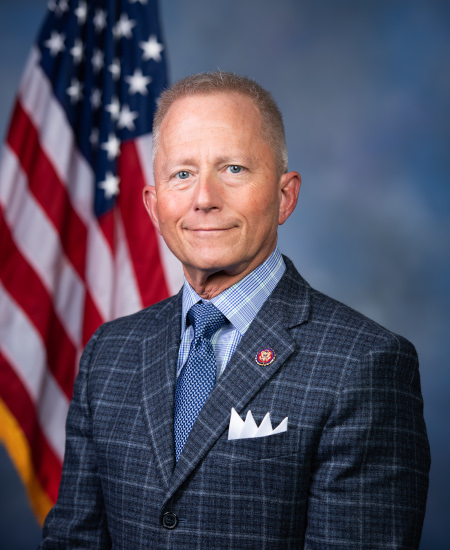
Rep. Jefferson Van Drew
Sponsored bills
Maddy summaryThis bill authorizes the Department of Homeland Security and Department of Justice to detect, identify, monitor, and mitigate drone threats to specific high-risk facilities including government buildings, airports, critical infrastructure, and locations hosting special events. It establishes a 5-year pilot program allowing state and local law enforcement agencies to use drone detection technology under federal oversight, with strict privacy protections requiring 180-day data retention limits and mandatory training for personnel. The bill requires coordination with the Federal Aviation Administration to minimize impacts on air traffic and mandates regular congressional reporting on how these authorities are being used. It sets an expiration date of 7 years after enactment for these new authorities.
Green Star Families Act This bill requires the Department of Veterans Affairs (VA) to furnish counseling services to the next of kin and former volunteer caregivers of certain veterans. The VA must publish information related to the counseling program online and provide information to next of kin and former volunteer caregivers of such veterans. Generally, Green Star families are families of servicemembers and veterans who have died by suicide.
Maddy summaryThe Project Safe Neighborhoods Reauthorization Act of 2023 extends federal funding for the Project Safe Neighborhoods (PSN) program through fiscal years 2024-2028, replacing its previous authorization period. The bill directly affects state, local, tribal, and federal law enforcement agencies, prosecutors, and community groups that receive PSN grants to reduce violent crime. Key provisions allow grantees to use funds for hiring crime analysts, covering overtime for officers and assistants, purchasing technology for crime reduction, and supporting multi-jurisdictional task forces. It also requires annual reports from the Attorney General detailing fund usage, community outreach, and violent crime statistics (including murder, robbery, and assault) in each program area. The program operates across all 94 U.S. federal judicial districts and territories.
Maddy summary# Summary of National Flood Insurance Program Reform Bill This comprehensive legislation proposes significant reforms to the National Flood Insurance Program (NFIP) with a focus on policyholder protections, program transparency, and program solvency. ## Key Provisions: ### Policyholder Protections (Sections 401-416) - **Enhanced Appeals Process**: Creates an Independent Office for Policyholder Appeals with a 90-day deadline for final decisions - **Foundation Damage Presumption**: Establishes a rebuttable presumption that foundation/structural damage was caused by flood, not earth movement - **Mold Remediation Guidance**: Requires FEMA to provide policyholders with guidance on mold prevention after floods - **Transparency in Claims**: Mandates disclosure of all claim documents to policyholders upon request - **Training Requirements**: Requires continuing education for insurance agents every 2 years - **Prohibition on Report Manipulation**: Prevents alteration of engineer reports before providing them to policyholders - **Agent Advisory Council**: Establishes a council with diverse representation to advise FEMA on policyholder experience ### Solvency Measures (Sections 301-306) - **Interest Forbearance**: Forbids interest on NFIP debt for 5 years - **Write Your Own Company Compensation Cap**: Limits reimbursement to 22.46% of premiums - **Third-Party Cost Transparency**: Requires public disclosure of vendor costs - **Mitigation Assistance**: Requires policyholders to accept mitigation offers or face 25% premium increases ### Flood Risk Disclosure (Section 416) - Requires property flood hazard disclosure before property transfer, including flood risk information and insurance cost estimates - Sets a deadline of October 1, 2024 for adoption of disclosure requirements ### Additional Key Provisions - **Appeals Process**: Creates formal appeals for map changes and levee protection assessments - **Levee Protection**: Requires proper assessment of levee systems and mandates flood insurance purchase only in unprotected areas - **Premium Calculator**: Requires public tool to estimate flood insurance rates and show impact of mitigation - **Grace Period**: Allows policyholders to renew within 90 days of lapse at the original renewal rate This legislation aims to balance program solvency with improved consumer protections, increased transparency, and better risk management for flood insurance policyholders.
Maddy summaryHR 4323 delays any changes to the National Oceanic and Atmospheric Administration's (NOAA) current rule limiting ship speeds to protect North Atlantic right whales. The bill requires NOAA to wait until two conditions are met: (1) new whale protection protocols from the 2022 Coast Guard Act are fully developed and deployed, and (2) the Secretary submits a report to four congressional committees detailing how those protocols will shape future rule updates. This directly affects NOAA's regulatory authority and vessel operators who must follow the existing speed rules. The law does not change the current rule but pauses any amendments until these specific steps are completed.
Maddy summaryThe HERO Act establishes a national data system to track suicides among public safety officers, including firefighters, EMTs, police, and telecommunicators, collecting detailed statistics by age, gender, occupation, and employment status (career, volunteer, or retired). It mandates annual reports to Congress and public availability of findings to identify suicide trends and effective interventions. The bill also funds peer-support wellness programs for fire/EMS departments, behavioral health programs for healthcare providers, and resources to train mental health professionals on treating public safety personnel. All data collection and program provisions include strict privacy safeguards to protect confidentiality and prohibit using suicide data to deny survivor benefits.
Maddy summaryHR 4263, the ADINA Act, requires drug manufacturers to clearly label human-use drugs containing major food allergens (like peanuts or shellfish) or ingredients derived from gluten-containing grains (such as wheat or barley). This affects drug producers and pharmacies by mandating that labels state the presence of these allergens and specify the exact gluten source if applicable. The law aims to inform consumers with allergies about potential risks in medications. It applies to all drugs meeting these criteria, with implementation beginning within two years of the bill's enactment.
Maddy summaryHR 3519, the Hot Foods Act of 2023, amends the Food and Nutrition Act of 2008 to allow Supplemental Nutrition Assistance Program (SNAP) benefits to be used for hot foods or hot food products ready for immediate consumption at participating retailers. This change directly affects SNAP recipients who purchase such hot foods and retailers that sell them. The key provision removes the previous exclusion of hot foods from SNAP eligibility, while adding a limit that no more than 50% of a retailer's total gross sales from SNAP can come from hot foods. The bill clarifies that hot foods can be purchased for home or immediate consumption, aligning SNAP rules with current retail practices for prepared foods.
Maddy summaryThe SAFE Act of 2023 extends a 2018 law that prohibits slaughtering animals for human consumption to include horses, donkeys, and other equine animals, such as ponies. It amends Section 12515 of the Agriculture Improvement Act of 2018 by updating the language to replace "dog or cat" with "dog, cat, or equine" in both the section title and the main prohibition. This change directly affects the livestock industry and slaughter facilities by banning the processing of equines for food. The bill modifies existing law without adding new enforcement mechanisms, closing a gap in animal protection.