

American Workforce Empowerment Act This bill allows tax-preferred college savings plans (529 plans) to fund certain postsecondary certificate programs and apprenticeship programs.
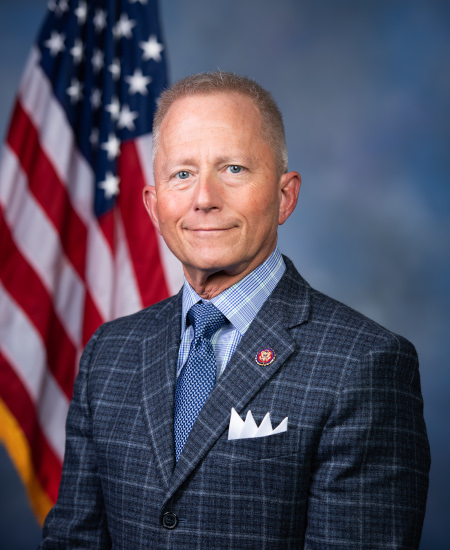
Rep. Jefferson Van Drew
Sponsored bills
Local Telecom Expansion Act of 2021 This bill requires the Federal Communications Commission to establish a program for awarding grants to states for the deployment of broadband service in underserved areas by small business broadband providers. A state that receives such a grant must use the funds to make subgrants to small business broadband providers that enable those providers to deploy broadband service in underserved areas in the state. This broadband service must have (1) a download speed of at least 25 megabits per second (Mbps); (2) an upload speed of at least 10 Mbps; and (3) latency that is sufficiently low to allow real-time, interactive applications.
New Overages in Crisis Areas Prevention Act or the NO CAP Act This bill prohibits broadband internet access service providers from increasing rates or enforcing data caps or allowances during a major disaster or emergency, including a public health emergency.
Broadband Equipment Rental Reform Act This bill prohibits a broadband internet provider from charging a consumer for the rental, lease, or provision of equipment if the consumer has paid the purchase price of such equipment through monthly rental fees.
Chiropractic Medicare Coverage Modernization Act of 2021 This bill expands Medicare coverage of chiropractic services to include all services provided by chiropractors, rather than only subluxation corrections through manual manipulation of the spine.
Amputation Reduction and Compassion Act of 2021 or the ARC Act of 2021 This bill provides for coverage of peripheral artery disease screening tests without cost-sharing under Medicare, Medicaid, and private health insurance for certain at-risk individuals, and requires the development of certain educational programs and Medicare quality measures to reduce amputations relating to such disease.
Workplace Violence Prevention for Health Care and Social Service Workers Act This bill requires the Department of Labor to address workplace violence in health care, social service, and other sectors. Specifically, Labor must issue an interim occupational safety and health standard that requires certain employers to take actions to protect workers and other personnel from workplace violence. The standard applies to employers in the health care sector, in the social service sector, and in sectors that conduct activities similar to those in the health care and social service sectors. In addition, Labor must promulgate a final standard within a specified time line.
Ensuring Seniors Access to Local Pharmacies Act of 2021 This bill establishes several requirements for prescription drug plans under the Medicare prescription drug benefit. Specifically, the bill requires prescription drug plans to allow any pharmacy located in a health professional shortage area, a medically underserved area, or a rural area to be included as an in-network pharmacy if the plan already has other in-network pharmacies in the same area. The bill also establishes certain standards for prescription drug plans regarding pharmacy reimbursements and related disclosures. Among other things, the bill prohibits prescription drug plans from reimbursing a pharmacy in an amount that is less than the amount the pharmacy benefits manager (PBM) reimburses an affiliated pharmacy (i.e., a pharmacy that has a shared ownership interest with the PBM) for the same services.
Colorectal Cancer Payment Fairness Act This bill eliminates Medicare coinsurance requirements with respect to colorectal cancer screening tests, regardless of the code billed for a resulting diagnosis or procedure, beginning in 2023 (rather than 2030).
Fire Fighters and EMS Employer-Employee Cooperation Act This bill requires the Federal Labor Relations Authority to determine whether a state substantially provides fire and emergency medical services (EMS) personnel the right to form and join a labor organization; recognition by fire and EMS employers of the employees' labor organization, agreement to bargain with the organization, and reduction of any agreements to writing in a contract or memorandum of understanding; the right to bargain over hours, wages, and terms and conditions of employment; and arbitration or other mechanisms to resolve an impasse in collective bargaining negotiations. The bill makes the authority responsible for (1) determining the appropriateness of units for labor representation; (2) supervising elections; (3) conducting hearings and resolving complaints of unfair labor practices; and (4) protecting the right of employees to form, join, or assist any labor organization, or to refrain from doing so. An employer, fire and EMS personnel, or labor organization may not engage in a lockout, sickout, work slowdown, strike, or any other organized job action that will measurably disrupt the delivery of emergency services and is designed to compel an employer, fire and EMS personnel, or labor organization to agree to the terms of a proposed contract.