Stop Iranian Drones Act This bill expands existing provisions requiring sanctions against individuals or entities that provide certain types of weapons to Iran. Specifically, the bill modifies the provisions by adding unmanned combat aerial vehicles to the list of weapons covered by the sanctions. The bill also requires the Department of State to periodically report to Congress on the identities of any Iranian entity that has attacked a U.S. citizen using an unmanned combat aerial vehicle. The President must designate any such entity as a foreign terrorist organization.
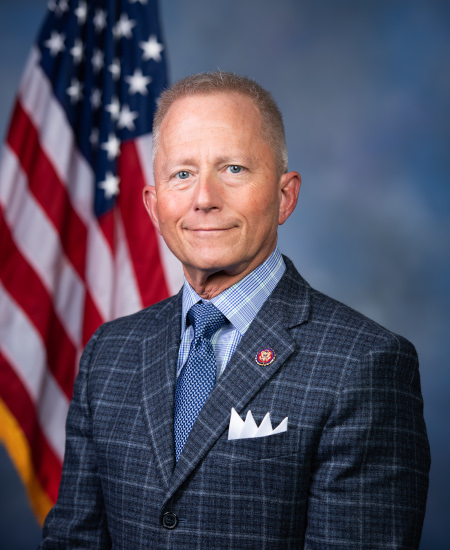
Rep. Jefferson Van Drew
Sponsored bills
Deterring Enemy Forces and Enabling National Defenses Act of 2022 or the DEFEND Act of 2022 This bill requires the Department of Defense to seek to cooperate with Middle East allies and partners (i.e., countries of the Gulf Cooperation Council, Iraq, Israel, Jordan, Egypt, and other countries in the region as appropriate) to identify and develop an approach for such allies and partners to implement an integrated air and missile defense capability to protect against attacks from Iran and groups linked to Iran.
Prohibition of Agricultural Land for the People's Republic of China Act This bill requires the President to prohibit nonresident aliens, foreign businesses, and agents associated with China's government from (1) purchasing agricultural (including ranching) real estate located in the United States, or (2) participating in Department of Agriculture programs that are unrelated to food and safety regulatory requirements.
Relief for Restaurants and other Hard Hit Small Businesses Act of 2022 This bill addresses support for restaurants, arts and entertainment venues, and small businesses impacted by the COVID-19 pandemic. The bill provides an additional $42 billion in FY2021 for the Restaurant Revitalization Fund and gives priority to previous applicants who have not received a grant. The Small Business Administration (SBA) must provide to applicants an explanation for denied applications, establish a reconsideration process for denied applications, and institute an audit and oversight plan with respect to grant recipients. Additionally, the bill establishes the Hard Hit Industries Award Program for small businesses that suffered a pandemic-related revenue loss of 40% or more. Aggregate grant amounts are capped at $1 million. Funds may be used for expenses including mortgage, rent, and utility payments and payroll. SBA must prioritize entities that have experienced significant pandemic-related revenue loss, with first priority going to those that experienced a loss of at least 80%, and second priority going to those that experienced a loss of at least 60%. Finally, the bill extends to March 11, 2023 (or a later date as determined by the SBA), the time frame during which Shuttered Venue Operators Grant recipients may use grant funds to cover their expenses.
This bill requires institutions of higher education (IHEs) to disclose information regarding gifts from and contracts with China-affiliated organizations. China-affiliated organization refers to any entity that receives support directly or indirectly from the Chinese government, including certain educational institutes or programs, think tanks, and business entities. Under current law, an IHE must disclose to the Department of Education (ED) a gift or contract from a foreign source that is valued at $250,000 or more, considered alone or in combination with all other gifts from or contracts with that foreign source in a calendar year. This bill establishes a special disclosure rule relating to China-affiliated organizations. Specifically, the bill requires an IHE to disclose a gift from or contract with a China-affiliated organization that is valued at $5,000 or more, considered alone or in combination with all other gifts from or contracts with that organization in a calendar year. Additionally, the bill requires an IHE that receives federal grants to annually file a report with ED that identifies any activities conducted pursuant to a contract or other agreement between the IHE and a China-affiliated organization, including any joint research or academic exchanges. Such a contract or other agreement must be made available on a publicly accessible website of the IHE.
Payment Choice Act of 2021 This bill requires retail businesses to accept cash as a form of payment for sales in amounts less than $2,000, and it prohibits them from charging cash-paying customers a higher price compared to customers not paying with cash. Such businesses are those engaged in the business of selling or offering goods or services at retail to the public that accept in-person payments at a physical location. The bill provides for enforcement through preventative relief and civil penalties.
Community Services Block Grant Modernization Act of 2022 This bill reauthorizes the Community Services Block Grant program through FY2032 and otherwise modifies the program. The program supports various antipoverty activities, primarily through formula-based allotments to states, Indian tribes, and territories. In particular, the bill makes changes to the program's administration and leadership; performance measurement; and allotments to states and territories. The bill also expands eligibility for services and activities funded by the program to 200% of the federal poverty line (FPL). Under current law, eligibility is generally set at the FPL.
Rights for the Transportation Security Administration Workforce Act of 2022 or the Rights for the TSA Workforce Act of 2022 This bill modifies the workplace rights, protections, and benefits applicable to Transportation Security Administration (TSA) personnel. Specifically, the bill by December 31, 2022, eliminates personnel authorities of the Department of Homeland Security (DHS) and the Department of Transportation governing the conditions of employment for TSA employees, thus making TSA employees subject to the personnel management system applicable to other federal employees; sets forth transition rules that protect the pay rates, leave rights, and other rights of TSA employees; and requires DHS to consult with the exclusive representative of TSA screening employees to carry out the conversion of those positions. The bill also permits the TSA to consult with organizations representing federal air marshals to address concerns, including mental health and suicide rates; directs the TSA to ensure its employees are provided proper guidance regarding prevention and protections against COVID-19; requires the TSA to provide a one-time bonus payment of $3,000 to each TSA employee carrying out duties that require substantial contact with the public during the COVID-19 national emergency; and requires the Government Accountability Office to report on implementation of the bill, TSA recruitment efforts, and specified TSA personnel policies.
Strengthening Our Health Security Act of 2022 This bill requires the Department of Health and Human Services (HHS) to meet conditions related to notification and planning before terminating certain restrictions on imports and individuals entering the United States. Current law authorizes HHS to restrict entries and imports from foreign countries to prevent the introduction of communicable diseases. HHS exercised this authority as part of its COVID-19 response, including to allow for the expulsion of undocumented migrants at the border without any asylum processing. Under this bill, HHS may not terminate the restrictions for (1) at least 60 days after it notifies Congress of the end of the COVID-19 emergency, and (2) at least 30 days after it submits to Congress a plan for addressing the possible influx of migrants or imports resulting from lifting the restrictions.
Federal Firefighters Fairness Act of 2022 This bill makes it easier for federally employed firefighters who contract certain illnesses to qualify for federal workers' compensation. Specifically, the bill provides that chronic obstructive pulmonary disease, mesothelioma, and specified other cancers of those employed in fire protection activities for at least five years are presumed to be proximately caused by such employment for purposes of a disability or death claim under the federal workers' compensation program. This presumption also applies to federal employees employed in fire protection activities for at least five years who experience a sudden cardiac event or stroke within 24 hours of performing a fire protection activity. The bill also requires the Department of Labor to conduct a review to determine whether breast cancer, gynecological cancer, and rhabdomyolysis should be included under the presumption and to conduct periodic reviews to determine whether other diseases should be included. In addition, a person may petition Labor to include another disease under the presumption. An employee in fire protection activities is a firefighter, paramedic, emergency medical technician, rescue worker, ambulance personnel, or hazardous material worker who (1) is trained in fire suppression; (2) has the legal authority and responsibility to engage in fire suppression; (3) is engaged in the prevention, control, and extinguishing of fires or response to emergency situations where life, property, or the environment is at risk, including the prevention, control, suppression, or management of wildland fires; and (4) performs such activities as a primary responsibility.